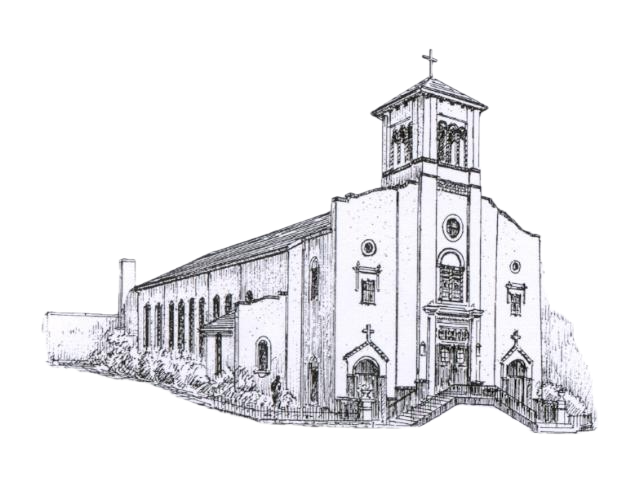
Mary Queen of Peace Church: An Archival History
A documented narrative of the parish, sacred space, and preservation effort in Pottsville, Pennsylvania.
Introduction
For more than a century, Mary Queen of Peace has been a witness to the Catholic faith in Pottsville, Pennsylvania. Established in 1919 to serve the Catholics of Fishbach, Jalappa, New Street, Mt. Laffee, and the northern section of the city, the parish became a spiritual home where generations of the faithful gathered for the Holy Sacrifice of the Mass, received the sacraments, practiced works of charity, educated their children in the Catholic faith, and grew together in the life of the Church. Its history encompasses the early Catholic communities of North Pottsville and Mt. Laffee, worship in school buildings and the Little Flower Chapel, the construction and dedication of the present Spanish Mission-style church in 1928–1929, decades of vibrant parish life, the parish’s consolidation in 2008, the church’s closure in 2021, and its remarkable reopening in 2025 as a Catholic chapel under the care of the Society of Mary Queen of Peace of Pottsville.
This history is presented chronologically by decade so that additional photographs, archival documents, newspaper accounts, and family memories may be incorporated as they become available. In doing so, we hope to preserve not only the history of a parish and its buildings, but also the enduring witness of the Catholic faith lived by generations of the faithful who called Mary Queen of Peace their spiritual home. Contributions to this ongoing historical archive are always welcome. Contributions can be made here.
Before 1920: Catholic Life in North Pottsville
Long before Mary Queen of Peace Parish was established, Catholic families living in northern Pottsville and the nearby Mt. Laffee community had already built a deeply rooted Catholic life marked by considerable faith and sacrifice. Families from Fishbach, Jalappa, New Street, Mt. Laffee, and the surrounding neighborhoods traveled to Pottsville’s established Catholic churches for Holy Mass, the sacraments, devotions, and parish life. As the Catholic population of these communities grew, their distance from the existing churches and the increasing number of faithful made the need for more accessible pastoral care increasingly apparent.
The 1929 Dedication Booklet explains that “for many years” the establishment of a new parish had been considered for the northern part of Pottsville. At the time, St. Patrick’s and St. John’s—the city’s two original Catholic parishes—served these families, but St. Patrick’s had become overcrowded while St. John’s was a considerable distance for many residents of Fishbach, Jalappa, New Street, and the surrounding neighborhoods. The pastors of the two parishes recognized the need for a separate church to serve the faithful of this growing area, although earlier efforts to establish one did not come to fruition.
A Long Tradition of Catholic Worship at Mt. Laffee
The Catholic community of Mt. Laffee possessed an especially rich history of faith and perseverance. During the early years of St. Patrick’s Parish, Catholics from Mt. Laffee routinely walked approximately three miles into Pottsville to attend Mass and other devotions. The 1929 Dedication Booklet praises the remarkable devotion of these families, recalling that the parents and grandparents of the 1929 generation made the journey in every season—often twice each Sunday—and allowed neither distance nor inclement weather to keep them from worship except in cases of illness.
Their desire for Catholic worship closer to home extended back well into the nineteenth century. According to the 1929 Dedication Booklet, more than fifty years before its publication, Father D. I. McDermott celebrated the first Mass for the Mt. Laffee community in the old stone schoolhouse atop Mt. Laffee Hill. Thereafter, Mass continued to be provided first in the stone schoolhouse and later in the newer frame school building, whose use was generously permitted by the township school board.
These humble schoolhouses therefore served as centers of Catholic worship for generations before a permanent chapel existed at Mt. Laffee. Several attempts were made over the years to establish a dedicated chapel, but each was ultimately abandoned. The desire for a permanent Catholic place of worship nevertheless endured and would eventually be fulfilled in the 1920s with the construction of the Little Flower Chapel.
The importance of this earlier history should not be overlooked. Catholic worship at Mt. Laffee did not begin with the Little Flower Chapel. Rather, the later chapel represented the culmination of decades of local Catholic devotion, during which generations of families worshipped in school buildings when a church of their own was not yet possible.
The Future Mary Queen of Peace Property
The property that would eventually become the Mary Queen of Peace parish campus possessed a distinctive local history long before its acquisition by the Church. Situated along North Centre Street at Temple Street in Pottsville’s Sixth Ward, the site formed part of the Seltzer family holdings in this section of the city.
A typed parish history dated June 1927 records that the William Seltzer property contained several buildings. Among them were the old Seltzer homestead, which would later serve as the parish rectory; a house formerly occupied by Mr. Seltzer’s son; two frame buildings; and the former residence of Dr. J. W. Seltzer, a local dentist. The same history records the cost of the property as approximately $41,000.
The surviving deed provides a contemporary legal record of the acquisition. On April 20, 1920, William H. Seltzer conveyed property in Pottsville’s Sixth Ward to Most Rev. Denis J. Dougherty, Archbishop of Philadelphia, for a stated consideration of $40,500. The deed describes property along North Centre and Temple Streets and traces portions of the title through earlier conveyances, including property associated with Conrad Seltzer and his wife in 1877.
The deed also preserves an unusual glimpse of the surroundings of the future parish campus. Part of the property adjoined the Seltzer Packing Company, and the conveyance acknowledged the operation of the neighboring packing house. The Archbishop accepted the property with knowledge that its operation could at times produce noise and fumes and agreed not to object to its continued operation on that basis. This provision places the future Mary Queen of Peace campus within the mixed residential and industrial landscape of early twentieth-century North Pottsville.
Later parish tradition preserves still older memories of the site. The 1927 history states that two frame buildings situated between the future rectory and convent had once formed an old tavern along the state highway toward Ashland and served as a stopping place for stagecoaches. It further records that the area later occupied by the first parish chapel had formerly contained cattle sheds and that open portions of the property were reportedly used for cavalry drilling during the Civil War. Because these details were recorded in a parish history written in 1927 rather than in the contemporary 1920 deed, they are best understood as local traditions preserved within the parish’s historical record.
Within months of the acquisition, the former Seltzer property began its transformation into the home of the newly established Mary Queen of Peace Parish. Existing buildings were adapted to parish use, while portions of the property were developed for worship, education, and parish life. Over the following decade, the site would evolve into a complete Catholic campus incorporating a chapel, rectory, convent, parochial school, and ultimately the present Mary Queen of Peace Church.
The Need for a New Parish
By the opening decades of the twentieth century, the pastoral need for a new parish in northern Pottsville had become increasingly evident. The Catholic population of the area had grown, St. Patrick’s faced overcrowding, and many families in the northern neighborhoods and outlying communities remained a considerable distance from their parish churches.
In 1919, Cardinal Dennis Dougherty, Archbishop of Philadelphia, determined that the time had come to establish a new parish for their spiritual care and convenience. He directed Monsignor James Nash, a native of Fishbach, together with Father Daniel McGettigan of Philadelphia, to examine the territory and determine the boundaries of the proposed parish.
Their work culminated in Cardinal Dougherty’s letter of December 13, 1919, establishing a new parish for Catholics in northern Pottsville and the surrounding communities. The new parish would serve Catholics living north of Nichols Street within the city limits, together with the faithful of New Street and Mt. Laffee, bringing these communities together under the patronage of the Blessed Virgin Mary, Queen of Peace.
The inclusion of Mt. Laffee joined a longstanding Catholic community to the newly established parish. Its faithful had already worshipped locally for decades in the community’s schoolhouses, while continuing their connection with the Catholic churches of Pottsville. With the establishment of Mary Queen of Peace, that relationship entered a new chapter—one that contemporary records would soon show included regular pastoral ministry between the new parish and Mt. Laffee.
A New Chapter Begins
By the close of 1919, generations of Catholic life in northern Pottsville and Mt. Laffee had prepared the way for a new chapter. Mary Queen of Peace was not created in isolation. It emerged from established neighborhoods, longstanding Catholic families, decades of worship at Mt. Laffee, and a pastoral need recognized by clergy and faithful alike.
At the heart of the new parish was the same purpose that had sustained these Catholic families through years of distance and sacrifice: access to the Holy Sacrifice of the Mass, the sacraments, prayer, and the communal life of the Church.
In 1920, those scattered threads would come together remarkably quickly. Under the leadership of its first rector, Rev. George W. Shay, the new parish would acquire a home, open its first chapel, establish an active liturgical and devotional life, extend regular Sunday ministry to Mt. Laffee, and begin building the Catholic community that would eventually erect the present Mary Queen of Peace Church.
1920s: Founding, School, Mt. Laffee Chapel, and the Present Church
1920: A Parish Takes Root
The year 1920 marked the transformation of Mary Queen of Peace from a newly established parish into a living Catholic community. Cardinal Dennis Dougherty had formally ordered the creation of the new parish on December 13, 1919, assigning to it Catholics living in the northern portion of Pottsville together with New Street and Mt. Laffee. The new congregation was to have its headquarters in the Fishbach area and a mission at Mt. Laffee. The task of organizing the parish and securing a permanent home was entrusted to Rev. George W. Shay, a Pottsville native then serving as pastor of Mary Star of the Sea Church in Branchdale. The 1929 Dedication Booklet records that Father Shay was directed to take possession of the new parish on May 4, 1920, and to place it under the protection of the Blessed Virgin Mary under the title Queen of Peace.
The Seltzer Property Becomes the Parish Home
After several months of negotiations, assisted by Hon. John F. Whalen and real-estate broker John W. Higgins, Father Shay secured the former Seltzer property on the east side of North Centre Street, near Temple Street and just below St. Patrick’s No. 3 Cemetery. The 1929 parish history describes a tract extending more than 200 feet along Centre Street and approximately 265 feet along Temple Street, containing four substantial buildings toward the front of the property and stables to the rear. The purchase price was reported as nearly $41,000.
The surviving deed, dated April 20, 1920, provides a contemporary legal record of this acquisition. William H. Seltzer conveyed property in Pottsville’s Sixth Ward to Most Rev. Dennis J. Dougherty, Archbishop of Philadelphia, for a stated consideration of $40,500. The deed traces portions of the property through earlier Seltzer-family ownership and situates the future parish campus within the residential and industrial landscape of North Pottsville.
The deed also preserves an unusual detail about the property’s surroundings. Part of the land adjoined the Seltzer Packing Company, and the conveyance acknowledged the operation of the neighboring packing house and the possibility of associated noise and fumes. The Archbishop accepted the property with knowledge of those conditions. What would become a Catholic parish campus therefore began amid the homes, businesses, streets, and industries of a working North Pottsville neighborhood.
A parish history written in June 1927 remembered the property as including the old Seltzer homestead, another residence occupied by a member of the Seltzer family, two frame buildings, and the former home of Dr. J. W. Seltzer, a local dentist. That account also preserved older local traditions concerning the site, including that two frame buildings had once been associated with a tavern and stagecoach stop on the road toward Ashland, and that portions of the grounds had reportedly been used for cavalry drilling during the Civil War. These latter details are parish traditions rather than claims established by the 1920 deed and should be understood as such.
Worship Begins Before the Chapel Is Ready
Catholic worship did not wait for construction of a permanent church—or even completion of the first chapel.
The 1929 Dedication Booklet records that a large brick building on the newly acquired property was initially occupied as the rectory, while its first floor was converted into a temporary chapel. Weekday Masses were celebrated there, and baptisms, weddings, and funerals were conducted in the building.
Sunday worship required an even more improvised arrangement. One Mass was celebrated in the Armory building on Centre Street, while another was offered in the public schoolhouse at Mt. Laffee. At the same time, buildings toward the rear of the Seltzer property were being converted into a larger and more suitable parish chapel.
These arrangements illustrate the practical challenges confronting Father Shay and the first parishioners. Mary Queen of Peace did not begin with a completed church complex. Existing houses and outbuildings were adapted as quickly as possible so that Mass could be celebrated and the sacraments provided while the new congregation established itself.
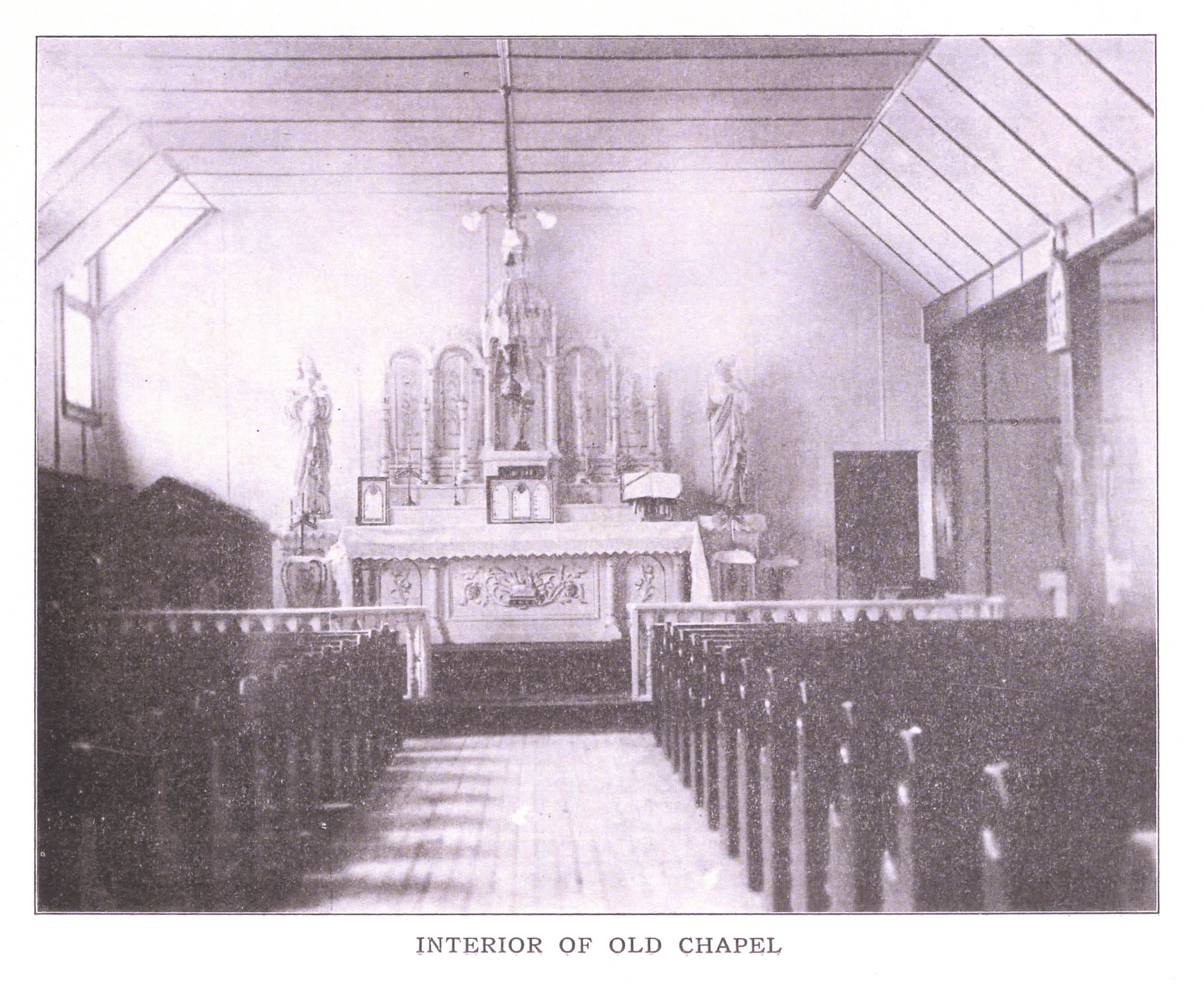
The Original Mary Queen of Peace Parish Chapel — c. 1920–1928.
An interior view of the original Mary Queen of Peace Chapel on North Centre Street, which served the young parish before construction of the present church began in 1928. Originally a stable on the former Seltzer property, the building was converted for Catholic worship following the establishment of Mary Queen of Peace. The photograph shows the chapel’s central altar, statues, devotional images, communion rail, wooden pews, and simple wood-framed interior. The statue of the Blessed Mother visible to the left of the altar, together with the Infant Jesus, is believed to be the same statuary preserved at Mary Queen of Peace today and presently displayed at the church’s left side altar. This identification is based on their apparent visual similarity and has not yet been independently documented. Though modest in its origins, the chapel became the spiritual home of the growing parish as Mary Queen of Peace developed its school, convent, societies, and community life during the 1920s. The photograph was preserved in the 1929 dedication booklet, where it was captioned simply “Interior of Old Chapel.” The exact date when the old chapel was removed has not yet been established from the surviving records, although it had been superseded by construction of the present Mary Queen of Peace Church beginning in 1928.
August 15, 1920: Dedication of the First Chapel
By August, the new chapel was ready. Approximately $10,000 had been spent converting buildings at the rear of the property into a more spacious place of worship. On Sunday, August 15, 1920—the Feast of the Assumption of the Blessed Virgin Mary—the first Mary Queen of Peace Chapel was formally opened and dedicated.
The day’s ceremonies began at 7:00 a.m., when Rt. Rev. Msgr. James Nash, who had helped establish the boundaries of the new parish the previous year, celebrated the first Mass in the completed chapel. According to the later parish history, he preached from the Gospel words, “Blessed are the eyes that see the things that you see, and the ears that hear the things that you hear.”
At 10:00 a.m., Rev. Patrick J. Dailey, representing Cardinal Dougherty, blessed the new chapel and celebrated the Mass of Dedication. Rev. Daniel S. Conahan, then pastor of St. Ambrose Church in Schuylkill Haven, preached the sermon, while numerous priests attended the ceremony and offered their congratulations to the new congregation.
The 1929 Dedication Booklet later remembered the transformation of the former outbuilding in explicitly spiritual terms: “From that day, our Lord took up His abode in the converted stable, and a new Bethlehem was established among us.” A contemporary year-end chronology published by the Pottsville Republican on January 1, 1921, independently recorded among the notable events of the previous year that the Mary Queen of Peace Chapel had been dedicated on North Centre Street on August 15. The date can therefore be regarded as firmly established.
A Parish Extending Beyond North Pottsville
From its beginning, Mary Queen of Peace was more than the congregation worshipping at Centre and Temple Streets.
Mt. Laffee formed an integral part of the new parish’s pastoral responsibility. Before the North Centre Street chapel was completed, Sunday Mass was already being celebrated in the public schoolhouse there. After the August dedication, contemporary newspaper calendars continued to advertise a regular 8:30 a.m. Sunday Mass at Mt. Laffee.
This relationship was rooted in a much older Catholic history. Families at Mt. Laffee had worshipped in school buildings for decades before Mary Queen of Peace was established. The creation of the new parish in 1919–1920 finally placed that community under the regular pastoral care of its own nearby parish.
The arrangement meant that Father Shay was responsible not simply for establishing a church in North Pottsville but for bringing together Catholics from Fishbach, Jalappa, New Street, Mt. Laffee, and surrounding neighborhoods into a common parish life.
Building a Parish Community
The surviving newspapers reveal how rapidly that community developed after the chapel opened.
By the autumn of 1920, newspaper calendars document regular Sunday and weekday worship at Mary Queen of Peace, together with evening Vespers and Benediction and the continuing Sunday Mass at Mt. Laffee. Weddings, baptisms, and funerals were already being celebrated through the new parish.
The newspapers also preserve the names and stories of ordinary Catholics whose lives became intertwined with Mary Queen of Peace. Families from Fishbach, New Street, Mt. Laffee, North Centre Street, Peacock Street, Nichols Street, and neighboring areas appear repeatedly in marriage announcements, funeral notices, parish activities, and social events.
These records give a human dimension to the establishment of the parish. Mary Queen of Peace was not simply a new building or an administrative division of territory. It quickly became the place where families brought their children for Baptism, couples entered into marriage, the dead were commended to God, and Catholics gathered together for prayer and community life.
Fundraising and the Work of the Parishioners
Establishing the parish also created a considerable financial burden. The Seltzer property had cost approximately $41,000, while conversion of the first chapel added roughly another $10,000. The money had initially been borrowed, leaving the young congregation responsible for a substantial debt. The 1929 Dedication Booklet would later credit the parishioners and their friends for the extraordinary support that enabled this original indebtedness to be eliminated within only a few years.
Fundraising therefore became part of parish life almost immediately.
Contemporary newspaper accounts document women of the parish organizing benefits and bazaars, parishioners selling tickets, and social events being used to support the church fund. These activities were not peripheral to the establishment of Mary Queen of Peace: they helped turn the newly purchased property into a sustainable Catholic parish.
One of the largest undertakings of the founding year was the November 24–25 parish bazaar, organized with extensive participation from the women of the parish. The fundraising effort included numerous prizes and attractions and reflected the remarkable degree of organization that had already developed only months after the chapel’s dedication.
The parish also maintained connections with Catholic organizations in the wider community. Events associated with the Knights of Columbus helped support parish fundraising, while Mary Queen of Peace itself soon became a gathering place for the Knights.
Thanksgiving Day 1920: A Requiem for the Knights of Columbus
On Thanksgiving Day, November 25, 1920, members of Schuylkill Council, Knights of Columbus, assembled at their council rooms at 18 North Centre Street and marched together to Mary Queen of Peace.
There, Father George W. Shay celebrated a Requiem High Mass for fifty-two deceased members of the council, with the Mary Queen of Peace choir assisting at the liturgy.
The deceased Knights represented communities throughout Schuylkill County and beyond, including Pottsville, St. Clair, Port Carbon, Mahanoy City, Tower City, Shenandoah, Lykens, New Philadelphia, Mt. Laffee, and other communities.
The event demonstrates how quickly the new chapel became part of Catholic life beyond the immediate boundaries of the parish. Only a little more than three months after its dedication, Mary Queen of Peace was already hosting a significant corporate Catholic observance involving participants from throughout the region.
The First Weddings and Funerals
The newspaper record also provides intimate glimpses into the first generation of sacramental life at Mary Queen of Peace.
Marriage banns were publicly announced at the parish, and couples soon celebrated their weddings there. In November 1920, for example, Elizabeth Young and James Holahan were preparing for marriage at Mary Queen of Peace, with contemporary newspapers documenting the publication of their banns.
On Thanksgiving morning, Margaret Fleischut of Fishbach married Edward Curren of Mt. Laffee at Mary Queen of Peace. After the ceremony, the wedding party returned to the Fleischut family home on Railroad Street in Fishbach for breakfast, and the newly married couple planned to establish their home at Mt. Laffee.
The marriage provides a particularly vivid example of the geographic community the new parish was bringing together: a Fishbach family, a Mt. Laffee groom, and their marriage celebrated at Mary Queen of Peace.
Funeral rites likewise became an important part of parish ministry. When John J. Curran of the Mt. Laffee/New Street area died in November, his funeral proceeded to Mary Queen of Peace, where a Solemn High Mass of Requiem was celebrated. Father Shay served as celebrant, assisted by Rev. Daniel Conahan as deacon and Rev. John O’Shea as subdeacon, before burial at St. Patrick’s No. 3 Cemetery.
Such accounts reveal that even in its first months the chapel supported a rich liturgical life extending well beyond ordinary Sunday worship.
The Arrival of an Assistant Priest
During much of 1920, Father Shay carried the responsibilities of the new parish alone.
The workload quickly demonstrated the need for assistance. The 1929 parish history recalls that two Sunday Masses became necessary in the Pottsville chapel in addition to the Mass at Mt. Laffee. Shortly before Christmas, Rev. James Devine was appointed the first assistant priest of Mary Queen of Peace.
His appointment is another measure of how rapidly the parish had developed. Within months of the chapel’s dedication, Mary Queen of Peace had grown from improvised worship in a rectory, an armory, and a schoolhouse into a parish requiring two priests to serve its congregation and mission territory.
Christmas and the Close of the Founding Year
By the end of 1920, the outlines of a permanent parish were already visible.
The Seltzer property had been acquired. A rectory was in use. The first chapel had been constructed from existing buildings and solemnly dedicated. Regular Mass and devotional schedules had been established. Mt. Laffee continued to receive Sunday Mass. Weddings, baptisms, funerals, and Requiem Masses were being celebrated. Parishioners organized substantial fundraising efforts, Catholic organizations gathered at the chapel, a choir participated in worship, and an assistant priest had arrived to help Father Shay.
What had existed only a year earlier as Cardinal Dougherty’s plan for a new parish in North Pottsville had become a functioning Catholic community.
The first chapel was modest and adapted from existing structures, but it provided Mary Queen of Peace with its first true spiritual home. The extraordinary pace of development during 1920 also established a pattern that would characterize the decade ahead: the parishioners repeatedly transformed what they had into what their growing Catholic community needed.
Within only a few years they would eliminate the original debt, establish a parish school and convent, expand religious and social organizations, strengthen the mission at Mt. Laffee, and ultimately undertake the construction of the permanent Mary Queen of Peace Church that stands today.
1921: Building a Catholic Community
The year 1921 was Mary Queen of Peace’s first full calendar year as an established worshipping community. The extraordinary work of 1920 had given the new parish a home on North Centre Street, a rectory, and its first chapel, dedicated on August 15. During the year that followed, the focus increasingly shifted from establishing the physical parish to developing its spiritual, educational, devotional, social, and community life.
Contemporary newspaper accounts provide an unusually detailed picture of this formative period. They reveal a parish already celebrating a full schedule of Masses and devotions, providing religious instruction in several communities, administering the sacraments, organizing benefits and social events, and maintaining an active mission at Mt. Laffee. Together, these records show how quickly Mary Queen of Peace developed from a newly established parish into an organized Catholic community.
The Weekly Rhythm of Parish Life
By early 1921, Mary Queen of Peace had already developed a regular pattern of worship. A Catholic calendar published in March identified Rev. George W. Shay as rector and Rev. J. J. Devine as curate and located the parish at Centre and Temple Streets. Sunday Masses were celebrated at the Pottsville chapel at 7:00 and 9:00 a.m., while an 8:30 a.m. Mass was celebrated at Mt. Laffee. Sunday School followed in the afternoon, and Sunday evening concluded with Rosary and Benediction at 7:30 p.m. During Lent, additional services were held on Wednesday and Friday evenings.
This basic rhythm remained remarkably stable throughout the year, even as the parish’s pastoral program expanded. By September, newspaper calendars identified Rev. James A. Quinn as Father Shay’s assistant, establishing that he had succeeded Father Devine no later than September 24. The regular Sunday schedule continued with Masses at 7:00 and 9:00 in Pottsville and 8:30 at Mt. Laffee.
By late November and December, the weekly program was especially well documented. Sunday Masses remained at 7:00 and 9:00 a.m. in Pottsville, with the 8:30 Mass at what the newspapers called the “Mt. Laffee chapel.” Sunday Schools were held at Pottsville, Mt. Laffee, and New Street at 2:00 p.m. A Rosary and sermon took place Sunday evening at 7:30 in Pottsville, while a Holy Hour was held every Friday evening at 7:30 at Mt. Laffee. Repeated publication of essentially the same schedule demonstrates that these were regular features of parish life rather than occasional observances.
For a parish whose first chapel had been dedicated only the previous August, the schedule reveals a remarkably developed spiritual and pastoral life.
One Parish Serving Several Communities
Mary Queen of Peace had been established to serve Catholics scattered across the northern portion of Pottsville and nearby communities, and the surviving 1921 record demonstrates how this worked in practice.
By autumn, contemporary calendars explicitly document Sunday Schools operating simultaneously in Pottsville, New Street, and Mt. Laffee. Earlier parish activities likewise grouped children from these same communities, suggesting an organized system of religious instruction designed to serve families throughout the parish territory.
Individual records provide an even more personal picture. When Agnes Ulmer, who lived at 769 Walnut Street in Jalappa, died in September, the newspaper explicitly identified her as a member of Mary Queen of Peace. Her funeral included Mass at the parish chapel before burial in St. Patrick’s Cemetery.
That same month, longtime Mt. Laffee resident Edward J. Kelly died. His obituary likewise explicitly described him as “a member of Mary, Queen of Peace church.” His funeral proceeded from Mt. Laffee to Mary Queen of Peace, where Father Shay celebrated High Mass.
Other records connect parish families with Fishbach, Nichols Street, New Street, and surrounding neighborhoods. Together, these individual lives give substance to the territorial boundaries established for Mary Queen of Peace: the parish was becoming a shared Catholic home for families living across several distinct communities.
Catholic Life at Mt. Laffee
The relationship between Mary Queen of Peace and Mt. Laffee was especially significant.
Catholic worship at Mt. Laffee long predated the establishment of the parish. A remarkable newspaper account from March 1921 thanked the New Castle Township School Board for permitting the use of the schoolhouse and its facilities for church purposes during approximately the preceding forty years. This contemporary recollection strongly corroborates later parish histories describing decades of Catholic worship in Mt. Laffee’s school buildings.
Under Mary Queen of Peace, that tradition continued as part of a much broader pastoral program. Throughout 1921, newspapers repeatedly advertised an 8:30 a.m. Sunday Mass at Mt. Laffee. Religious instruction was provided there, and by autumn a Friday evening Holy Hour had become a regular weekly devotion.
Contemporary newspapers sometimes referred to the worship location as the “Mt. Laffee chapel” and even the “Mt. Laffee church.” These references predate the later Little Flower Chapel and appear to describe the schoolhouse worship site rather than a separate purpose-built Catholic chapel. The terminology is important because it demonstrates how contemporaries could describe a building used regularly for Catholic worship even when it remained a schoolhouse.
The relationship between Mt. Laffee and Mary Queen of Peace was also reciprocal. In March, a Mt. Laffee newspaper column advertised a euchre for the benefit of Mary Queen of Peace. In September, the Social Club of Mt. Laffee organized an elaborate lawn fete in the school park specifically to benefit the parish. The grounds were to be brightly illuminated, with refreshments, children’s amusements, and an orchestra for dancing. Another euchre and bazaar was held at the Mt. Laffee schoolhouse for the benefit of Mary Queen of Peace in December.
These activities demonstrate that Mt. Laffee was not merely receiving pastoral care from Mary Queen of Peace. Its Catholic families participated actively in the spiritual, social, and material life of the young parish.
A Parish Under the Patronage of Mary
Devotion to the Blessed Virgin Mary was woven deeply into the spiritual life of the parish bearing her title.
As early as March, the regular Sunday schedule concluded with Rosary and Benediction. Marian devotion became especially visible during May through the processions, crowning, and other observances documented that spring, including activities involving the Catholic community at Mt. Laffee.
October, traditionally associated with the Holy Rosary, brought an intensified devotional schedule. Newspaper calendars advertised Rosary devotions following the weekday 7:00 a.m. Mass and again on Sunday, Tuesday, and Friday evenings at 7:30. A parish Sodality met in connection with the Tuesday evening devotions.
The Rosary was not merely an October observance. By late November and December, newspaper calendars consistently advertised Rosary and a sermon every Sunday evening at 7:30 in Pottsville.
Taken together with the May devotions, these records reveal Marian prayer not as an occasional addition to parish life but as a recurring feature of Mary Queen of Peace’s spiritual identity from its earliest years.
Sacramental and Family Life
The newspapers also preserve intimate glimpses of the ordinary Catholics whose lives filled the first chapel.
Baptisms, marriages, funerals, Requiem Masses, and anniversary Masses appear regularly in the surviving record. In May, for example, Father Shay celebrated a 7:00 a.m. anniversary Mass for the repose of the soul of Mrs. Charles H. Downey. Other anniversary Masses were likewise celebrated during the year, demonstrating that the chapel had already become a place where families continued to remember their dead through the offering of the Holy Sacrifice of the Mass.
Weddings reveal the geographic and social character of the congregation. In April, Anna Childs of Mt. Laffee married Joseph Roth at Mary Queen of Peace, with Father Devine officiating. Anna had worked as a clerk in a Pottsville store, while Joseph was employed in the coal industry. Another April marriage united Theodore Lecher, son of a prominent Fishbach grocer, and Jennie Holly, with Father Shay officiating.
In November, Margaret D. Kenney and John J. Flanagan were married during a Nuptial High Mass celebrated by Father Shay. Their wedding provides one of the most vivid surviving descriptions of the original chapel. Contemporary reporting described it decorated with ferns and palms, while its altars were adorned with cut flowers and roses and illuminated by candles. An organist provided the wedding music, and Rosewig’s Ave Maria was sung during the Offertory.
Such accounts reveal that despite the first chapel’s humble origins as an adapted building, a rich Catholic liturgical and musical life had already developed within it.
Music and Worship in the First Chapel
Music was becoming an identifiable part of parish worship.
The Kenney-Flanagan wedding documents an organ in use at the chapel and identifies Mrs. Harry Lecher at the instrument. By Christmas, she was directing the parish choir, which prepared special music for the Christmas Masses.
The musical record is significant because the first chapel was intended as an interim worship space. Yet contemporary accounts show that parishioners did not treat it merely as a temporary room in which Mass happened to be celebrated. Its altars were decorated for solemn occasions, music accompanied major liturgies, a choir served the congregation, and Solemn and Nuptial High Masses were celebrated there.
The adapted chapel had become a genuine spiritual home.
Building Community and Supporting the Young Parish
The enormous financial demands associated with establishing Mary Queen of Peace continued after the chapel opened, and fundraising remained a prominent feature of parish life.
Support came not only from the congregation itself but also from the broader Catholic and civic community.
In March, Schuylkill Council of the Knights of Columbus announced plans for a major musical comedy to benefit what the newspaper called the “new parish fund of Mary, Queen of Peace church.” The production was an original musical comedy titled Dolly. Rehearsals began during the spring, and by May full rehearsals were underway for performances scheduled from June 13 through June 18.
The production involved substantial organization. Edmund Brennan directed the cast, while Edgar Brown and Miss Wilhelm served as musical directors. A May newspaper account described the production as being presented for a “most worthy cause”—the benefit of Mary Queen of Peace under Father Shay’s pastorate.
Parishioners themselves were equally active. In April, the young women of Mary Queen of Peace Parish organized a euchre and dance at Chariton’s Hall, with preparations made for a large crowd. Later that year, another progressive euchre and promenade at Chariton Hall drew substantial attendance, including, according to the newspaper, many people from outside the congregation.
The social gatherings served more than a financial purpose. They helped families scattered throughout the parish territory form relationships with one another while connecting the new parish with the wider Pottsville community.
Remembering the First World War
The experiences of the First World War remained close to the founding generation of Mary Queen of Peace.
On Armistice Day, November 11, 1921, Catholic churches throughout the region offered prayers for those who had served and died. At Mary Queen of Peace, the 7:00 a.m. Mass was offered specifically in memory of the “soldiers and sailors of the congregation.” Special prayers followed for the dead of the World War, and a further evening service included prayers for the dead.
Held only three years after the Armistice, the observance provides a poignant reminder that many of the families forming the new parish had only recently experienced the sacrifices of war.
The surviving records preserve individual echoes of that experience as well. When Mt. Laffee parishioner Edward J. Kelly died in September, his obituary recalled that his only son, James J. Kelly, had served in the United States Army and later died following an illness the newspaper reported had been contracted during his military service.
Mary Queen of Peace therefore emerged not in isolation from the events of its time, but among families whose lives had been shaped by war, industrial labor, economic change, migration, and the close-knit communities of the Coal Region.
Christmas 1921
The vitality of the young parish was especially evident at Christmas.
On Christmas Day, December 25, 1921, Mary Queen of Peace scheduled Masses at the Pottsville chapel at: 5:00 a.m., 6:00 a.m., 7:00 a.m., 9:00 a.m., and 11:00 a.m.
The 11:00 celebration was a Solemn High Mass followed by Solemn Benediction. At 8:30 a.m., an additional High Mass was celebrated at Mt. Laffee. Special Christmas music was prepared for the Masses by a choir under the leadership of Mrs. Harry Lecher.
The extensive schedule—five Masses at the main chapel plus another at Mt. Laffee—provides a striking picture of how active Mary Queen of Peace had become within little more than a year of the first chapel’s dedication.
Christmas also demonstrates how closely the central chapel and Mt. Laffee mission were integrated. Both communities celebrated the great feast through solemn liturgy, while the regular pastoral schedule of Mass, religious instruction, prayer, and parish activity continued into the new year.
From a New Parish to an Established Community
By the close of 1921, Mary Queen of Peace looked considerably different from the parish that had begun the year.
The physical chapel remained modest, but the Catholic community surrounding it had matured rapidly. Two priests served the parish during portions of the year. Regular Sunday and weekday worship had been established. Religious instruction reached children in Pottsville, New Street, and Mt. Laffee. The Rosary, Benediction, Holy Hours, Lenten services, Marian devotions, and other observances formed a regular rhythm of prayer. Baptisms, marriages, funerals, anniversary Masses, and solemn liturgies marked the lives of parish families. Laypeople organized benefits and social events, while organizations such as the Knights of Columbus provided substantial support.
Mt. Laffee, with its much older tradition of Catholic worship, was fully integrated into this developing parish life while retaining its own local identity and devotional practices. Families from Fishbach, Jalappa, New Street, Mt. Laffee, Nichols Street, and the surrounding neighborhoods increasingly shared a common spiritual home under the patronage of the Blessed Virgin Mary, Queen of Peace.
Perhaps the most revealing feature of the surviving 1921 record is how little the parish now resembles a temporary undertaking. The first chapel had been dedicated only in August 1920, yet by the end of the following year Mary Queen of Peace possessed the sacramental, devotional, educational, social, and organizational rhythms of an established Catholic parish.
The work of founding Mary Queen of Peace had given Catholics of North Pottsville a church. During 1921, they transformed it into a community.
1922: A Growing Parish Looks to the Future
By 1922, Mary Queen of Peace was still a young parish, yet contemporary newspaper accounts reveal a Catholic community developing with remarkable speed. Under the leadership of Rev. George W. Shay, rector, and Rev. James A. Quinn, assistant, the parish maintained an active schedule of worship, religious instruction, devotions, sacramental life, parish societies, fundraising, and social events. Its pastoral responsibilities extended beyond the original chapel on North Centre Street to Catholics in New Street and the substantial Catholic community at Mt. Laffee.
The surviving records make 1922 particularly important because they reveal not only what parish life was like during these formative years, but also how early Mary Queen of Peace began planning for its future. Parishioners were already raising money toward a new church, the original property and chapel debt was approaching liquidation, and Father Shay was preparing to undertake a parochial school. The institutional foundations of the campus that would emerge during the remainder of the decade were already clearly visible.
A Parish Serving Three Communities
The weekly Catholic church calendars published during 1922 provide an unusually detailed picture of the rhythm of early parish life. Sunday Masses were ordinarily celebrated in Pottsville at 7:00 and 9:00 a.m., while another Mass was offered at 8:30 a.m. at Mt. Laffee. Earlier schedules also document Sunday evening Rosary and sermon in Pottsville and a Friday evening Holy Hour at Mt. Laffee.
Religious education extended throughout the parish territory. By the autumn, contemporary calendars regularly listed Sunday School at 2:00 p.m. in three locations—Pottsville, New Street, and Mt. Laffee. This repeated schedule demonstrates that Mary Queen of Peace was not simply serving the congregation gathered around its North Centre Street chapel. Father Shay and his assistant were responsible for a geographically dispersed Catholic community and maintained an organized pastoral presence throughout it.
Mt. Laffee represented a particularly significant part of that responsibility. A newspaper account published on February 25, 1922, reported that St. Patrick’s Parish had previously cared for almost one hundred Catholic families residing in and around Mt. Laffee before the establishment of Mary Queen of Peace brought them within the new parish arrangement.
Contemporary records show that Mt. Laffee retained a distinctive local Catholic life while remaining closely connected to Mary Queen of Peace in Pottsville. Mass, Sunday School, the Rosary, and Holy Hour were offered there, while funeral notices repeatedly show Mt. Laffee families traveling into Pottsville for Mass at Mary Queen of Peace before burial in the Catholic cemeteries. One newspaper even referred to the community as the “Mt. Laffee parish of Mary Queen of Peace church,” reflecting the distinctive terminology sometimes used to describe the relationship.
The connection was social as well as sacramental. On Wednesday evening, October 11, Mary Queen of Peace held a parish picnic on the grounds of the Mt. Laffee school. Long before the construction of the Little Flower Chapel later in the decade, the school and its grounds were therefore serving not only as a place for Catholic worship and instruction, but also as a gathering place for the wider parish community.
The Great Parish Mission
One of the defining events of 1922 was the first major parish mission held at Mary Queen of Peace. Plans were announced in February, when the local newspaper described the forthcoming event as the “first big mission” of the new parish.
The two-week mission opened on Sunday, March 5, during the first week of Lent. Father Shay anticipated an extraordinary response, telling the local press that he expected it to be “one of the largest held in this region” and hoped for a “record breaking attendance.” Every member of the parish was encouraged to participate.
Fathers O’Loughlin and Hartnett conducted the mission, with contemporary reporting identifying Father O’Loughlin with the Congregation of the Holy Ghost. The mission opened with High Mass at 10:00 a.m. During the mission, Masses were celebrated at 6:00, 7:00, and 9:00 each morning, while the principal evening exercises began at 7:45 p.m. and included the Rosary, a sermon, and Benediction.
The first week was directed particularly toward the women of the parish and the second toward the men, while separate exercises were arranged for children.
The response fulfilled Father Shay’s expectations. Contemporary newspapers described the church as crowded and reported large congregations at the daily exercises. During the women’s portion of the mission, participation was estimated at as high as 95 percent of the women of the parish, attending at least one Mass and the evening exercises each day.
The mission concluded on Sunday, March 19. Among its closing exercises was a special service arranged for children not yet old enough to attend school. Contemporary reporting described the idea as something new to the community and presented it as the first mission of its kind for preschool-age children in Pottsville’s Catholic mission history.
The extraordinary participation during those two weeks provides one of the clearest surviving glimpses of the intensity of Catholic life at the young parish.
The Holy Name Society and Parish Organizations
Only one week after the mission concluded, another important development occurred. On Sunday, March 26, approximately 150 men were enrolled in the newly organized Holy Name Society of Mary Queen of Peace.
The organization quickly became part of parish life. Among its members was Raymond C. Fey, a twenty-one-year-old Nichols Street resident whom a September newspaper obituary described as “active in the parish work.” His story provides a rare personal glimpse of one of the young working men who participated in the early life of Mary Queen of Peace.
The Holy Name Society was only one part of an increasingly developed network of parish organizations. The Sodalitywas already sufficiently established by February to be divided into multiple “bands,” several of which organized euchres and social gatherings. One February event attracted participants from St. Clair, Port Carbon, Schuylkill Haven, and communities farther up the valley and was described as a significant financial success.
The Sodality’s purpose, however, extended beyond parish fundraising and social activity. On Friday, December 8, the Feast of the Immaculate Conception, Mary Queen of Peace celebrated Masses at 7:00 and 9:00 a.m., and members of the Sodality received Holy Communion together as a body. The observance provides a reminder of the distinctly religious and devotional character underlying the organization’s work.
A Ladies Auxiliary was likewise active by the end of the year. Together, these organizations provided opportunities for prayer, fellowship, service, fundraising, and participation in the growing life of the parish.
Already Raising Money for a New Church
Among the most significant discoveries in the surviving 1922 record is evidence that Mary Queen of Peace was already raising money toward the construction of a new church.
On the evening of Thursday, February 23, a benefit dance organized by Margaret McKeever was held at Chariton Hall for the benefit of Mary Queen of Peace. Music was furnished by the La Mason Orchestra, and prizes were awarded for the best fox trot and waltz.
The event netted approximately $300, which the newspaper reported would go:
“towards building a new church.”
The brief statement is historically significant. It establishes that organized fundraising toward a future church was underway by February 1922—seven years before the dedication of the present Mary Queen of Peace Church on August 25, 1929.
The source does not identify the design of the proposed church, nor does it establish that the architectural plans ultimately used later in the decade had already been developed. It does demonstrate, however, that the aspiration for a new church—and organized financial support toward achieving it—was already present remarkably early in the parish’s history.
Worship and Sacramental Life
The great March mission was only one part of a rich year of worship and devotion. Contemporary newspapers document Holy Week observances, First Communion, Marian devotions, Benediction, First Friday services, Confirmation, baptisms, marriages, funerals, and Solemn Requiem Masses throughout the year.
The surviving reports also occasionally allow the voice of Father Shay’s preaching to emerge. On Sunday, October 29, he preached at the 9:00 a.m. Mass on the duty of remembering deceased relatives, friends, and all the faithful departed. He encouraged parishioners to assist the departed through prayer and good works, anticipating the Church’s traditional November remembrance of the Holy Souls.
On Monday, November 6, Mary Queen of Peace welcomed Bishop Michael J. Crane of Philadelphia during his Confirmation visitation through Schuylkill County. Confirmation at Mary Queen of Peace was scheduled for 9:30 a.m., bringing an episcopal sacramental celebration to the young parish only a few years after its establishment.
The numerous smaller notices preserved in the newspapers are equally revealing when considered together. Children were baptized, couples were married, the dead were carried into the chapel for Requiem Masses, and Father Shay and his assistant ministered to families throughout the parish territory.
These records reveal Father Shay as more than the energetic builder and administrator remembered by later generations. They show him in his fundamental role as a parish priest—celebrating Mass, preaching, administering the sacraments, conducting funerals, leading devotions, and ministering to Catholics in Pottsville and the surrounding communities.
A Change in Parish Clergy
The year also brought a change in the clergy serving Mary Queen of Peace.
Father James A. Quinn, who had served alongside Father Shay during the first portion of the year and participated in the great parish mission, was transferred during the summer. By July 13, the local newspaper described him as the recently transferred former curate of Mary Queen of Peace.
His successor was Rev. C. A. Carman. Father Carman was already celebrating a Solemn High Mass at Mary Queen of Peace by July 18, and the published Catholic calendar of July 22 formally identified him as Father Shay’s assistant.
Under Fathers Shay and Carman, the established Sunday schedule continued, including the regular 8:30 a.m. Mass at Mt. Laffee. Father Carman also appears in contemporary accounts administering baptisms, celebrating funeral liturgies, and participating in the wider sacramental life of the region.
Building Community Beyond the Chapel
The social life of Mary Queen of Peace was nearly as energetic as its religious life. Throughout 1922, parishioners organized euchres, dances, bazaars, socials, theatrical entertainment, picnics, and other gatherings.
Beginning on Thursday evening, July 27, Mary Queen of Peace held a three-night block party on the rectory grounds along North Centre Street, continuing on Friday and Saturday evenings for the benefit of the church. The event demonstrates that the developing parish property itself had already become a place for community gathering as well as worship.
Parish events also extended beyond the campus. Gatherings were held in local halls, and some drew participants from communities throughout the surrounding region.
The scale of this social life is particularly evident in an event held on Tuesday evening, November 28. The Ladies Auxiliary of Mary Queen of Peace Parish sponsored an euchre and bazaar at Charlton’s Hall that attracted approximately 350 people. The evening included card games, a bazaar, dancing to the Cresco Orchestra, and an extraordinary 150 prizes.
The attendance is particularly striking for a parish only a few years old. Such events strengthened relationships among parish families, attracted participation from the surrounding community, and provided practical support for the rapidly developing parish.
Plans for a Parochial School
As 1922 drew toward its conclusion, Father Shay announced another major step in the development of Mary Queen of Peace.
At Sunday Mass on November 19, he announced that preliminary plans for a new parochial school would be taken up immediately.
The contemporary newspaper report provides particularly valuable information about the parish’s financial position. It explained that the “large debt” incurred through the purchase of the parish’s several buildings and grounds and the erection of the chapel was approaching liquidation. Father Shay stated that immediately upon the conclusion of that obligation, the school project would begin.
The goal was ambitious: the parish planned to have the school in operation by the following fall.
The announcement provides an important glimpse into the sequence of development envisioned for the young parish. Mary Queen of Peace had acquired its property and buildings, established its chapel, and was nearing the end of the substantial financial obligations associated with those first projects. It was now preparing to expand Catholic education.
At the same time, the February benefit dance demonstrates that parishioners were already contributing toward the longer-term goal of a new church.
The evidence therefore reveals a parish pursuing several stages of development at once: consolidating the accomplishments of its first years, preparing for a parochial school, and raising funds toward the future church that would eventually rise on North Centre Street.
Christmas at Mary Queen of Peace 1922
The year concluded with a particularly vivid celebration of Christmas.
In preparation for the feast, contemporary reporting noted that Mary Queen of Peace would have an augmented choirfor its Christmas liturgies. Pottsville’s Catholic churches were decorated with flowers and illuminated for the celebration, while choirs prepared special Christmas music.
On Monday, December 25, Mary Queen of Peace joined the city’s other Catholic churches in celebrating the traditional 5:00 a.m. Solemn High Mass. The local newspaper reported that these early Christmas Masses were:
“crowded to the doors.”
Mary Queen of Peace also displayed an entirely new Nativity grotto, which the newspaper described as a gift of the parish.
The Christmas celebration provides a fitting conclusion to the surviving record of 1922. The original chapel that had been crowded during the great Lenten mission in March was once again filled with worshippers on Christmas morning.
A Parish Taking Shape
By the close of 1922, Mary Queen of Peace was only a few years old, yet the surviving contemporary record reveals a parish already possessing a remarkably developed spiritual, social, and institutional life.
Sunday Mass was celebrated in both Pottsville and Mt. Laffee. Religious instruction was provided in Pottsville, New Street, and Mt. Laffee. The first great parish mission drew extraordinary participation. Approximately 150 menentered the newly organized Holy Name Society. The Sodality and Ladies Auxiliary contributed to the religious and social life of the parish. Hundreds attended parish gatherings, while baptisms, marriages, funerals, Confirmation, First Communion, Marian devotions, and other observances filled the liturgical year.
At the same time, the parish was already looking well beyond its immediate circumstances. In February, money was explicitly being raised toward “building a new church.” By November, Father Shay could report that the large debt associated with the original property, buildings, and chapel was nearing liquidation and announce preliminary plans for a parochial school.
The year began with a young parish still establishing its institutions and ended with plans for expansion already underway. The buildings that would later define the Mary Queen of Peace campus had not yet all appeared, but the community that would make them possible was clearly taking shape.
In that sense, 1922 stands as a formative year in the history of Mary Queen of Peace—a year in which worship, education, parish organizations, community life, financial sacrifice, and ambitious plans for the future came together to lay the foundations for the extraordinary development that would follow during the remainder of the decade.
1923: Education, Expansion, and a Parish Coming of Age
A Parish Continuing to Grow
Mary Queen of Peace entered 1923 only a few years after its establishment, but contemporary newspaper accounts show a parish with an increasingly active religious and community life. Rev. George W. Shay continued as rector, assisted by Rev. Charles Carman. Contemporary newspapers vary in the spelling of Father Carman’s surname and occasionally his initials, using both Carman and Carmen, but consistently identify him as Father Shay’s assistant.
The parish’s ministry extended beyond the church on North Centre Street. Early in the year, published Catholic calendars listed Sunday Masses in Pottsville at 7:00 and 9:00 a.m., with another Mass at 8:30 a.m. at Mt. Laffee. At 2:00 p.m., Sunday School was conducted separately in Pottsville, Mt. Laffee, and New Street.
This three-community arrangement appears repeatedly in the contemporary record. Pottsville remained the principal church and sacramental center, while organized religious, educational, and social activities also took place at Mt. Laffee and New Street. Throughout the year, newspaper accounts record Mt. Laffee residents coming to Mary Queen of Peace for major sacramental occasions, while parish picnics and other activities were held in both Mt. Laffee and New Street.
The published Sunday schedule changed somewhat with the seasons. During the summer, the later Pottsville Mass generally appeared at 9:30 a.m., while Sunday School disappeared from the newspaper calendars. The newspapers do not state whether this represented a formal summer recess. By September 29, Sunday School had returned to the published schedule, with Masses listed at 7:00 and 9:00 a.m. in Pottsville, Mass at 8:00 a.m. at Mt. Laffee, and Sunday School at 2:00 p.m.
At the end of September, Father Shay temporarily left Pottsville. On Sunday, September 30, he departed for Pasadena, California, where he planned to spend approximately a month visiting his sister, Margaret. Contemporary reporting noted that she had cared for their late father, Henry Shay, a veteran of Company H, 48th Regiment, who had also served for many years as a Pottsville police patrolman. During Father Shay’s absence, his parish duties were entrusted to his assistant, Rev. Charles Carman. Father Carman continued the regular sacramental work of the parish during this period, including baptisms and other pastoral duties.
By December, the published parish schedule generally included Masses at 7:00 and 9:00 a.m. in Pottsville, Sunday School in the afternoon, and evening devotions. Newspaper schedules for Mt. Laffee occasionally conflict regarding the exact number and times of Sunday Masses. This discrepancy is particularly clear on December 29, when the general Catholic Calendar listed Masses at Mt. Laffee at 8:00 and 9:30 a.m., while a separate Mary Queen of Peace notice in the same newspaper listed a single Mass at 8:30 a.m.
The separate December 29 notice is significant for another reason: it explicitly referred to the worship site as the “Mt. Laffee Chapel.” It listed Sunday Mass there at 8:30 a.m., devotions in Pottsville at 7:30 p.m., and announced a Holy Hour at 7:30 p.m. the following Friday in both Pottsville and Mt. Laffee.
The contemporary record therefore establishes regular Mary Queen of Peace worship and devotional activity at Mt. Laffee, even though the surviving newspaper schedules do not permit the precise late-1923 Sunday Mass schedule there to be reconstructed with certainty. The reference to “Mt. Laffee Chapel” also confirms that this terminology was in contemporary use by the end of 1923, although the source does not identify the site as the later Little Flower Chapel.
Taken together, the year’s published schedules and parish notices show Mary Queen of Peace functioning as more than a church serving the immediate North Centre Street neighborhood. By 1923, its regular pastoral activity encompassed Pottsville, Mt. Laffee, and New Street, with Mass, religious instruction, devotions, sacramental ministry, and parish activities connecting these communities to Mary Queen of Peace.
The Parish School Moves Forward
One of the principal developments of 1923 was Father Shay’s effort to establish a parochial school.
The project had been announced publicly in November 1922. By January 17, 1923, it had moved beyond an initial proposal. In reporting on plans for new schools in Pottsville, the Pottsville Republican stated that Mary Queen of Peace had been authorized to operate a parochial school.
Further developments followed in the spring. On May 9, Mary Queen of Peace was specifically identified in reporting on Cardinal Dennis Dougherty’s efforts to expand Catholic parochial education. The plan called for new schools to open in the fall wherever possible, even if temporary quarters had to be used until permanent facilities could be provided.
By August 1, Mary Queen of Peace had a specific timetable. The newspaper reported that the parish school was expected to open about September 10, under the care of the Sisters of the Immaculate Heart of Mary. Four Sisters were expected in preparation for the undertaking, and temporary accommodations were to be used.
This was an important transition. Mary Queen of Peace did not intend to wait for construction of a permanent school building before beginning its educational work.
The surviving newspaper material does not, however, confirm that regular classes actually began on September 10. That date should therefore be understood as the announced opening date, rather than a confirmed one.
By autumn, there is clear evidence that the Sisters were present in the educational life of the parish. On October 27, the newspaper reported that children preparing for First Holy Communion would receive several weeks of instruction from “the Sisters.” An “exceptionally large class” was expected to receive First Communion in December.
The documentary record therefore establishes a clear progression during 1923: authorization for a parish school in January, detailed preparations for four IHM Sisters and a September opening by August, and Sisters actively instructing Mary Queen of Peace children by October. The precise date on which regular school classes actually began remains unconfirmed by the surviving newspaper reports examined to date.
Lent and the Devotional Life of the Parish
The regular schedule of Mass was accompanied by an active devotional life.
During Lent, Stations of the Cross were celebrated at Mary Queen of Peace. On Friday, February 16, Stations were scheduled twice, at 3:30 p.m. and 7:45 p.m.
Benediction, Sunday evening devotions, Holy Hours, Marian observances, and preparation for First Holy Communion also appear throughout the year’s newspaper record.
One of the most detailed descriptions of parish worship comes from May.
On Sunday, May 20, Mary Queen of Peace held its Children’s May Procession before what the newspaper described as a large attendance. The procession opened with “Bring Flowers of the Rarest” and included additional Marian hymns, the Rosary, an address to the Blessed Virgin, and the traditional crowning of Mary.
Children represented the mysteries of the Rosary. Alma Purcell delivered the crowning address, Marie Cunninghamparticipated in the crowning, and Elizabeth Casale and Doris Egan served as attendants.
The observance concluded with Benediction of the Most Blessed Sacrament, given by Father Carman with Fathers Shay and Labuda assisting. Father Shay preached. The altars were decorated for the occasion by Mrs. Arch Lecher and Miss Helen Kalbach.
The account provides a rare detailed description of devotional life within the original Mary Queen of Peace church and records the participation of both clergy and laity in its preparation.
The First Mass of Rev. David Vincent Brown
The following Sunday brought one of the year’s most significant liturgical occasions.
Rev. David Vincent Brown was ordained to the priesthood by Cardinal Dougherty in Philadelphia on Saturday, May 26. The next morning, Sunday, May 27, at 10:30 a.m., he celebrated his First Solemn High Mass at Mary Queen of Peace.
Father Brown was the son of Mr. and Mrs. David Brown of 130 West Railroad Street. Contemporary reporting stated that he was born and raised in Pottsville, graduated from St. Patrick’s High School in 1913, and entered St. Charles Borromeo Seminary the following September. He and his parents had become associated with Mary Queen of Peace after moving within Pottsville, and the newspaper described him as well known to the parishioners.
At his First Mass, Father Brown was assisted by Rev. Joseph McCaffery as deacon and seminarian Frank Brecker of Locust Gap as subdeacon. Father Shay preached.
The church was decorated for the occasion, and the parish choir provided special music. The advance announcement identified the musical setting as Gounod’s Mass in C, under the direction of Mrs. Anna Lecher.
A reception followed at the home of Father Brown’s parents, attended by clergy, relatives, and guests from Pottsville and surrounding communities.
The newspaper treated the celebration as the first First Mass held at Mary Queen of Peace up to that time.
Within days, Father Brown was reported as having been appointed Catholic chaplain of the City House of Correction at Holmesburg, Philadelphia.
Parish Societies and Social Life
The parish’s societies continued to play an important role in both religious and social life.
The Young Men’s Club of Mary Queen of Peace Church held a smoker on February 27 in what the newspaper described as the organization’s rooms on Centre Street.
The B.V.M. Sodality was especially active. On March 15, members held a linen shower and entertainment for the benefit of the church in a building next to the rectory on North Centre Street. The committee included Lizzie Ford, Florence Brown, Julia Connor, Mrs. Harry Lesher, and Agnes Brennan.
The reference is also useful in reconstructing the early parish property. It demonstrates that a building adjacent to the rectory was being used for organized parish functions, although the newspaper does not identify the building more precisely.
In September, Father Shay introduced a new Sodality fundraiser. Members would each contribute an article of linen to a cedar hope chest, which would ultimately be awarded for the benefit of the church fund. The newspaper called it an “entirely novel idea.”
The project culminated on October 24 at a grand progressive euchre at Moose Hall. Nearly 500 people attended. The completed cedar chest, filled with linens and valued at approximately $350, was awarded to Mrs. Joseph Shugars of Peacock Street. Dancing followed until 11:00 p.m.
The attendance is noteworthy. Only a few years after the parish’s establishment, an individual Mary Queen of Peace social event could draw almost 500 people.
The Holy Name Society remained active as well. A December smoker was described as well attended and included vocal and instrumental music. Children of the parish also held their own euchres in the rectory hall or basement during December.
These reports preserve the names and activities of many of the lay men and women whose volunteer work sustained the early parish.
Support for Catholic Institutions Beyond the Parish
Even as Mary Queen of Peace pursued its own building and educational plans, it was expected to contribute to Catholic institutions beyond the parish.
In March, the parish contributed $15 to the Catholic University of America. Later that month, Mary Queen of Peace was listed as contributing $220 to St. Charles Borromeo Seminary.
A considerably larger obligation followed.
On April 7, Father Shay published a notice addressed to the “Parishoners And Friends of Mary Queen of Peace Church,” calling them to a meeting at the Majestic Theatre at 8:00 p.m. on Sunday, April 8.
The purpose was explicit:
“Six Thousand Dollar Assessment placed upon this parish for the Orwigsburg Orphanage.”
Cash contributions and pledges were requested.
The $6,000 assessment represented a substantial obligation for a young parish that was simultaneously preparing to establish its own parochial school.
The parish responded with a major fundraising effort later that summer.
The Orwigsburg Orphanage Festival
On August 16, 17, and 18, Mary Queen of Peace held a three-day festival on the church property and adjoining area of North Centre Street for the benefit of the Catholic orphanage at Orwigsburg. Contemporary reports also referred to the event as a block party.
The festival included decorated booths, refreshments, dancing, contests, automobile rides, pony rides, and a special children’s program on Saturday afternoon. Organizers planned special lighting and decorations along North Centre Street.
One advertised prize was a 150-mile automobile excursion to Harrisburg and return, including dinner at Hershey Park.
The newspapers published extensive lists of the parishioners responsible for the event. Women organized candy, cake, soup, sandwich, and other stands, while men assisted with the construction and decoration of the booths.
After the opening evening, the newspaper reported:
“The first night of the Mary Queen of Peace Block Party was a great success.”
It added that the Orwigsburg orphanage would be “greatly benefited.”
The surviving reports examined do not provide a final amount raised.
The event nevertheless documents the scale of the parish’s response to the orphanage assessment and the extent of lay participation in its charitable work.
New Street and Mt. Laffee
The parish’s connections with New Street and Mt. Laffee extended beyond Sunday Mass and religious instruction.
On June 12 and 13, Mary Queen of Peace conducted an outing and picnic at Mt. Laffee, described as the first of a series planned for the summer. Refreshments were served, and dancing was scheduled from 8:00 p.m. until midnight on both evenings.
On July 11, parishioners held what the newspaper called a “delightful picnic” at School Park in New Street.
Sacramental records further establish the connection between these communities and the Pottsville church.
Numerous funeral notices throughout 1923 document Mt. Laffee residents being brought to Mary Queen of Peace for High or Solemn Requiem Masses before burial in the Catholic cemeteries. In August, Elizabeth Louella Burk, the infant daughter of a New Street family, was baptized at Mary Queen of Peace by Father Shay.
These records show that the early parish was not confined to the immediate North Centre Street neighborhood. Its organized religious, sacramental, and social life extended into both Mt. Laffee and New Street.
Mary Queen of Peace and St. Patrick’s
The newspaper record also provides important evidence concerning the relationship between Mary Queen of Peace and St. Patrick’s.
On July 2, an article discussing St. Patrick’s stated that its congregation had grown again toward the size it had maintained before Mary Queen of Peace and St. Francis de Sales were taken from St. Patrick’s Parish.
Another article gives a more personal example of that transition.
Katherine Galligan, of 229 Peacock Street, died in July. In reporting her funeral, the newspaper noted that her family had “belonged to St. Patrick’s congregation until the new parish was formed several years ago.”
Her funeral was held at Mary Queen of Peace on July 18, with a Solemn Requiem Mass at 10:00 a.m. Father Shay was celebrant, Rev. C. V. O’Brien served as deacon, and Rev. Vincent A. Burke as subdeacon.
These contemporary accounts provide direct evidence of how the establishment of Mary Queen of Peace affected Catholic families in Pottsville’s North End.
The relationship with St. Patrick’s nevertheless remained close.
After the death of Monsignor Francis J. McGovern, longtime rector of St. Patrick’s, Mary Queen of Peace celebrated a Memorial Mass for him. Father Shay was celebrant, and the newspaper reported a large attendance that included parishioners from both churches.
Parish Ministry in the Community
The newspaper record documents the ordinary pastoral work of Fathers Shay and Carman throughout the year: baptisms, marriages, funerals, confessions, preaching, sick calls, and participation in religious observances throughout the region.
One particularly direct example occurred on November 16, when Father Carman was summoned to the Eastern Steel works after Leo Sipple suffered catastrophic burns. Sipple survived long enough for Father Carman to administer the last rites.
Father Carman also contributed a published Thanksgiving reflection on November 29, discussing gratitude, prayer, good works, and civic thanksgiving.
Father Shay likewise participated in Catholic activities beyond his own parish. On August 19, he addressed a meeting of area Catholics at the Knights of Columbus Hall promoting the forthcoming National Conference of Catholic Charitiesin Philadelphia.
In September, he was among the priests assisting with the annual Forty Hours’ Devotion at St. Stephen’s Catholic Church in Port Carbon.
These accounts place Mary Queen of Peace within the wider Catholic life of Pottsville and the surrounding region.
A Possible Expansion of the Parish
By the end of the year, there was even discussion of another possible change to Mary Queen of Peace’s boundaries.
On December 12, the Pottsville Republican reported a rumor that archdiocesan authorities were considering altering the northern boundary of St. Patrick’s so that:
“more parishioners will reside within the new parish of Mary Queen of Peace”
The newspaper explicitly presented the matter as a rumor, and the source does not establish that the proposed boundary adjustment was ever carried out.
It is nevertheless a useful contemporary indication that the boundaries of Pottsville’s recently reorganized Catholic parishes remained an active matter only a few years after Mary Queen of Peace had been established.
Christmas 1923
The year closed with the celebration of Christmas in the original church on North Centre Street.
The Catholic calendar published on December 22 announced a Solemn High Mass at 5:00 a.m. on Christmas Day.
Before dawn on Tuesday, December 25, 1923, parishioners therefore gathered at Mary Queen of Peace for the Christmas Solemn High Mass.
By the close of the year, the contemporary record documents a parish maintaining regular Masses, Sunday School and devotions; serving Catholics in Pottsville, Mt. Laffee, and New Street; supporting active parish societies; providing extensive sacramental ministry; contributing to Catholic institutions outside the parish; and moving forward with plans for Catholic education under the Sisters of the Immaculate Heart of Mary.
The permanent school, convent, and present church still lay ahead. Yet many of the institutions and traditions that would characterize Mary Queen of Peace in the following decades were already taking recognizable form during 1923.
1924 — A Parish Taking Root
By 1924, Mary Queen of Peace had moved beyond the first years of organization and was developing into an increasingly established parish community. Under the leadership of Rev. George W. Shay, the parish maintained an active schedule of worship in Pottsville while continuing its pastoral work at Mt. Laffee and religious instruction at New Street. Throughout the year, newspaper accounts documented an ambitious school and convent program, fundraising and social activities, organized parish societies, youth programs, major devotional observances, and the beginnings of the parish’s own vocation to the priesthood.
The parish was still worshipping in the original chapel created from buildings on the former William Seltzer property on North Centre Street. A parish history written only three years later recalled that the Seltzer property had been purchased in 1920 for $41,000 and included the old Seltzer homestead, which became the rectory, several additional residences and two frame buildings.
Parish Life Beyond North Centre Street
Mary Queen of Peace’s ministry extended well beyond the immediate neighborhood surrounding the church. Contemporary schedules published during 1924 regularly listed Masses in Pottsville at 7:00 and 9:00 a.m., with an additional 8:30 a.m. Mass at Mt. Laffee. Sunday School was conducted at 2:00 p.m. in Pottsville, New Street and Mt. Laffee, while evening devotions were held in Pottsville at 7:00 p.m. A weekly Holy Hour at Mt. Laffee from 7:30 to 8:30 p.m. on Fridays provided another regular point of worship for Catholics there.
The relationship between Mt. Laffee and Mary Queen of Peace was particularly close. Later parish records explicitly remembered the people of Mt. Laffee as being included within Mary Queen of Peace Parish and recalled that Father Shay celebrated Sunday Mass in the schoolhouse there.
The 1924 newspapers demonstrate this relationship in practice. Mt. Laffee residents appeared regularly in the sacramental life of the parish church in Pottsville. In May, for example, the infant daughter of Richard and Mrs. Casey of Mt. Laffee was baptized at Mary Queen of Peace by Father Shay. In June, the banns of marriage were published for Euphemia Hoskins of Mt. Laffee and Robert McDonald of Port Carbon.
The parish also had a meaningful connection with Jalappa. Newspaper reports identified an organized group of Mary Queen of Peace parishioners there, including a committee led by Mrs. Edward Motley that arranged a benefit dance at the Armory. This is consistent with the later parish history, which remembered Mary Queen of Peace as having been established in part to serve Catholics in the Fishbach and Jalappa sections of Pottsville.
Building a Chapel Community at Mt. Laffee
The development of the Catholic community at Mt. Laffee remained an important part of Mary Queen of Peace’s mission during 1924. An old schoolhouse had been transferred for the parish’s use, providing a local place for Catholic worship and gatherings while Mt. Laffee remained under the pastoral care of Mary Queen of Peace.
The surrounding property also became a center of parish social life. In July, Mary Queen of Peace announced an “old time picnic” at Mt. Laffee. The grove opposite the schoolhouse had been converted into a picnic ground and illuminated with numerous electric lights. A dancing pavilion had been erected, an eight-piece orchestra provided music, and the newspaper noted that the Coal Castle streetcars stopped at the picnic grove.
Contemporary newspapers continued to refer to the building simply as the “school house,” reflecting its earlier use and its familiar identity within the Mt. Laffee community. Rather than becoming the later Little Flower Chapel itself, the schoolhouse provided a place for the developing Catholic mission during the years before a permanent chapel could be built.
That permanent home would begin to take shape in 1926, when Mary Queen of Peace undertook construction of a new, purpose-built chapel at Mt. Laffee. Dedicated to St. Thérèse of Lisieux as the Chapel of the Little Flower, its cornerstone was laid on September 19, 1926, and the completed chapel was dedicated on May 22, 1927.
Plans for a Parish School and Convent
Educational expansion was another major undertaking.
In May, newspapers reported plans for a new Mary Queen of Peace parochial school. The proposed school would incorporate part of a Seltzer residence adjacent to the rectory. The existing front portion was to be remodeled and an addition constructed at the rear, producing seven classrooms with accommodations for approximately 250 children.
The Seltzer identification is supported by the surviving 1927 parish history, which records that the original property purchased in 1920 belonged to William Seltzer and included several residences in addition to the homestead that became the rectory.
The school was planned as a distinct building to the right of the rectory, according to preserved firsthand accounts of the former parish campus. The convent was a separate structure situated to the left of the present church. A May newspaper report described the Mary Queen of Peace convent as already “in the course of construction.”
Fundraising accompanied these plans. The Columbian Players prepared the three-act comedy The Full House, presented at Moose Hall on May 19 and 20 for the benefit of Mary Queen of Peace. The cast had rehearsed for more than three months and even traveled to the state sanatorium at Hamburg to perform for patients before the Pottsville performances. A later newspaper account remembered the Mary Queen of Peace production as having been successfully staged.
The ambitious school project appears to have evolved over the following years rather than being completed exactly as originally proposed. By June 1927, the parish history described Mary Queen of Peace as having its own functioning parochial school, accommodating approximately 300 children, with about 125 pupils enrolled. Four Sisters of the Immaculate Heart of Mary taught in the school and lived in an 18-room convent. The same history placed the combined expense associated with remodeling the convent and developing the school at approximately $40,000.
Thus, the plans reported in 1924 represent an important stage in a larger educational building program that would eventually produce a permanent parish school and convent.
A First Solemn High Mass
One of the year’s most significant liturgical events occurred on Sunday, April 27, when newly ordained Rev. James John O’Brien, B.A., celebrated his First Solemn High Mass at Mary Queen of Peace.
Father O’Brien had been ordained by Bishop John J. McCort on Easter Monday, April 21, in the Cathedral of the Blessed Sacrament at Altoona. Six days later, he returned to Pottsville for his First Mass.
At 10:25 a.m., the procession left the Mary Queen of Peace rectory. The First Solemn High Mass began at 10:30 a.m.
Father O’Brien was assisted by his brother, Rev. Cornelius V. O’Brien, as archpriest; Rev. Joseph Krishock of Altoona, deacon; Rev. James McCloskey of St. Clair, subdeacon; Rev. Charles Weidekamp of Brooklyn, first master of ceremonies; and James Hickey of Altoona, second master of ceremonies. Richard Crosser of Akron, Martin Tracey of Brooklyn and other seminarians also assisted at the altar.
The sermon was preached by Rev. Damien Jr., rector of St. Francis College, under whom Father O’Brien had studied.
That evening, a reception was held at the O’Brien family home on Peacock Street from 8:00 to 10:00 p.m.
The occasion was particularly noteworthy because Mary Queen of Peace had hosted another First Solemn High Mass less than a year earlier—that of Rev. David Vincent Brown on May 27, 1923. Two such celebrations within eleven months demonstrate the place the young parish had already assumed in Pottsville’s Catholic community.
Supporting Priestly Formation
The parish’s connection with priestly formation was visible in other ways. In April, Mary Queen of Peace’s contribution to the annual collection for St. Charles Borromeo Seminary was reported as $447.75.
Then, in July, the parish reached a milestone of its own. John H. Donnelly was identified by the newspaper as the first student for the priesthood to come from Mary Queen of Peace Parish. Donnelly, a 1923 graduate of St. Patrick’s High School, had already successfully passed the entrance requirements for seminary in 1923 but had been advised to delay his studies for a year because of his health. By the summer of 1924, he had been admitted without having to repeat the examination and was preparing to enter St. Charles Borromeo Seminary at Overbrook.
A follow-up in August reported that Donnelly was visiting relatives in Philadelphia before returning home to make his final preparations for seminary. For a parish only a few years old, the emergence of its first candidate for the priesthood was a significant milestone.
Forty Hours and the Devotional Life of the Parish
Mary Queen of Peace maintained a rich devotional calendar alongside its regular Sunday worship.
A three-day Forty Hours Devotion opened during the late Mass on Sunday, May 25, and continued through Tuesday, May 27. Fathers Shay and Carman were assisted by visiting clergy who preached and heard confessions.
The devotion was reported as largely attended, and the newspaper stated that the parish clergy were pleased with both the attendance and its spiritual results.
Among the visiting preachers was Rev. F. X. McGinty of St. Ambrose Church in Schuylkill Haven. The closing sermon on Tuesday evening was delivered by Rev. Louis Myers of St. Mary’s Church in St. Clair.
The summer brought additional devotions. On the Feast of the Sacred Heart, June 27, Masses were celebrated at 7:00 and 8:00 a.m., followed by evening services at 8:00 p.m.
A particularly detailed account survives from the Feast of St. Anne on Saturday, July 26. At a special 8:00 a.m. Mass, celebrated by Father Shay with Father Lambert assisting, a class of parish boys and girls received their First Holy Communion. The children processed together at the conclusion of the morning ceremonies. The parish returned for services at 8:00 p.m., followed by a procession of the Sodality concluding a Novena to St. Anne.
Near the end of the year, another special observance was held. A Triduum of Prayer opened on the evening of Sunday, December 7, and concluded on Tuesday evening, December 9.
A Change in Parish Clergy
The summer also brought a change in Father Shay’s assistant. In June, Rev. Charles Carman, who had served Mary Queen of Peace for approximately two years, was transferred to Chester. He was succeeded by Rev. Paul Lambert.
The transition occurred quickly. By June 15, Father Lambert was already documented administering a baptism at Mary Queen of Peace, and at the June 23 funeral of George Grace, the newspaper specifically described him as the parish’s “new curate.”
Subsequent newspaper reports repeatedly identify him as Rev. Paul Lambert, resolving an earlier newspaper notice that had apparently given his first name incorrectly. The parish’s own 1927 history likewise names Rev. Paul Lambert as Father Shay’s assistant.
Father Lambert soon assumed an active role in parish life. During Father Shay’s summer vacation, Lambert was placed in charge of the parish’s major August festival, in addition to celebrating Masses, baptisms, weddings and funerals.
The Holy Name Society and Parish Organizations
By 1924, Mary Queen of Peace supported an increasingly organized lay life. Contemporary obituaries repeatedly identify parishioners as members of the Holy Name Society, while other reports document the active Sodality. Parish committees organized benefits, dances, euchres and other activities throughout the year.
The later 1927 parish history confirms that these organizations became established features of Mary Queen of Peace, identifying the B.V.M. Sodality, Altar and Rosary Society, and Holy Name Society among the parish’s societies.
These organizations provided more than social opportunities. They helped sustain the spiritual, charitable and financial life of the growing parish.
Youth Life and the Vacation Club
One of the most revealing glimpses of parish youth life came in July. On Thursday, July 17, approximately thirty boys from the Mary Queen of Peace Vacation Club departed for Camp Cardinal Dougherty at Sea Isle City, New Jersey.
The boys had reportedly been saving money for nearly a year to make the trip possible. They came from both Pottsville and Mt. Laffee, another indication that the two communities functioned together as part of a single parish. Father Shay accompanied the boys and planned to remain with them throughout the week.
The outing provides an unusually personal glimpse of the parish beyond formal worship. Mary Queen of Peace was already developing organized activities for its young people and creating relationships between children from Pottsville and the outlying Mt. Laffee community.
Fundraising, Festivals and Community Life
The parish’s extensive social calendar served an important practical purpose. Mary Queen of Peace was simultaneously maintaining its existing facilities, developing Mt. Laffee, and pursuing school and convent projects.
Parishioners responded with an extraordinary variety of activities.
In April, a benefit dance was held at the Armory, organized under the direction of Mrs. Edward Motley and associated with the parishioners of Jalappa.
In May came the successful performances of The Full House at Moose Hall.
On June 19, Mary Queen of Peace sponsored a street carnival on Centre Street between Nichols and Peacock Streets. Significantly, this event was not held for the parish itself but for the benefit of the firemen, demonstrating the parish’s involvement in the wider civic community.
July brought the large picnic at Mt. Laffee.
Then, on August 19, 20 and 21, the parish held a three-night festival and block party on the church grounds for the parish building fund. Men of the parish erected stands and strung electric lights around the grounds, while games, amusements and dancing were offered each evening. Father Lambert directed the event while Father Shay was away.
The newspaper described all three nights as successful and reported that the festival had surpassed previous events both financially and socially. The final evening included a large dance and pony rides for children.
Fundraising continued into the autumn and winter with euchres, dances and other parish-sponsored events. In November, the newspaper reported that a series of winter entertainments was being organized to help defray parish expenses, including a Sodality masquerade in the church basement and a euchre and dance organized by the parish children.
Social activity was therefore not separate from the parish’s development. It was one of the principal ways parishioners financed their institutions while creating a strong community around them.
Thanksgiving and the Closing Weeks of the Year
The parish observed Thanksgiving Day, November 27, with Masses at 7:00 and 8:00 a.m., the latter specifically announced as a Thanksgiving Mass.
December provides another particularly strong example of the continuing bond with Mt. Laffee. Michael F. Kirk, described as one of Mt. Laffee’s prominent residents, died on December 7. His obituary identified him explicitly as a member of Mary Queen of Peace Parish and its church societies.
His funeral left his Mt. Laffee residence at 9:00 a.m. on December 11 and proceeded to Mary Queen of Peace in Pottsville, where a Solemn High Mass of Requiem was celebrated at 10:00 a.m. by his nephew, Rev. Thomas Kirk. Father Paul Lambert served as deacon and Father George Shay as subdeacon. Father Lambert performed the absolution and preached.
The account is another clear example of the relationship between the two communities: regular worship was available at Mt. Laffee, but Mary Queen of Peace in Pottsville remained the principal parish church for major sacramental occasions.
Christmas 1924
The year closed with an extensive schedule of Christmas worship. On Christmas Day, Thursday, December 25, Mary Queen of Peace scheduled five consecutive morning Masses:
5:00 a.m. — Mass, 6:00 a.m. — High Mass, 7:00 a.m. — Mass, 8:00 a.m. — Mass, 9:00 a.m. — High Mass, Benediction followed the final Mass.
Five Masses celebrated hourly from 5:00 through 9:00 a.m., including two High Masses, provide a striking final image of Mary Queen of Peace in 1924: only a few years after its establishment, the parish had developed a substantial and active Catholic community.
A Parish Becoming Established
By the close of 1924, Mary Queen of Peace was no longer simply a new parish finding its footing.
Its regular ministry extended from North Centre Street into Mt. Laffee, with religious instruction also conducted at New Street and organized parish activity reaching Jalappa. Plans for a permanent parochial school and convent reflected the parish’s growing institutional ambitions. Fundraising events brought parishioners together while helping meet both building costs and ordinary expenses.
The parish’s spiritual life was equally active. Forty Hours, First Holy Communion, the Novena to St. Anne, Sacred Heart observances, the December Triduum, Thanksgiving worship and five Christmas morning Massesaccompanied the ordinary cycle of baptisms, marriages, funerals, Sunday Masses and devotions.
The year also marked developments that reached beyond buildings. Mary Queen of Peace hosted Father James John O’Brien’s First Solemn High Mass, supported the formation of priests through its contribution to St. Charles Borromeo Seminary, and saw John H. Donnelly identified as the first young man from the parish to prepare for the priesthood.
Its Holy Name Society and Sodality were active; its young people traveled together to summer camp; parishioners organized plays, dances, picnics, festivals and charitable events; and the Catholics of Pottsville and Mt. Laffee increasingly appeared in the historical record as members of one parish community.
1924 was, above all, a year in which Mary Queen of Peace took deeper root. The foundations laid during its first years were developing into the institutions, traditions and community life that would shape the parish for decades to come—and eventually prepare the way for the permanent Mary Queen of Peace Church that would rise on North Centre Street later in the decade.
1925 — Mary Queen of Peace Takes Root
The year 1925 marked an important stage in the development of Mary Queen of Peace. Six years after the establishment of the parish, its members were no longer concerned only with maintaining a place of worship. They were building the institutions that would sustain Catholic life in the growing parish: a school, a convent for the teaching Sisters, active religious societies, organized programs for young people, and continued ministry to the Catholic community at Mt. Laffee.
The year began, however, with a significant financial challenge. Construction of the parish school and convent had advanced during 1924 but had been interrupted before the project could be completed. Father George W. Shay appealed directly to his parishioners for the financial support necessary to resume the work. The response during the months that followed would make the completion and opening of Mary Queen of Peace School the defining accomplishment of 1925.
The Chapel at the Center of a Growing Parish
Throughout these developments, the original Mary Queen of Peace chapel on North Centre Street remained the spiritual center of parish life. Contemporary newspapers referred to it interchangeably as Mary Queen of Peace Church or chapel and sometimes geographically identified the parish and rectory as being in the Fishbach section of Pottsville.
The modest building accommodated an increasingly active schedule of Sunday and weekday Masses, funerals, weddings, missions, devotions, parish societies, and major feast-day observances. The growth occurring around it during 1925 increasingly transformed the former Seltzer property into a complete parish campus.
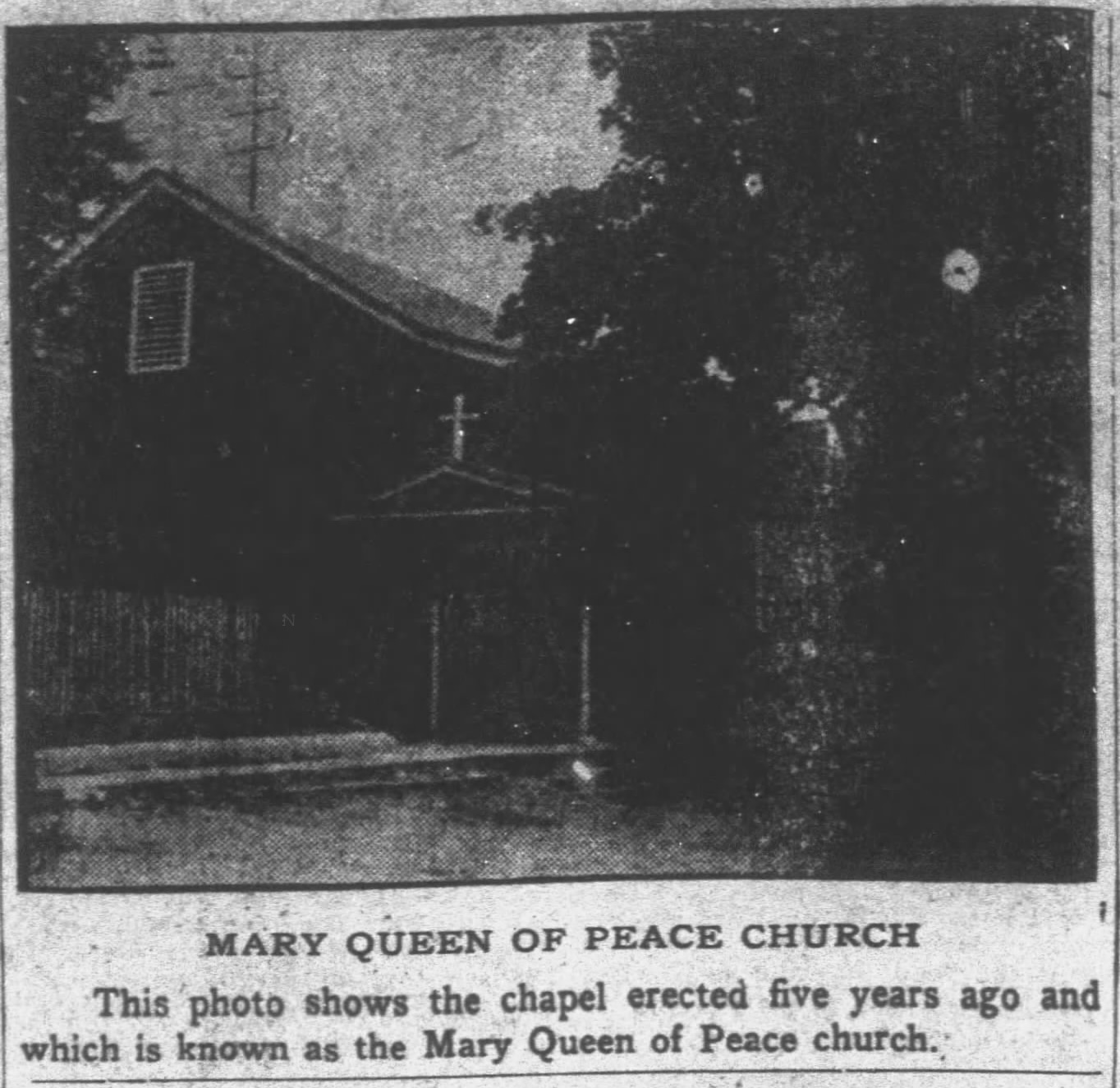
Original Mary Queen of Peace Church — 1 August, 1925
The original chapel on North Centre Street served as the parish church from the early years of Mary Queen of Peace until construction of the present church was completed in 1929. This chapel originated as a stable and was located at the rear of the current church, where portions of the foundation still exist. This photograph appeared in the August 1, 1925 edition of the Pottsville Republican as part of an illustrated feature on the development of the parish campus.
Completing the School and Convent
The most pressing issue facing the parish at the beginning of 1925 was completion of its new parochial school and convent.
Construction had begun the previous year on the former Seltzer property, but financial difficulties had interrupted the work. In January, Father Shay presented the situation to his congregation and sought their support to complete the project. Parishioners responded through contributions and an extensive series of benefits, euchres, dances, and other fundraising activities.
One of the largest was held at Charlton’s Hall on Monday, February 23. Organized for the school and church fund, the euchre and dance involved committees responsible for admissions, cards and games, prizes, cakes and candy, programs, and other arrangements. Contemporary reporting described the event as exceptionally large, with approximately 1,200 prizes awarded.
Fundraising continued throughout the spring. Another large dance was held at the Holly Roof on April 23 for the building campaign, with music by the Adelphia Orchestra and a cedar hope chest among the prizes.
By May 11, the Pottsville Republican reported that the new school was “about completed,” with principally furnishings and interior work remaining. Approximately $45,000 was reported as having been invested in the school, convent, and furnishings, and the parish anticipated opening the school in September with between 150 and 200 pupils.
The newspaper emphasized that the school was to be modern in its appointments and comparable in equipment to larger contemporary schools.
Father Shay and the Expansion of Mary Queen of Peace
At the center of the building campaign was Rev. George W. Shay, founding pastor of Mary Queen of Peace.
An illustrated feature published by the Pottsville Republican on August 1, 1925 placed Father Shay’s portrait between photographs of the new school and convent. The article credited his leadership in developing the parish property and bringing the school and convent project toward completion.
The same report identified the property as the former Seltzer property and stated that approximately $41,000 had originally been invested in the entire plot. With the subsequent development of the church property, remodeling of the convent, and construction of the school, the newspaper estimated that the parish’s overall investment was approaching $75,000.
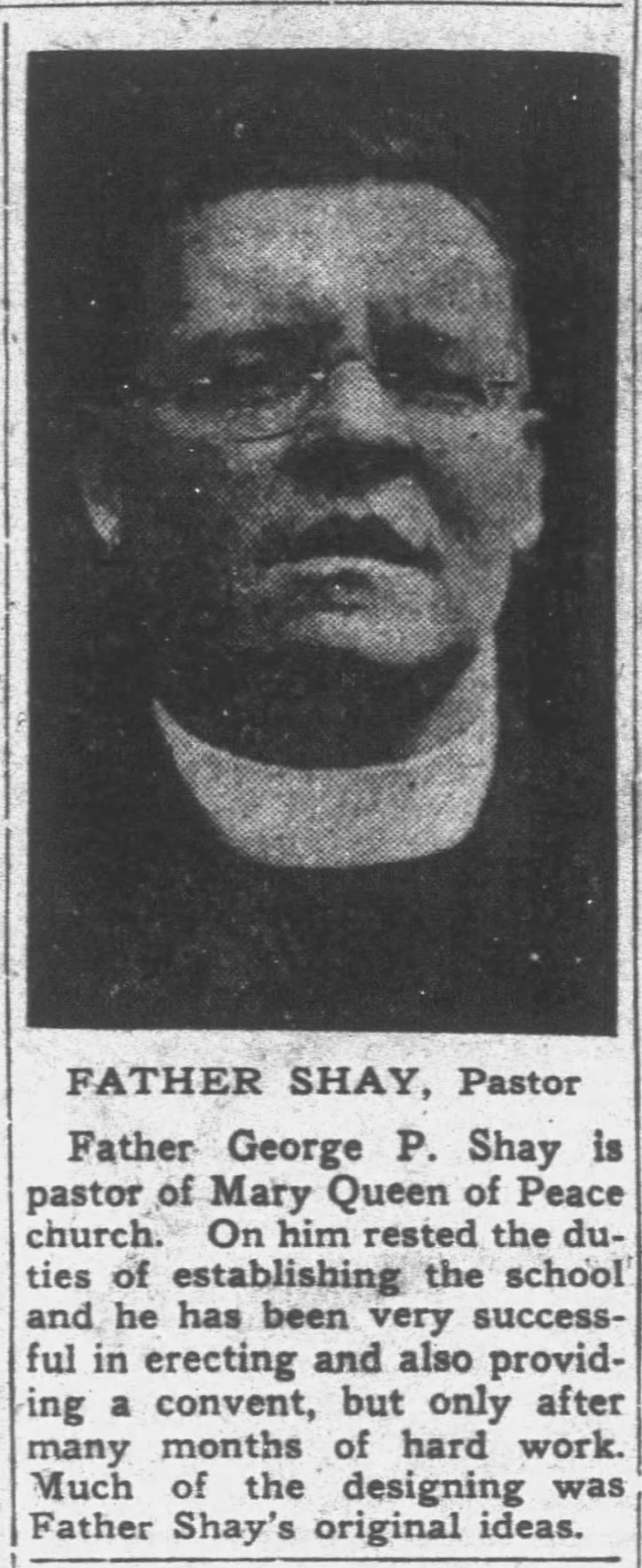
Rev. George W. Shay, founding pastor of Mary Queen of Peace, 1925.
Father Shay led the parish during the development of its North Centre Street campus and the construction of the new parochial school and convent. His portrait appeared with photographs of the parish buildings in the August 1, 1925 edition of the Pottsville Republican.
A Major Parish Mission
While the parish was raising money and building, its religious life remained exceptionally active.
On Sunday, March 1, Mary Queen of Peace opened a two-week parish mission conducted by Passionist Fathers McCloskey and Lukenbill. The first week was devoted principally to the women and children of the parish, while the second was arranged for the men.
The mission included special morning Masses, instructions, sermons, evening devotions, and Benediction. The schedule for working men was deliberately early, with special mission Masses during the second week at approximately 5:45 and 7:45 a.m.
On Sunday, March 8, the women’s portion concluded at 3:00 p.m. with ceremonies including the renewal of Baptismal Vows, Profession of Faith, and Papal Benediction. Contemporary reporting described the church as filled for the closing service.
The men’s mission continued through the following week and concluded on Sunday, March 15. The children’s mission also formally closed that afternoon before a church filled with parents and family members.
At its conclusion, the Republican described the two-week observance as:
“one of the most successful ever conducted at this church.”
Father Shay and the visiting Passionist Fathers were reported to be highly pleased with its success.
The mission set the tone for an active Lent. Mary Queen of Peace celebrated two weekday Masses during the season, held Wednesday and Friday evening services, and observed Stations of the Cross on Friday afternoons and evenings. Palm Sunday included the blessing and distribution of palms, while Holy Thursday and Good Friday observances included processions.
Youth, Societies, and Parish Life
The growth of Mary Queen of Peace was also evident outside formal worship.
The parish maintained a Holy Name Society, a Rosary Society, and a girls’ Sodality, while young parishioners increasingly participated in organized social and recreational activities.
During the spring, boys approximately eleven to fourteen years old formed a baseball team known as the Mary Queen of Peace Yanks. Other youth teams from Pottsville and neighboring communities—including the St. Clair Tigers, St. John’s Robins, Bunker Hill Orioles, and St. Patrick’s Juniors—publicly sought games with the MQP team.
Challenges were directed to Father Paul Lambert at 728 North Centre Street, indicating his direct involvement with the boys’ program.
The rectory basement also functioned as an important parish gathering space. Euchres, meetings, and youth activities were held there throughout the year. In November, both the boys of the parish and the girls of the Sodality held separate Halloween gatherings there, complete with games, refreshments, and costume prizes.
These activities reflected a parish that was developing not only buildings but an increasingly organized community life.
Father Lambert’s Holy Year Pilgrimage
One of the most unusual events of 1925 involved Rev. Paul Lambert, curate of Mary Queen of Peace.
On April 19, Father Lambert announced that he would soon leave for Rome with his mother and brother as part of the Philadelphia Holy Year pilgrimage. Before departing, he told the congregation that he hoped to visit the Pope and obtain a blessing for every member of the parish.
His continued assignment to Mary Queen of Peace was uncertain. Contemporary reporting noted that he might be transferred following the pilgrimage and that his April departure could potentially mark the end of his service at the parish.
The affection of the congregation for their curate was evident on April 23, when parishioners presented Father Lambert with a leather wallet containing nearly $200 in new bills to help defray the expenses of his journey.
He subsequently sailed with the Holy Year pilgrimage aboard the S.S. Ohio.
During his travels, Father Lambert visited Rome, Lourdes, Lisieux, sites in France and Italy, former battlefields, and American military cemeteries. His pilgrimage coincided with the Holy Year ceremonies surrounding the canonization of St. Thérèse of Lisieux, the “Little Flower.”
Most significantly, Father Lambert had an audience with Pope Pius XI.
He returned to the Mary Queen of Peace rectory on June 30, describing his journey as a wonderful trip. Within days, it became clear that he had not been transferred and would remain at Mary Queen of Peace for at least another year. The newspaper observed simply that Father Lambert was “very well liked by the members of that parish.”
Later that year, parishioners learned that Pope Pius XI had authorized Father Lambert to impart the Papal Blessingfollowing his return. Lambert arranged to give the blessing both at Mary Queen of Peace and to the Catholic community at Mt. Laffee.
He also organized public presentations of moving pictures he had brought home from the pilgrimage. On November 29, audiences at Pottsville’s Hippodrome Theatre were shown scenes from Rome, Lourdes, Lisieux, the canonization of the Little Flower, European battlefields, American military cemeteries, and the Philadelphia pilgrimage itself.
The New School Nears Completion
By the summer, the transformation of the parish campus was readily visible.
The Pottsville Republican devoted a substantial illustrated feature to Mary Queen of Peace on August 1, announcing that the new parochial school and convent were nearly complete.
The school contained seven classrooms, together with additional rooms for special purposes, and was designed to accommodate all eight elementary grades. Approximately 175 to 187 pupils were anticipated in contemporary reporting.
Four Sisters of the Immaculate Heart were expected to staff the new school.
The opening was especially significant for Mary Queen of Peace families because parish children had previously attended St. Patrick’s parochial school. For the first time, children of the growing parish would receive their Catholic education within their own parish community.
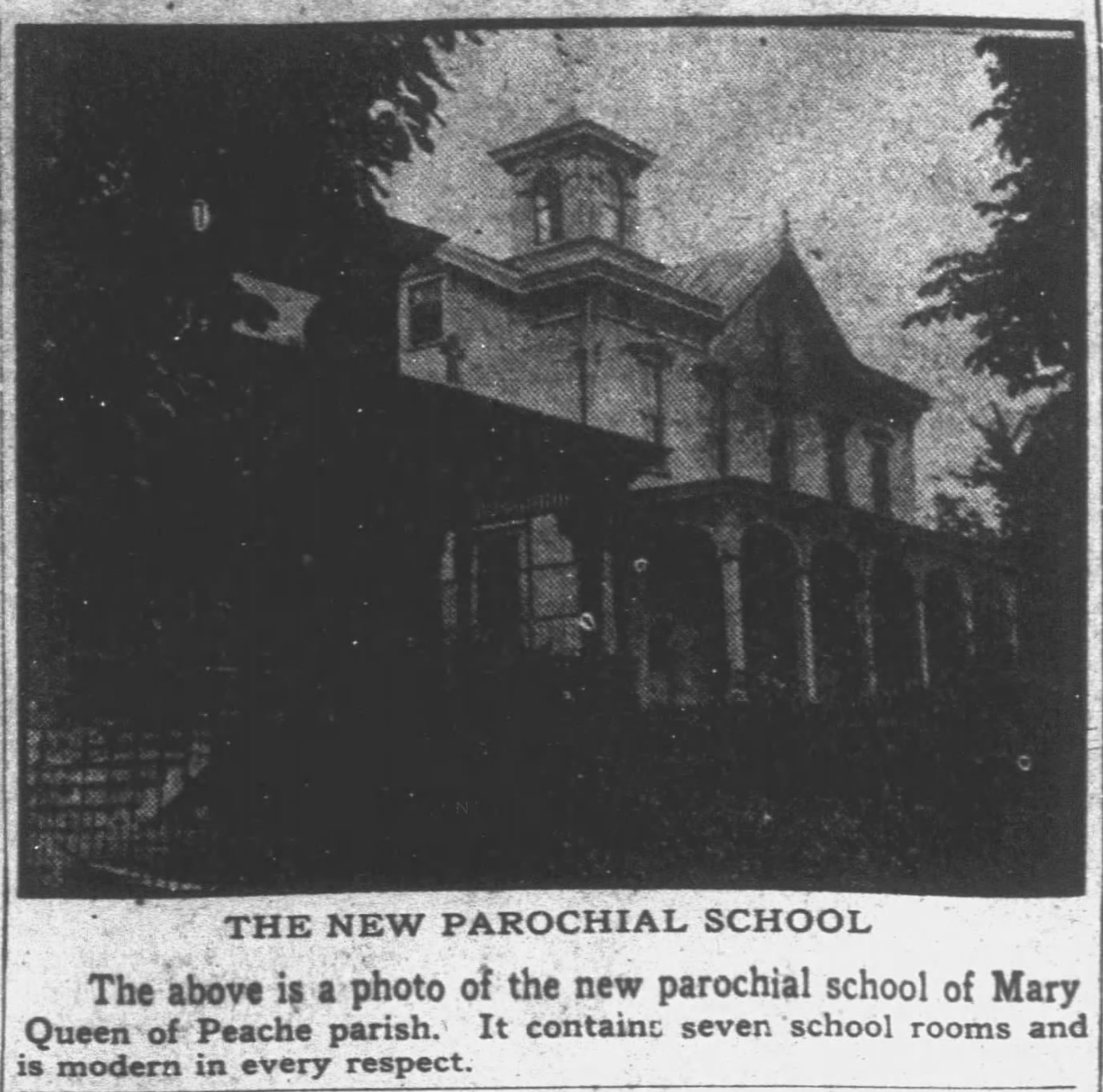
The new Mary Queen of Peace Parochial School, 1 August 1925.
Nearly completed when this photograph was published on August 1, the school contained seven classrooms together with additional rooms for specialized purposes and was designed to accommodate all eight elementary grades. The school opened for its first term in September 1925.
A Home for the Sisters
The school project also provided a permanent residence for the Sisters who would teach there.
An existing house on the parish property was extensively renovated as a thirteen-room convent for the Sisters of the Immaculate Heart. Contemporary reporting described the renovated residence as handsome and comfortable and identified it as the Convent of the Immaculate Heart.
As opening day approached, parishioners helped furnish and provision the Sisters’ new home.
Father Shay issued a rhyming invitation for a summer “shower,” requesting practical gifts such as linens, china, glassware, silver, and kitchen utensils. Then, on August 31 at 8:00 p.m., parishioners held a “larder party or grocery shower” in the convent to help stock the Sisters’ household.
These events offer a particularly tangible picture of the parish effort behind the school. The community was not simply financing construction; its members were preparing a home for the women who would educate their children.
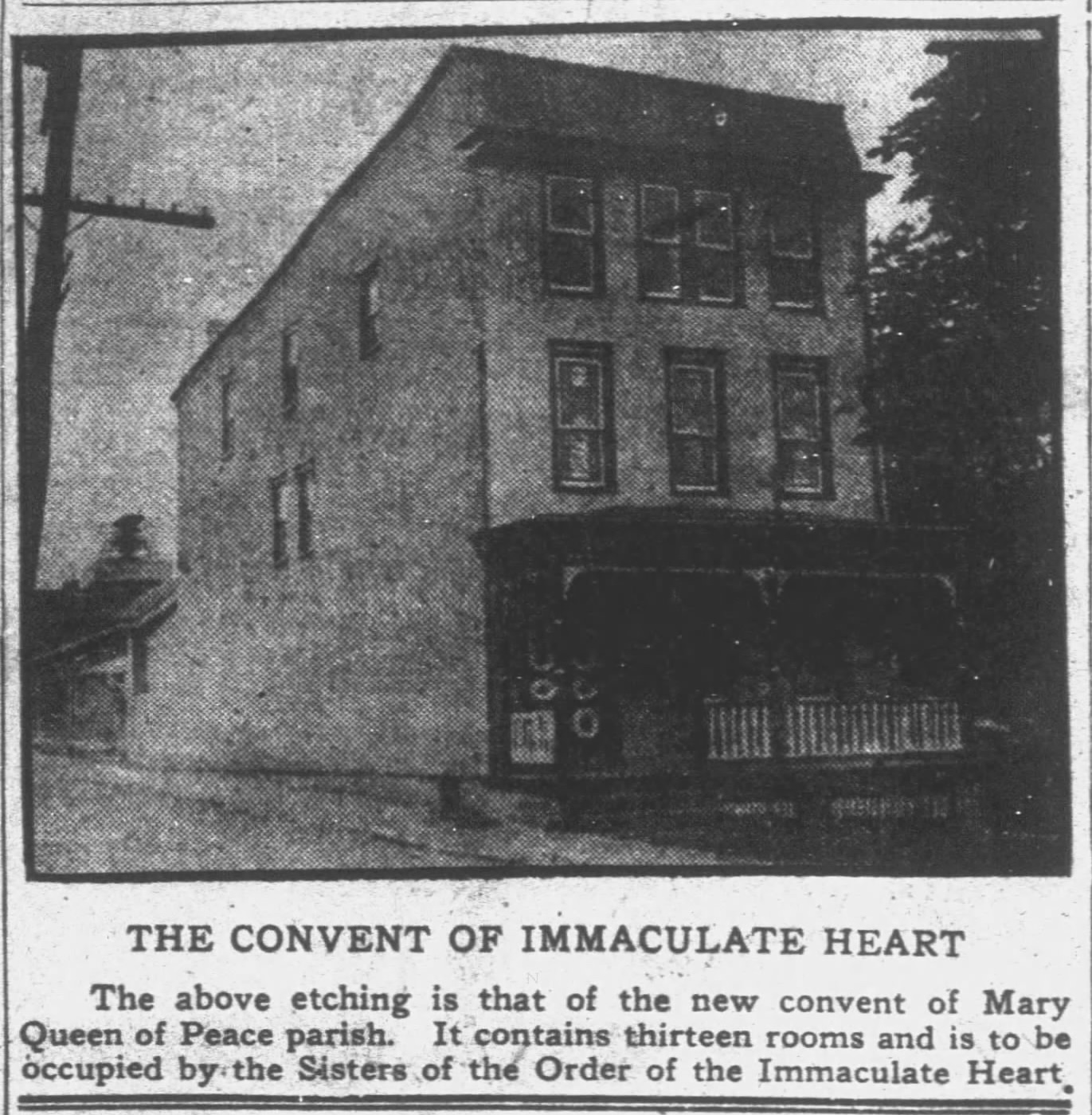
The new Convent of the Immaculate Heart, 1 August 1925.
An existing residence on the parish property was renovated into a thirteen-room convent for the Sisters of the Immaculate Heart, four of whom were assigned to teach at the new Mary Queen of Peace School. This photograph appeared in the Pottsville Republican on August 1, 1925.
Mary Queen of Peace School Opens
The culmination of the parish’s building campaign came in September 1925. The school had originally been expected to open around September 14, but preparations progressed sufficiently for an earlier opening. By Labor Day, the completed building had already been open for several days so parishioners could inspect it.
Contemporary reporting indicates that Mary Queen of Peace Parochial School opened for its first term on Tuesday, September 8, 1925, together with the other parochial schools of the area.
It was a major milestone for a parish established only six years earlier.
The new school quickly became more than a classroom building. Its hall served as a meeting and social space for the parish, while the building itself contained specialized facilities unusual enough to draw favorable public notice.
In November, a representative of the local library praised the quarters provided at Mary Queen of Peace School. Rather than being assigned a corner of a classroom or hallway, the circulating library had its own small room, complete with a desk, swivel chair, window, and bookshelves. The newspaper affectionately described the room as:
“a Library to its last inch.”
The financial work did not end with the opening. Boys and young women of the parish continued holding euchres for the school fund during the autumn, demonstrating the ongoing commitment required to establish and maintain the new institution.
An Annual Parish Tradition
Another sign of the parish’s developing community life was its annual summer block party.
Beginning on Tuesday, August 25, Mary Queen of Peace held its block party for three evenings on the grounds surrounding the chapel on North Centre Street.
The grounds were illuminated with varicolored lights, while music, dancing, refreshments, games, and other amusements filled the evenings. The Branchdale Band provided music on opening night.
Contemporary reporting already referred to these gatherings as an established tradition and noted that previous block parties had been well attended. Father Lambert directed the 1925 event with Father Shay and numerous parish volunteers assisting.
The block party illustrates the important role played by lay parishioners in sustaining Mary Queen of Peace. The same community that financed buildings and supported religious societies also created a vigorous social life around the parish campus.
The Mission at Mt. Laffee
The Catholic community at Mt. Laffee remained closely connected to Mary Queen of Peace throughout 1925.
Mass continued to be celebrated there regularly, while baptisms, funerals, and other important sacramental observances involving Mt. Laffee families frequently took place at the parish church in Pottsville. Contemporary newspapers explicitly referred to Mt. Laffee as a mission of Mary Queen of Peace.
During the summer, the parish began taking concrete steps toward giving the community a permanent chapel of its own.
On August 10, the Republican reported that construction of a new chapel at Mt. Laffee was being contemplated and that bids had already been requested.
The project would continue into 1926 and ultimately provide Mt. Laffee with its own chapel.
The timing is particularly interesting. Father Lambert’s Holy Year pilgrimage included the canonization of St. Thérèse of Lisieux and a visit to Lisieux, while the Mt. Laffee chapel would later become closely associated with the Little Flower. The surviving 1925 material, however, does not establish that Lambert’s pilgrimage determined the chapel’s dedication, so any direct connection remains a question for the surviving 1926 record.
A Proposal to Enlarge the Parish
The opening of the new school also prompted discussion about the geographic size of Mary Queen of Peace Parish.
On July 20, the Republican reported that diocesan officials were considering enlarging the parish boundaries, apparently in connection with the opening of the school. The proposed change would have transferred additional territory from neighboring Catholic parishes to Mary Queen of Peace.
The proposal did not proceed.
On August 10, the newspaper reported that the contemplated division had “fallen through,” that Father Shay had made no official request for additional parishioners, and that diocesan authorities did not intend to act on the proposal.
Although ultimately unsuccessful, the discussion itself illustrates the rapid development of the young parish and the expectations surrounding its new school.
A Full Parish Life
The new institutions developed alongside a rich devotional and sacramental life. Confirmation was celebrated at Mary Queen of Peace on the afternoon of May 25, during the diocesan Confirmation visitation. Throughout May, evening May devotions were held at 7:30 p.m., in addition to the regular schedule of Masses. At the end of May, the parish observed its annual Forty Hours Devotion. Contemporary reporting described Mary Queen of Peace Church in Fishbach as filled to capacity for its opening. Father Shay connected the devotion with the successful parish mission earlier that spring and encouraged broad participation by the congregation.
In December, the Feast of the Immaculate Conception again drew crowded Masses at Mary Queen of Peace.
The Christmas schedule provides perhaps the clearest indication of the demands being placed upon the original church. On Christmas Day 1925, Mary Queen of Peace scheduled Masses at: 5:00 a.m., 6:00 a.m., 7:00 a.m., 8:00 a.m. and 9:00 a.m. Five Christmas Masses were therefore scheduled within four hours in the small chapel on North Centre Street.
Remembering a Civil War Veteran
The closing days of 1925 provide a remarkable connection between the young Mary Queen of Peace Parish and an earlier generation of American history.
George Ritzel, an approximately 81-year-old lifelong resident of Pottsville and member of Mary Queen of Peace, died on December 21, 1925. His contemporary obituary identified him as a Civil War veteran and reported that he had served with the 48th Pennsylvania. Subsequent examination of surviving military records, however, identifies George Ritzel as a private in Company D of the 96th Pennsylvania Volunteer Infantry, a regiment organized largely from Schuylkill County.
Ritzel was mustered into service on September 23, 1861, for a three-year term and remained on the rolls until he was mustered out with his company on October 21, 1864. His service therefore extended through nearly three years of the Civil War. The discrepancy between the military record and the 1925 obituary appears to have resulted from the newspaper confusing the 96th with the locally famous 48th Pennsylvania.
Ritzel’s funeral was held on Christmas Eve, December 24, 1925. The procession left the home of his son-in-law at 9:00 a.m., followed by a High Requiem Mass at Mary Queen of Peace at 9:30 a.m., celebrated by Father George W. Shay. The funeral was described as largely attended, and burial followed in St. Patrick’s Cemetery No. 3.
Ritzel’s documented membership at Mary Queen of Peace provides an early connection between the parish and the military service of its members. A veteran of the Civil War was thus among the congregation of the still-young parish during its formative years—a parish that, by the time of his death, had grown to include its church, rectory, newly opened school and convent, and the developing mission at Mt. Laffee.
The Year Draws to a Close
Even in the final days of December, parish fundraising and community activity continued.
On Tuesday evening, December 29, the New Street girls held a euchre and dance in the Mary Queen of Peace School Hall on North Centre Street. The event drew what the newspaper called a “very good attendance” and was reported successful both socially and financially, raising a “goodly sum” through the event and sale of refreshments.
The gathering provides an appropriate ending to the story of 1925.
At the beginning of the year, Mary Queen of Peace faced the difficult task of completing a school and convent that the young parish could not easily afford. Parishioners responded with contributions, dances, euchres, benefits, volunteer labor, household gifts, and continued fundraising.
By the end of the year, the results were visible across the North Centre Street property.
The original chapel remained the center of worship. The rectory served both the clergy and parish organizations. The renovated convent housed the Sisters of the Immaculate Heart. The new eight-grade school was educating the parish’s children and its hall had already become a gathering place for the wider community. At Mt. Laffee, meanwhile, plans were advancing for another permanent Catholic chapel.
Mary Queen of Peace had entered 1925 as a young parish still building its foundations. It ended the year with the institutions of a mature Catholic community taking shape around it.
That growth would soon create another challenge. The school, convent, societies, missions, and increasingly active sacramental life were developing around the relatively modest original chapel. The five Christmas morning Masses of 1925 and reports of crowded services provide an early indication of the demands being placed upon it.
Within only a few years, Mary Queen of Peace would undertake its most ambitious project yet: the construction of a new parish church.
1926 — A Growing Parish and the Chapel of the Little Flower
By 1926, Mary Queen of Peace had entered a new stage in its development. The school and convent completed during the previous year were now established parts of parish life, the original chapel on North Centre Street remained busy with Masses and devotions, and the parish’s societies and social organizations supported an increasingly active Catholic community.
The year was especially significant for the parish’s longstanding mission at Mt. Laffee. After generations of Catholic worship in local school buildings, plans for a permanent chapel moved decisively forward. At the same time, devotion to St. Thérèse of Lisieux—the “Little Flower”—became particularly prominent at Mary Queen of Peace.
By year’s end, the cornerstone of a new Chapel of the Little Flower had been laid at Mt. Laffee, an imported statue of St. Thérèse had arrived for the chapel, and the project that Catholics there had sought for generations was nearing fulfillment.
The School’s First Full Year
Mary Queen of Peace School entered 1926 in its first academic year. Opened in September 1925 and staffed by the Sisters of the Immaculate Heart of Mary, the school gave parish children the opportunity to receive their Catholic education within their own parish for the first time.
By June, contemporary reporting described the school’s first year as a marked success. Approximately 125 pupils had attended, and enrollment was expected to increase by at least forty during the following term. The Sisters provided instruction not only in the regular curriculum but also in music and other arts, and plans were already being considered for a school orchestra.
The school was closely connected with the parish’s mission territory. A June newspaper account specifically noted a sizable attendance of children from Mt. Laffee and stated that the community, under an order of Cardinal Dennis Dougherty, was “governed by Mary Queen of Peace parish.”
This contemporary statement provides especially clear evidence of the relationship that had existed since the parish’s establishment: Mt. Laffee was not an independent parish, but part of the pastoral responsibility entrusted to Mary Queen of Peace.
The school’s religious life was equally active. On May 27, thirty-one children received their First Holy Communion at Mary Queen of Peace. Father Paul Lambert celebrated the Mass, while the Sisters who had prepared the children assisted in the day’s observances.
A Second Year of Rapid Growth
During the summer, preparations began for the school’s second academic year.
By August, approximately 175 pupils were expected to enroll, compared with the 125 reported during the first year. About thirty beginners were anticipated. Father George W. Shay personally supervised registration, assigned pupils to classrooms and teachers, and prepared the promotion lists, assisted by Father Lambert, whom contemporary reports identified as the parish curate.
The teaching community also underwent several changes. The Mother Superior and the Sister serving as music supervisor returned from the previous year, while two Sisters were transferred and replaced by two new members of the community. Contemporary reporting therefore indicates a teaching staff of four Sisters.
The second academic year opened on September 7, 1926.
The school had quickly become more than an educational institution. Its auditorium and hall served as centers of parish social life, while its pupils participated regularly in processions, devotions, fundraising events, and other parish activities.
Devotion to the Little Flower
One of the most distinctive features of Mary Queen of Peace during 1926 was its growing devotion to St. Thérèse of Lisieux, canonized by Pope Pius XI the previous year.
The devotion had a particularly meaningful connection with Father Paul Lambert. During his 1925 Holy Year pilgrimage, Father Lambert had traveled to Rome during the ceremonies surrounding the canonization of St. Thérèse and had also visited Lisieux. Upon returning to Pottsville, he shared experiences and images from the pilgrimage with the parish.
Early in 1926, Mary Queen of Peace began an extended series of devotions honoring the Little Flower. A nine-Sunday novena began on January 31 and continued through March 28. Contemporary reports described substantial attendance and included special Sunday afternoon and evening exercises.
The devotion was not confined to adults. A separate six-week novena was conducted for the children during the spring. It concluded on May 16, the day before the first anniversary of St. Thérèse’s canonization. Pupils of the parochial school participated in a procession, Father Shay preached to the children, and their singing formed part of the closing exercises.
The prominence of the Little Flower at Mary Queen of Peace during these months provides important context for the dedication soon chosen for the permanent chapel at Mt. Laffee. The surviving sources, however, do not establish who specifically selected the name or whether Father Lambert personally proposed it.
The May Procession and Crowning of the Blessed Virgin
Marian devotion remained equally central to the life of the parish bearing the name of Mary, Queen of Peace.
On Sunday, May 23, the parish held its annual May procession and crowning of the Blessed Virgin Mary. Contemporary reporting described the procession as one of the major annual features of parish life.
The Sisters prepared the children for the observance, which began at the school and proceeded through the surrounding area before returning to the church. Approximately 300 girls were reported as participating. Younger children dressed in white and carried flowers, while other participants carried religious banners.
The procession culminated in the crowning of the statue of the Blessed Virgin, followed by parish devotions.
Significantly, children from Mt. Laffee were among those taking part, another indication of the close relationship between the mission community and the parish school in Pottsville.
First Communion and Forty Hours
The spring devotional calendar continued almost without interruption. At the end of May, Mary Queen of Peace began its annual Forty Hours Devotion. The observance opened with High Mass on Sunday, May 30, followed by a procession involving many of the schoolchildren.
During the following days, Masses were celebrated as early as 5:00 a.m., with additional Masses at 7:00 and 8:00. Evening services included the Rosary, sermons by visiting priests, and Benediction of the Most Blessed Sacrament. Confessions were heard throughout the devotion.
The schedule illustrates the extensive religious life already being maintained in the original Mary Queen of Peace chapel even as the parish continued to expand its educational and missionary work.
Mt. Laffee and Mary Queen of Peace
The surviving newspapers provide an unusually detailed picture of the relationship between Mary Queen of Peace and Mt. Laffee during 1926.
Catholics there continued to receive regular pastoral care while remaining closely connected with the parish church in Pottsville. Mt. Laffee residents appear repeatedly in baptisms, marriages, funerals, parish activities, and school records. Contemporary obituaries explicitly identify lifelong Mt. Laffee residents as members of Mary Queen of Peace.
The parish also made practical efforts to maintain that connection. Transportation was sometimes arranged for Mt. Laffee residents to attend parish activities in Pottsville, while Mary Queen of Peace itself conducted events at Mt. Laffee.
The relationship was educational as well as sacramental. Contemporary reporting specifically states that a sizable number of Mt. Laffee children attended Mary Queen of Peace School.
These records confirm that the eventual Little Flower Chapel did not create the relationship between the two communities. Rather, it provided a permanent sacred home for a Catholic community that had already formed an integral part of Mary Queen of Peace Parish.
Raising Funds for a Permanent Chapel
By the spring of 1926, the effort to provide Mt. Laffee with a permanent chapel was becoming increasingly visible.
Local euchres and other gatherings were conducted under Mary Queen of Peace auspices, and a May newspaper report explicitly described one successful Mt. Laffee event as being held “for the benefit of the chapel.”
The need was longstanding.
Catholics at Mt. Laffee had worshipped in local schoolhouses for decades. Later that year, speakers at the cornerstone ceremony recalled that the community had desired a chapel of its own for approximately fifty years.
The project therefore represented far more than an expansion of a young Pottsville parish. It was the culmination of a much older Catholic presence at Mt. Laffee.
The Chapel of the Little Flower
On Sunday, September 19, 1926, that long effort reached a major milestone when the cornerstone of the new Chapel of the Little Flower was laid at Mt. Laffee.
The Pottsville Republican devoted prominent coverage to the ceremony and reported that several thousand peopleattended. The newspaper described the occasion as the realization of years of hope for the community.
The new chapel was planned as a substantial two-story structure measuring approximately 30 by 80 feet, with a large basement intended for meetings and social activities. Its construction was described as hollow tile with an asbestos-tile roof, and the completed cost was estimated at between $25,000 and $30,000.
J. H. Reilly was identified as architect and John Houser as contractor.
Father George W. Shay and Father Paul Lambert, pastor and curate of Mary Queen of Peace, were in general charge of the arrangements.
A Major Catholic Gathering at Mt. Laffee
The cornerstone ceremony drew clergy, parishioners, schoolchildren, Catholic societies, and visitors from throughout the surrounding area.
The Branchdale Band led the procession. Participants included children from both Mt. Laffee and Mary Queen of Peace School, members of the Knights of Columbus and Ancient Order of Hibernians, parish organizations, and visiting clergy. Contemporary reporting noted that those in the procession carried small American flags.
Rt. Rev. Msgr. James Nash, a native of the Fishbach section of Pottsville and one of the priests involved in establishing Mary Queen of Peace’s original parish boundaries, presided over the cornerstone ceremony.
Rev. William Higgins of St. Francis Orphanage preached and recalled the longstanding desire of Mt. Laffee Catholics for a chapel of their own. Attorney Vincent Dalton of Schuylkill Haven also addressed the gathering, and Father Shay offered closing remarks. The ceremony concluded with Benediction of the Most Blessed Sacrament, with Father Lambert serving as Master of Ceremonies.
The event represented one of the most significant developments in the history of Mary Queen of Peace since the opening of its school the previous year.
Little Flower Devotion Continues
Only three days after the cornerstone ceremony, another Novena to the Little Flower began at Mary Queen of Peace following the 6:30 a.m. Mass on September 22.
The novena continued through the closing days of September and concluded with special ceremonies and a procession of the parish children. Father Shay and Father Lambert both participated.
The close timing of the two events—the laying of the Little Flower Chapel cornerstone on September 19 and the beginning of the parish’s Little Flower Novena on September 22—illustrates how closely devotion to St. Thérèse had become woven into the religious life of Mary Queen of Peace and its Mt. Laffee mission.
A Statue from Spain
Construction of the new chapel continued through the autumn. In November, the parish received another important addition for the new sacred space: an imported statue of the Little Flower from Spain.
The statue was intended for installation in the Mt. Laffee chapel after its completion. Until then, it was placed on exhibition at Mary Queen of Peace Church in Pottsville, allowing parishioners to see the image destined for the new chapel.
The episode provides a tangible connection between the mother church and its mission. Before the statue of St. Thérèse found its permanent home at Mt. Laffee, it was first received and displayed at Mary Queen of Peace.
Father Lambert and the Eucharistic Congress
The year also included an important event in the ministry of Father Paul Lambert.
In June, Father Lambert traveled to Chicago to attend the International Eucharistic Congress, joining priests and Catholic faithful from across the United States and around the world.
His return was marked by personal tragedy. While his parents were returning from the Congress, their automobile was involved in an accident near Fort Wayne, Indiana. Father Lambert’s mother died from her injuries, while his father was also injured. Father Shay and numerous area priests later traveled to Philadelphia for her funeral.
Father Lambert subsequently returned to his ministry at Mary Queen of Peace and continued serving alongside Father Shay throughout the remainder of the year.
Parish Societies and Community Life
Behind the major developments of 1926 stood a remarkably active lay community.
Fundraising and social activity continued throughout the year through a sustained series of euchres, dances, picnics, entertainments, and other gatherings. Neighborhood groups and parish organizations took turns conducting events, many in the school hall.
Participants included the choir, altar boys, schoolchildren, married and unmarried men and women, and the parish Sodality. By the end of the year, contemporary reporting identifies at least four numbered Bands within the Sodality.
The parish’s annual picnic was held at Green’s Park during July, with buses arranged to transport parishioners. In August, a three-night block party was held on the church grounds. During the autumn, another series of weekly euchres was organized in the school auditorium.
A particularly large parish euchre and dance was held at Moose Hall in November. Numerous committees were formed to manage prizes, refreshments, patronesses, and other arrangements, illustrating the extensive volunteer structure that had developed within the parish.
These activities provided fellowship, but they also helped sustain the institutions Mary Queen of Peace was continuing to build and maintain.
Religious Vocations
The parish’s religious life was also reflected in emerging vocations. In September, Father Shay and Sister Rose Amilda of Mary Queen of Peace accompanied two young women to St. Joseph’s Convent at Chestnut Hill, Philadelphia, as they prepared to enter religious life.
At the close of the year, another young woman associated with the parish, Isabel Sheehan of North Centre Street, was preparing to leave for St. Joseph’s Convent in West Chester. Members of the Mary Queen of Peace Sodality were invited to her farewell gathering before her departure in January 1927.
Together with the parish’s earlier support of young men preparing for the priesthood, these accounts show that Mary Queen of Peace’s growth was measured not only in buildings and enrollment, but also in religious vocations emerging from its community.
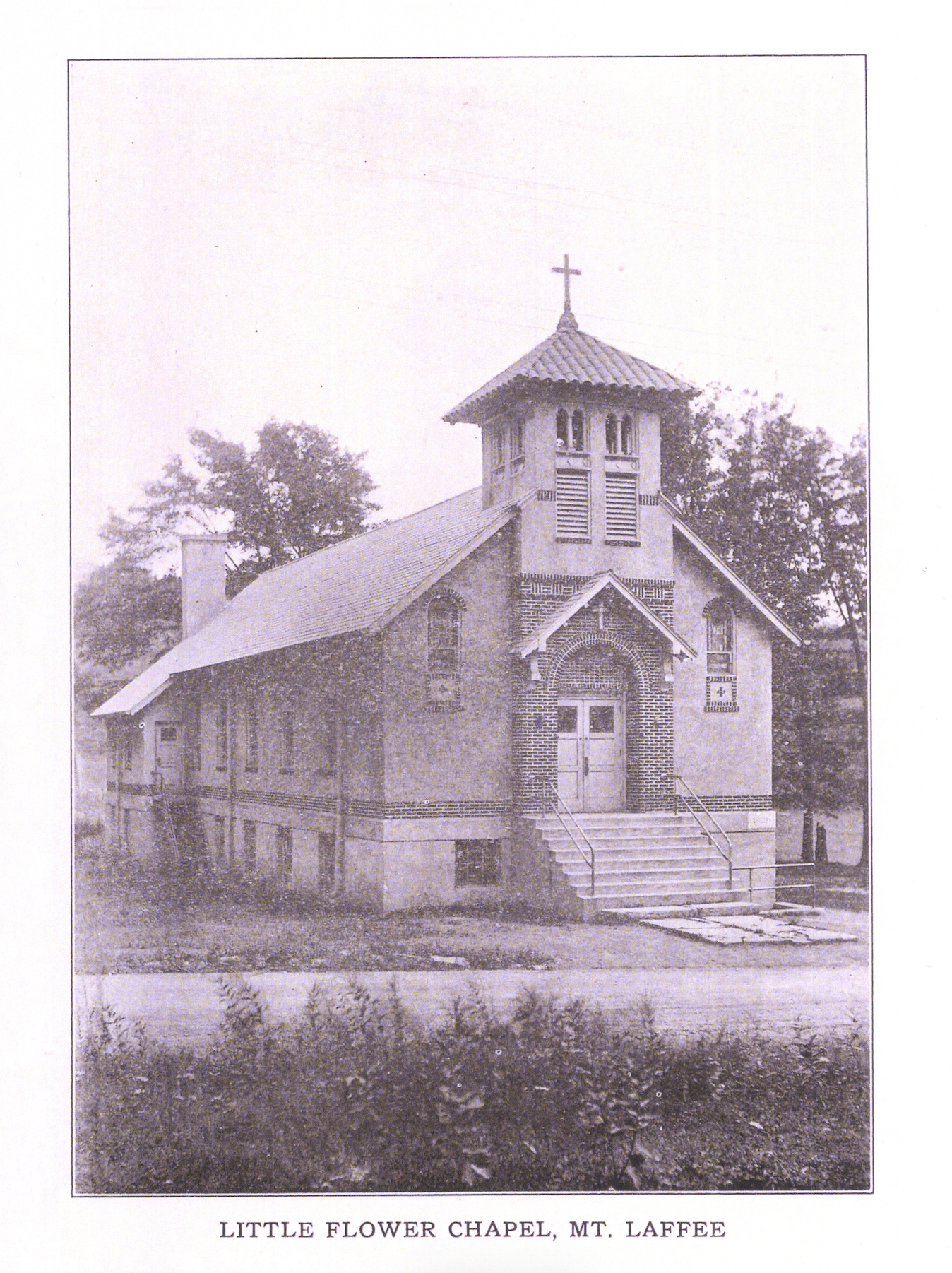
The Chapel of the Little Flower — 1926
An early photograph of the Chapel of the Little Flower at Mt. Laffee, constructed as a mission chapel of Mary Queen of Peace Parish to serve the Catholic families of the surrounding community. After decades of worship in local school buildings, the cornerstone of the new 30-by-80-foot chapel was laid on September 19, 1926, before a gathering reported to number several thousand. Designed by architect J. H. Reilly and constructed by John Houser, the chapel was dedicated to St. Thérèse of Lisieux, the “Little Flower,” whose devotion had become especially prominent at Mary Queen of Peace. A statue of St. Thérèse, imported from Spain for the new chapel, was first displayed at Mary Queen of Peace while construction continued. The completed chapel was solemnly dedicated on May 22, 1927, providing a permanent place of Catholic worship for the Mt. Laffee community.
Christmas at Mary Queen of Peace and Mt. Laffee
The year closed with an extensive Christmas schedule. On Christmas morning, Mary Queen of Peace scheduled five Masses: 5:00 a.m. — High Mass, 6:00 a.m. — Mass, 7:00 a.m. — Mass, 8:00 a.m. — Mass, 9:00 a.m. — High Mass with benediction of the Most Blessed Sacrament followed the final Mass.
The same Christmas announcement also scheduled a 9:00 a.m. Mass at the Mt. Laffee chapel, with the Mt. Laffee choir providing the music.
The notice is an important year-end marker. The cornerstone of the new Little Flower Chapel had been laid only three months earlier, and construction was still reported underway in November. The surviving 1926 newspaper material does not establish the exact date on which the new chapel was completed or formally blessed. A later parish history records its dedication as occurring on May 22, 1927.
The Christmas notice nevertheless demonstrates that Catholic worship continued at Mt. Laffee as the permanent chapel project moved toward completion.
Preparing for the Next Chapter
By the close of 1926, Mary Queen of Peace had changed considerably from the parish established only a few years earlier. Its school had completed a successful first academic year and entered its second with growing enrollment. Four Sisters of the Immaculate Heart of Mary continued the work of Catholic education. Parish children participated prominently in First Communion, Forty Hours, May processions, Little Flower devotions, and the wider religious life of the church.
Father George W. Shay remained at the head of the parish, assisted by Father Paul Lambert. Around them, the Sodality, schoolchildren, altar boys, choir, neighborhood groups, and numerous lay committees supported an active schedule of worship, education, fundraising, and community life.
At Mt. Laffee, meanwhile, generations of Catholic hopes were finally taking permanent form. The cornerstone of the Chapel of the Little Flower had been laid, its walls were rising, and a statue of St. Thérèse had arrived from Spain for the new sacred space.
The growth of 1926 also pointed toward another challenge. The original Mary Queen of Peace chapel on North Centre Street remained the center of a parish now supporting a school, convent, active societies, a growing sacramental life, and a mission chapel at Mt. Laffee. Five Christmas morning Masses again illustrate the demands being placed upon the modest worship space.
The parish had spent the first half of the decade establishing itself. It had acquired its property, created a chapel, eliminated early debts, built a school, established a convent, developed parish societies, and strengthened its mission at Mt. Laffee.
The next stage would be its most ambitious undertaking yet: a permanent parish church on North Centre Street.
1927 — The Little Flower Chapel and a Parish Preparing for Its Next Chapter
The year 1927 marked another important period of growth for Mary Queen of Peace. The parish entered the year with its school firmly established on North Centre Street and with construction of the new Little Flower Chapel at Mt. Laffee nearing completion. During the months that followed, the chapel was completed and dedicated, the parochial school continued to expand, parish organizations became increasingly active, and a change occurred among the clergy serving alongside Father George W. Shay.
By the closing months of the year, contemporary newspapers were also referring explicitly to a Mary Queen of Peace “building fund.” Although the surviving 1927 reports do not yet identify the specific building for which the fund was intended, its appearance came immediately before the parish embarked upon construction of the permanent church that would soon rise on North Centre Street.
Completing the Chapel of the Little Flower
One of the most significant accomplishments of 1927 was the completion of the new Catholic chapel at Mt. Laffee.
For years, Catholics of Mt. Laffee and the surrounding communities had been connected with Mary Queen of Peace in Pottsville. Contemporary reports from the previous year stated that Mt. Laffee was governed by Mary Queen of Peace Parish under an order attributed to Cardinal Dennis Dougherty. Children from Mt. Laffee attended the Mary Queen of Peace parochial school, while local Catholics traveled to the mother church in Pottsville for baptisms, marriages, funerals, and other parish observances.
A former schoolhouse had provided an earlier place for Catholic worship at Mt. Laffee, but the parish undertook construction of a permanent, purpose-built chapel in 1926. The cornerstone of the new Chapel of the Little Flower was laid on September 19, 1926, before a crowd reported in the thousands.
Construction continued into 1927.
The completed chapel was a substantial two-story building, approximately 30 by 80 feet, constructed of hollow tile and designed with a large basement that could accommodate meetings and social activities. Architect J. H. Reilly prepared the plans, while John Houser served as contractor. Contemporary estimates placed the cost of the project between $25,000 and $30,000.
The Dedication of Little Flower Chapel — May 22, 1927
On May 22, 1927, the new Little Flower Chapel was formally dedicated, completing a project that had occupied the parish for much of the previous year.
The dedication represented more than the completion of another parish building. It provided the Catholics of Mt. Laffee with a permanent place of worship closer to their homes while preserving their relationship with Mary Queen of Peace in Pottsville.
The chapel was dedicated in honor of St. Thérèse of Lisieux, the Little Flower of Jesus, whose devotion had become particularly prominent at Mary Queen of Peace during the preceding years. A statue of the Little Flower, imported from Spain during construction of the chapel, had first been displayed at Mary Queen of Peace before being placed in the new building.
Little Flower Chapel now became the center of Catholic worship and community life at Mt. Laffee.
A Mission of Mary Queen of Peace
Newspaper reporting throughout 1927 makes the relationship between the two churches particularly clear.
Little Flower was not treated as an independent parish. Rather, it functioned as a mission chapel of Mary Queen of Peace under the pastoral direction of Father Shay and his assistants.
This relationship is captured especially well in a December newspaper report, which referred to the building at Mt. Laffee as the “Chapel of Mary Queen of Peace church.”
At the same time, the chapel developed a distinct local religious life. Regular Sunday Mass was established, and newspaper schedules later in the year placed Sunday Mass at Mt. Laffee at approximately 8:45 a.m. Holy Hours, Benediction, feast-day Masses, Little Flower devotions, and other services were also held there.
Yet important sacramental and parish occasions continued to bring Mt. Laffee families to Mary Queen of Peace in Pottsville. Numerous contemporary funeral notices, for example, record corteges leaving homes at Mt. Laffee and traveling to Mary Queen of Peace for Solemn or High Masses of Requiem.
The surviving record therefore reveals a recognizable mother-parish and mission-chapel relationship: Little Flower provided regular Catholic worship at Mt. Laffee, while Mary Queen of Peace remained the center of the larger parish community.
Devotion to the Little Flower
The completion of the chapel strengthened a devotion that had already become an important part of parish life.
Mary Queen of Peace had held extensive novenas in honor of St. Thérèse during 1926, and Father Paul Lambert had previously traveled to Europe during the period surrounding her canonization. Although the surviving sources do not establish that Father Lambert personally selected the dedication of the Mt. Laffee chapel, devotion to the Little Flower was clearly flourishing within the parish by the time the new building was completed.
During 1927, newspaper reports document Little Flower novenas and other devotional services at the chapel, including veneration associated with a relic of St. Thérèse.
The chapel’s dedication therefore gave a permanent home to a devotion that had already become closely associated with the parish.
The Blessed Mary Sodality at Mt. Laffee
By the end of the year, Little Flower Chapel had developed its own active religious organizations.
On December 18, the Blessed Mary Sodality held what the newspaper described as its semiannual celebration and reception at the Mt. Laffee chapel. The ceremony included a procession of the Sodalists, hymns, the reception of new members, a sermon by Father Shay on the Blessed Mother, and Benediction.
Nine new members were received: Mrs. William Grace, Mrs. Richard Casey, Lawrence Fogarty, Benjamin Reddington, Joseph Reddington, Richard Casey, Thomas Grace, George Moffett, and George Steffnick.
The presence of both men and women among the new members demonstrates the breadth of participation in the chapel’s devotional life.
Only seven months after its dedication, Little Flower had therefore developed into much more than a building. It possessed a regular cycle of worship, devotions, religious organizations, and community activities while remaining an integral part of Mary Queen of Peace Parish.
The Parochial School Continues to Grow
Meanwhile, the Mary Queen of Peace parochial school continued its own development on North Centre Street.
Established during the previous years and staffed principally by the Sister Servants of the Immaculate Heart of Mary, the school had quickly become one of the parish’s central institutions. Children attended not only from the immediate North Centre Street area but also from Mt. Laffee and other neighborhoods within the parish.
By the 1927–28 school year, newspaper reports indicate that the curriculum and teaching staff were expanding. A commercial course was added, and an additional Sister joined the faculty.
The surviving newspaper record also confirms that the school included at least the first through sixth grades by December 1927.
In December, when Santa Claus made his annual visits to Pottsville schools, Mary Queen of Peace was included alongside the city’s neighborhood schools. The newspaper reported that Santa visited “all grades” at Mary Queen of Peace and specifically mentioned the first, second, third, and sixth grades.
The article preserves several teachers’ names, although it does not establish from that report alone whether each was a Sister or lay teacher.
The Mary Queen of Peace School Orchestra
Music also became an increasingly visible part of school and parish life.
Plans for a school orchestra had been discussed as early as 1926. By 1927, the orchestra was no longer merely an aspiration. Contemporary newspaper reports show the Mary Queen of Peace School Orchestra performing at parish functions and community gatherings.
Named young musicians included violinists Joseph Hanney, Harry Singer, and Albert Moser, John McAnulty on percussion, and Eugenia Eagan at the piano. Other young musicians associated with Mt. Laffee included Catherine, Winifred, and Francis Eagan.
The orchestra appeared repeatedly at parish social events later in the year, providing entertainment at euchres and other gatherings.
Its development illustrates the broader educational role of the parish school. Mary Queen of Peace was providing not simply classroom instruction, but opportunities in music, religious formation, social activities, and parish service.
An Active Parish Community
The extraordinary number of parish activities reported during 1927 provides one of the clearest pictures yet of the developing Mary Queen of Peace community.
Euchres, card parties, dances, parish socials, neighborhood gatherings, school events, picnics, and religious observances occurred throughout the year. The school auditorium became an important gathering place, frequently hosting events organized for the benefit of the parish.
Participation was organized through numerous groups. The Sodality was divided into numbered bands, with newspaper reports documenting at least seven bands by November. Individual bands organized their own events and sometimes competed informally to make their activities more successful than those of the others.
Neighborhood groups also remained important. Residents of New Street, Nichols Street, North Centre Street, Mt. Laffee, and other parts of the parish frequently organized activities of their own.
This system distributed responsibility for supporting the parish throughout the congregation and created a remarkably active network of lay participation.
The Altar Boys of Mary Queen of Peace
Even the parish’s altar boys maintained an organized role in parish activities.
In October, the altar boys conducted a euchre in the Mary Queen of Peace school hall. The newspaper reported that the event was successful both financially and socially and preserved the names of the boys responsible:
Frank Sheehan, John Rodenbough, Frank Melody, Daniel Eagan Jr., Fred Eagan, Edmund Schlitzer Jr., William Sheehan, Roy Campion, and John McNulty.
Their activity provides a rare surviving record of the young men serving at the altar during this period and illustrates how parish responsibilities extended across generations.
Athletics and Parish Youth
Parish life also extended into athletics.
In November, the Pottsville Republican reported on a football game involving a team described simply as the “Mary Queen of Peace eleven.” The MQP team played the H.A.C. before what the newspaper described as a sizable crowd, with the game ending in a 6–6 tie.
Although the surviving report does not explain whether the team was formally connected with the parochial school or another parish youth organization, its identification with Mary Queen of Peace provides early evidence of organized athletics associated with the parish.
Several surnames appearing in the lineup—including Rodenbough, Campion, Flanagan, Young, and Eagan—also occur elsewhere in the parish record.
A Change Among the Parish Clergy
The year also brought an important clergy transition.
Father George W. Shay continued as rector and pastor of Mary Queen of Peace, overseeing both the mother church in Pottsville and the mission at Mt. Laffee.
Father Paul Lambert, who had served alongside him during an important period of parish expansion, departed Mary Queen of Peace during 1927. His years at the parish had coincided with the establishment of the parochial school, construction of Little Flower Chapel, and the growth of the Little Flower devotion.
He was succeeded by Father Henry McPeak, who quickly became involved in parish life.
By autumn, Father McPeak appears frequently in newspaper accounts of Mary Queen of Peace activities. He assisted with parish services and took an active role in organizing social and fundraising events.
Father Shay himself had become sufficiently prominent in the Catholic community of Pottsville that, following a vacancy at nearby St. Patrick’s, his name appeared in newspaper reports as a possible candidate for that parish. During the interim, Mary Queen of Peace clergy were also expected to assist with Sunday services at St. Patrick’s. Father Shay nevertheless remained at Mary Queen of Peace as the parish approached the most ambitious building project in its history.
Worship and Devotional Life
Alongside the building projects, school activities, and social events, the sacramental and devotional life of the parish remained central.
Masses, Benediction, Holy Hours, novenas, processions, weddings, baptisms, and solemn funerals appear constantly in the surviving newspaper record.
For the Feast of the Immaculate Conception on December 8, Mary Queen of Peace scheduled Masses at 7:00 and 9:00 a.m., with Benediction following the later Mass. Mass was also celebrated at Mt. Laffee at 8:45 a.m.
The arrangement again illustrates how worship at the mother church and its Mt. Laffee mission was coordinated as part of the same parish.
A Parish Extending Beyond North Centre Street
The newspaper record also reveals the geographical breadth of Mary Queen of Peace.
Parish families appear throughout North Centre Street, Nichols Street, New Street, Fishbach, Jalappa, Peacock Street, Mt. Laffee, Coal Castle, and neighboring areas.
Several obituaries from 1927 explicitly identify deceased residents as members of Mary Queen of Peace, providing some of the strongest surviving evidence of the parish’s early congregation.
Among them was Theodore Snyder Sr., a lifelong Pottsville resident. When he died in the closing days of December, his obituary specifically identified him as a member of Mary Queen of Peace. His funeral was celebrated with a High Mass of Requiem at the church at 10:00 a.m. on December 31, followed by burial in St. Patrick’s No. 3 Cemetery.
Other contemporary obituaries likewise document parishioners living well beyond the immediate church property, reinforcing Mary Queen of Peace’s identity as a parish serving several neighborhoods and outlying communities.
The Parish Building Fund
Late in 1927, a new phrase begins appearing in newspaper accounts of Mary Queen of Peace activities: “the building fund.” On November 16, the newspaper reported that proceeds from an upcoming Sodality euchre would be used for the parish’s building fund. A planned dance was intended to support the same purpose.
At approximately the same time, Mrs. Daniel Eagan of North Centre Street hosted a card party at her home, with proceeds designated for the “building fund of the Mary Queen of Peace church.” Another euchre and “500” party later that month, organized by Anna Leibel, Mrs. Fred Leibel, and Mrs. Charles Greisel, was likewise reported as benefiting the building fund. These reports establish that an organized Mary Queen of Peace building fund was active by November 1927.
The surviving newspaper reports, however, do not yet explicitly identify the project for which this money was being collected. It would therefore be premature to describe every 1927 fundraiser as being specifically for construction of the present church. Nevertheless, the timing is significant.
Little Flower Chapel had been completed. The school was established and expanding. The parish’s organizations were flourishing. And Mary Queen of Peace was now accumulating funds for another period of building.
Preparing for the Present Church
By the close of 1927, Mary Queen of Peace had changed dramatically from the small parish established only a few years earlier.
The parish now maintained a parochial school and convent on North Centre Street, served a mission chapel at Mt. Laffee, supported an expanding network of religious and social organizations, provided Catholic education to a growing number of children, and maintained an increasingly ambitious program of worship and devotional life.
The dedication of Little Flower Chapel represented the completion of one major chapter in that development. The appearance of the building fund late in the year pointed toward the next.
The surviving 1927 newspaper reports stop short of explicitly announcing a new Mary Queen of Peace Church. That distinction is important. The documentary record allows the story to unfold naturally: 1927 was the year in which Little Flower Chapel was completed and the parish consolidated its growing institutions; 1928 would bring the project that transformed the North Centre Street property once again.
Within two years, the permanent Spanish Mission-style Mary Queen of Peace Church would stand beside the rectory, school, and convent—a new home for the parish community whose growth throughout the 1920s had made such a building possible.
1928 — Building the New Mary Queen of Peace Church
The year 1928 marked one of the most important turning points in the early history of Mary Queen of Peace. Less than eight years after the parish acquired the former Seltzer property on North Centre Street, and only a year after contemporary parish history recorded plans for a permanent church between the rectory and convent, those plans became reality. The earlier parish record confirms that by June 1927 a new church was already envisioned for precisely that location.
Under the leadership of Rev. George W. Shay, Mary Queen of Peace began construction of the permanent church that continues to stand on North Centre Street today. The project became much more than a building campaign. Throughout 1928, the newspaper record reveals a parish mobilized around its new church while continuing an active life of worship, education, devotion, athletics, and community activity.
Construction Begins
By the spring of 1928, plans for the new church had moved from proposal to construction. Work began in April on the site between the parish rectory and convent, fulfilling the plan recorded in the parish’s 1927 history. The new building was intended to replace the much smaller chapel that had served the parish during its formative years.
The construction project unfolded while the existing parish complex remained active. Mary Queen of Peace School continued to operate, the Sisters of the Immaculate Heart of Mary continued their work among the children, and Masses and devotions continued despite the limitations created by the construction site.
Contemporary reports initially anticipated that the new church could be substantially completed before the arrival of cold weather. As the year progressed, that expectation proved remarkably close to reality.
A Parish Builds Its Church
Construction of the new church quickly became a parish-wide undertaking. Throughout the spring and summer, Mary Queen of Peace maintained an extensive series of weekly card parties, euchres, dances, and socials. Different groups took turns serving as hosts, including neighborhood committees, women of the parish, clergy, altar boys, schoolchildren, and parish organizations.
The purpose of the campaign became especially clear by July. When the weekly series paused for the summer, the Pottsville Republican reported that the proceeds had been placed in the church fund and would be used toward the building and furnishing of the new church, which the newspaper described as being rapidly built.
The campaign resumed in September, explicitly for the benefit of the new Mary Queen of Peace Church, and continued through the remainder of the year.
The scale of some events was considerable. In December, a benefit hosted by Father Joseph Rhoades attracted between 200 and 250 people, including visitors from St. Clair, Port Carbon, Palo Alto, Minersville, Heckscherville, and Schuylkill Haven. Father Shay himself also hosted benefits during the final weeks of the year.
Fundraising for the new church had become not merely a parish effort, but a regional Catholic social undertaking.
The Children Help Build Their Church
Even the children of Mary Queen of Peace participated directly in the building campaign. In June, pupils of the parish school hosted a card party and social under the direction of the newly arrived Father Joseph Rhoades. The newspaper reported that the children held the event specifically for the purpose of providing: “a window in the new church.” The surviving article does not identify which window was purchased or whether it was one of the stained-glass windows eventually installed in the building. Nevertheless, the account provides remarkable evidence that the children themselves helped provide part of the new church.
The altar boys also took their turn hosting one of the parish’s weekly benefits, further demonstrating how widely responsibility for the building campaign was shared.
Mary Queen of Peace School
The building project did not interrupt the growth of parish education. On April 29, pupils presented the school’s second annual musicale before a capacity audience at the Moose auditorium. Under the direction of the Sisters of the Immaculate Heart of Mary, the children performed piano, violin, cornet, vocal, and orchestral selections and presented the two-scene playlet A Day in Flowerdom. The extensive program preserved in the newspaper names dozens of Mary Queen of Peace pupils and offers a rare glimpse into the cultural and musical education provided by the Sisters.
The 1928–29 academic year also brought changes to the religious community serving the school. Mother Germania, a Sister Servant of the Immaculate Heart of Mary, began her first term in Pottsville as the Sister in charge of Mary Queen of Peace School, while two new teachers were assigned to the school.
Parish school life also extended beyond the classroom. In October, Mary Queen of Peace pupils, accompanied by the Sisters, attended a special presentation of The King of Kings at Pottsville’s Hollywood Theatre.
Mary Queen of Peace Takes the Field
The surviving newspapers also reveal a part of parish life largely absent from formal histories: organized athletics. Earlier references to Mary Queen of Peace baseball and football clubs suggested that parish youth were participating in local competition. In November 1928, the evidence becomes definitive when the newspaper reported a football game between:
Mary Queen of Peace School of Pottsville and St. Mary’s School of St. Clair.
St. Mary’s won the game 14–6, with an MQP player identified as Egan scoring Mary Queen of Peace’s touchdown. The newspaper preserved the Mary Queen of Peace starting lineup, providing a rare record of the parish school’s early athletic life.
By the late 1920s, Mary Queen of Peace had therefore developed beyond its original chapel into a community supporting not only worship and education, but music, social organizations, and organized youth athletics.
Confirmation at Little Flower Chapel
The relationship between Mary Queen of Peace and its mission community at Mt. Laffee remained particularly important in 1928.
On May 22, Auxiliary Bishop Michael J. Crane administered Confirmation to more than eighty children of Mary Queen of Peace Parish and Little Flower of Jesus Chapel.
Because construction of the new church had affected the available worship space in Pottsville, the combined Confirmation ceremony was held at Little Flower Chapel in Mt. Laffee.
The event was attended by clergy from throughout the region, including Fathers Shay and McPeak, and represents one of the most significant sacramental events documented during the construction year.
It also illustrates the close relationship between the mother parish and its mission chapel. Ordinarily, Mt. Laffee families continued to travel to Mary Queen of Peace for many major sacraments and funerals. During construction, however, Little Flower Chapel was able to receive the larger parish community for Confirmation.
Mt. Laffee and New Street Remain Part of Parish Life
Throughout 1928, newspaper accounts repeatedly identify residents of Mt. Laffee and New Street as members of Mary Queen of Peace.
Funeral processions regularly traveled from Mt. Laffee and New Street to North Centre Street for Solemn Requiem Masses at the mother church, even though Little Flower Chapel was available locally.
Among those explicitly identified as members of Mary Queen of Peace were Louisa Hoffman Holley of New Street, Lucy Kirk of New Street, Mary Daley of Mt. Laffee, and Anna Campion Muldowney of the Mt. Laffee area. Lucy Kirk was additionally identified as a member of the parish Sodality, while Anna Muldowney belonged to several parish societies.
These records reinforce the continuing structure visible throughout the 1920s: Little Flower served the Mt. Laffee community as a mission chapel within the larger life of Mary Queen of Peace Parish, rather than as a separate parish.
Residents of Mt. Laffee and New Street also participated actively in fundraising for the new church in Pottsville. In July, one particularly successful parish social drew guests from Mt. Laffee, Heckscherville, Schuylkill Haven, and surrounding communities.
Devotional Life Continues During Construction
Despite the enormous attention required by the new church, Mary Queen of Peace maintained an active liturgical and devotional life throughout 1928.
Holy Thursday included High Mass and a procession of the Blessed Sacrament involving the children of the parish school. May brought Marian observances and Confirmation, while later months included a Triduum in honor of St. Ann, regular feast-day Masses, and coordinated liturgical schedules between Mary Queen of Peace and Little Flower Chapel.
Devotion to St. Thérèse of Lisieux, the Little Flower, also remained prominent.
In October, special evening devotions were held at Mary Queen of Peace consisting of the Rosary, a sermon, and Benediction. Father Joseph Rhoades preached on the life of St. Thérèse, after which the newspaper reported the application of a “Little Flower relic.”
The observance continued a devotion that had become especially prominent at Mary Queen of Peace during the years surrounding the establishment of Little Flower Chapel at Mt. Laffee.
Forty Hours and the Return of Father Lambert
One of the year’s largest devotional observances came in late October with the celebration of Forty Hours Devotion. The devotion opened with a High Mass of Exposition celebrated by Father Rhoades. The altar boys and children’s choir participated in the procession, while early Masses and evening services continued throughout the three-day observance.
The evening devotions included the Rosary, sermons, and Benediction, with priests from neighboring parishes participating.
Among the visiting clergy was Rev. Paul A. Lambert, the former curate of Mary Queen of Peace. Father Lambert returned from Philadelphia to preach during Forty Hours, providing a direct connection with the earlier years of the parish and with the period in which devotion to the Little Flower had become particularly prominent.
The Blessed Virgin’s Sodality
The newspaper record also reveals the remarkable size and organization of the Blessed Virgin’s Sodality.
Earlier records had shown the Sodality divided into numbered “Bands,” each capable of organizing its own activities. During the fall of 1928, these bands took turns hosting benefits for the church.
By December, contemporary reports document at least ten numbered bands within the Sodality.
Individual bands organized card parties, dances, masquerades, and other benefits, often drawing participants from outside Pottsville. Their activities demonstrate both the strength of the Sodality and the central role of lay women in financing and sustaining the growing parish.
The parish organizations first established during Mary Queen of Peace’s early years had become a formidable network of volunteers by the time the permanent church was constructed.
Changes Among the Clergy
Father George W. Shay remained pastor throughout the building campaign and was deeply involved not only in overseeing parish life but also in its social and fundraising activities.
During 1928, Rev. Henry D. McPeak, who had served as assistant rector, was transferred. A contemporary clergy-transfer announcement identified his successor as newly ordained Rev. Joseph Rhoades.
Father Rhoades quickly became active in the parish. Within weeks of his arrival, he was directing the schoolchildren’s fundraiser for a window in the new church. He subsequently celebrated parish funerals, administered baptisms, led devotions, participated in Forty Hours, and hosted building-fund events.
Father Shay also remained prominent in the wider civic life of Pottsville. In November, he was selected to give the benediction at the city’s observance marking the tenth anniversary of the Armistice ending the First World War.
Changes Along North Centre Street
Construction of the new church also coincided with changes to the surrounding parish property.
In September, Pottsville officials proposed realigning the eastern curb of North Centre Street along Mary Queen of Peace property. The proposed line passed through the yard in front of the convent.
The municipal report stated that part of the convent yard would become sidewalk and that another portion would be donated by Mary Queen of Peace Church for street purposes.
The report is particularly valuable because it documents the arrangement of the parish property during construction and records the parish’s cooperation with improvements along North Centre Street.
The New Church Stands
By the end of November, attention turned toward the formal laying of the new church’s cornerstone. Father Shay announced that a meeting had been planned to arrange the ceremony. The parish hoped that Cardinal Dennis Dougherty, Archbishop of Philadelphia, would officiate.
The Cardinal, however, could not come to Pottsville before winter.
As a result, the cornerstone ceremony was postponed until the following spring. This did not mean that construction of the church itself had stalled. On December 3, 1928, the Pottsville Republican reported that: “The building of the new church proper, is complete including the floors.” Further interior work was expected to pause until after the formal cornerstone ceremony.
The report provides an important distinction in the history of the present church. Although its cornerstone would not be ceremonially laid until 1929, the principal structure of the church was already standing by December 1928.
In only about eight months, the parish had transformed the open space between its rectory and convent into the permanent church envisioned in its earlier plans.
Christmas 1928
Christmas arrived with the new church standing nearby but not yet ready for dedication. Parish life continued in the existing worship space, where the Christmas decorations included a particularly personal contribution from Father Shay’s family. The altar was decorated with poinsettias grown at Father Shay’s family home in Los Angeles, California, and sent to Pottsville by his sister. The newspaper reported that the decorations were “much admired.”
At the same time, fundraising for the new church continued almost until the end of the year. Father Shay personally hosted some of the final benefits, while larger parish events continued at halls elsewhere in Pottsville.
On New Year’s Eve, Mary Queen of Peace closed the year with a card party and dance at Charlton’s Hall, listed in the newspaper as being held under the auspices of the church.
Looking Toward 1929
Mary Queen of Peace entered 1928 with plans for a permanent church. It entered 1929 with that church standing.
The achievement had required far more than the work of architects and builders. Parishioners had supported the project week after week through benefits and socials. Sodality bands, neighborhood groups, clergy, altar boys, and schoolchildren all participated. Mt. Laffee and New Street families remained active in the life of the mother parish, while Little Flower Chapel continued serving the mission community. The school flourished, children performed music and played football, and the parish maintained a full devotional and sacramental life throughout construction.
Yet the work was not finished. The church still awaited its formal cornerstone ceremony, completion of the interior, furnishings, and solemn dedication. Those events would make 1929 the culmination of nearly a decade of work begun with the establishment of Mary Queen of Peace on North Centre Street in 1920.
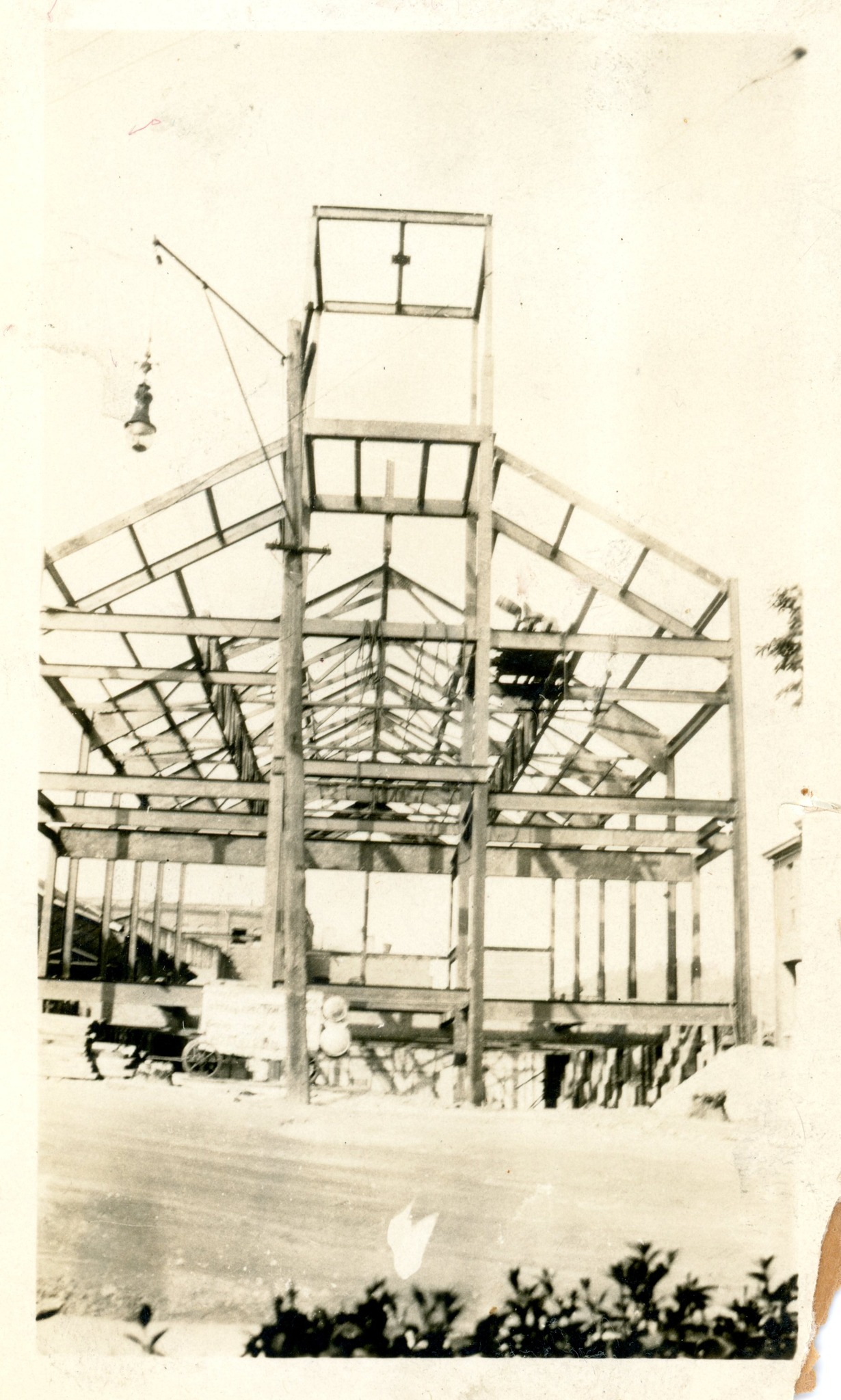
The Construction of Mary Queen of Peace Church — 1928–1929
The steel framework of the present Mary Queen of Peace Church rises on North Centre Street during construction. The photograph provides a rare view of the building’s structural frame, including the developing nave, roof structure, and bell tower. This photo captures an important moment in the creation of the new church that would be dedicated on August 25, 1929.
1929 — The New Mary Queen of Peace Church
The year 1929 stands as one of the most important in the history of Mary Queen of Peace. Less than a decade after Catholics in northern Pottsville began worshipping in a converted building on the former Seltzer property, the parish completed and dedicated the Spanish Mission-style church that still stands on North Centre Street today.
The achievement represented the culmination of years of rapid parish development. By June 1927, Mary Queen of Peace already had a rectory, convent, parochial school, temporary chapel, active parish societies, and a mission community at Mt. Laffee. The old chapel accommodated approximately 385 people, while plans were already being made to construct a permanent church between the rectory and convent.
Construction of the new church began in 1928. By December of that year, contemporary newspaper reporting indicated that the principal structure, including its floors, had been completed. Yet much remained to be done. Interior work continued, furnishings and devotional appointments were still arriving, the bell had not yet been placed in its tower, and the parish continued raising money for the building campaign.
During 1929, all of those pieces came together. The bell was blessed and raised. Cardinal Dennis Dougherty laid the cornerstone. The interior was completed and furnished. Bishop Gerald O’Hara solemnly dedicated the church. New devotional shrines were established. And before the year ended, the large social auditorium beneath the church had opened and was already drawing people from communities throughout the region.
Completing the New Church
The beginning of 1929 found Mary Queen of Peace still very much engaged in its building campaign. Fundraising resumed almost immediately after the holidays. Parish organizations, neighborhood groups, schoolchildren, and individual families continued the card parties, socials, and benefits that had helped finance construction during 1928. Weekly events commonly featured euchre, five hundred, bridge, refreshments, donated prizes, and dancing, with proceeds repeatedly identified as benefiting the church building fund.
The children of Mary Queen of Peace School participated directly. Different grades and school groups took turns sponsoring benefits, including a March card party organized by the fifth and sixth grades specifically for the building fund. By March 27, 1929, the Pottsville Republican described the new church as nearing completion. Stained-glass windows had already been presented to the parish, while Stations of the Cross and other furnishings were arriving from donors. Contemporary reporting praised the interior artwork and repeatedly credited the energy and leadership of Rev. George W. Shay, pastor of Mary Queen of Peace, with bringing the project toward completion.
One particularly notable feature of the new interior was its openness. Contemporary descriptions emphasized that the nave contained no columns or pillars obstructing the congregation’s view. The roof was instead carried by structural truss work, allowing an unobstructed view through the body of the church.
The new church was designed in the Spanish Mission style, with its stucco exterior, curvilinear parapets, prominent bell tower, and original clay-tile roof creating an architectural character quite different from the Gothic and Romanesque churches more commonly associated with northeastern Pennsylvania.
Yet the building was as much the work of the parish community as it was of its pastor, architect, or contractors. The surviving record repeatedly documents children raising money, families donating furnishings, parish societies organizing benefits, and Catholics from Pottsville and Mt. Laffee contributing to the effort.
The Mary Zachar Memorial Bell
Among the most enduring gifts to the new church was the bronze bell that remains in the tower today. In January 1929, Mary Zachar, wife of Andrew Zachar, died at Pottsville Hospital. Her funeral was held at Mary Queen of Peace, where a Solemn High Mass of Requiem was celebrated before her burial in St. Patrick’s Cemetery. Within months, the Zachar family made an extraordinary memorial gift to the new church.
Contemporary reports described the bell as weighing approximately 800 pounds and being composed of approximately 80 percent copper and 20 percent tin. It was cast in St. Louis, Missouri, consistent with the surviving bell’s identification with Stuckstede & Bro. of St. Louis.
By early April, the bell had arrived in Pottsville and was placed in the center of the main floor of the still-unfinished church. On Sunday, April 7, 1929, the bell was solemnly blessed by Father George W. Shay before being raised into the tower. Father Shay was assisted by Rev. Joseph Toye and Rev. John Foody, while Rev. Joseph Rhoades served as master of ceremonies. The children’s orchestra provided music for the ceremony.
The 1929 dedication history identifies the bell as a gift of Andrew Zachar and family, while contemporary newspaper reporting explains that it was presented in remembrance of the family’s mother, Mary Zachar. The bell survives as memorial to Mary Zachar today.
Cardinal Dougherty Lays the Cornerstone
Only four days after the bell blessing, Mary Queen of Peace reached another major milestone. On Thursday, April 11, 1929, Dennis Cardinal Dougherty, Archbishop of Philadelphia, came personally to Pottsville to lay the cornerstone of the new church.
The sequence was somewhat unusual. Much of the building had already been erected before the cornerstone ceremony. A formal laying had been contemplated during 1928, but Cardinal Dougherty had been unable to visit before winter. Construction therefore continued, with the ceremonial cornerstone rites postponed until the following spring. The cornerstone itself was donated by Philip Storch of Fishbach.
Cardinal Dougherty’s visit became a major parish occasion. Schoolchildren participated in the procession carrying American flags and wearing red, white, and blue bows. Clergy, parish societies, children, and members of the congregation gathered as the Cardinal performed the prescribed rites.
Newspaper coverage of the event also preserved an invaluable photograph of the newly constructed Mary Queen of Peace Church several months before its dedication.
The ceremony represented far more than another construction milestone. Less than ten years after the parish had begun organizing on the North Centre Street property, the Archbishop of Philadelphia had come personally to mark the establishment of its permanent church.
Worship Continued During Construction
Construction never brought the religious life of Mary Queen of Peace to a halt. During Lent, weekday Masses were celebrated in the early morning. Wednesday evenings included the Rosary, sermon, and Benediction, while Stations of the Cross were held on Fridays. Sunday devotions included Stations, the Novena to the Little Flower, Benediction of the Most Blessed Sacrament, and application of a relic of St. Thérèse of Lisieux.
Holy Week brought an extensive schedule of liturgies and devotions, including the Holy Thursday procession to the Repository and Adoration, the Good Friday rites and Stations of the Cross, and the traditional Holy Saturday blessing of the new fire, Paschal candle, and Easter water.
Mary Queen of Peace was also one of only three Pottsville Catholic churches designated during 1929 for the special church visits associated with the plenary indulgence granted in connection with the priestly jubilee of Pope Pius XI. These records show that even while the permanent church was being completed, Mary Queen of Peace already possessed an active and well-developed devotional life.
Mary Queen of Peace School
The parish school had likewise become a substantial institution by the time the new church was completed.
Only two years earlier, a parish history had reported that the school could accommodate approximately 300 children, with about 125 enrolled. Four Sisters Servants of the Immaculate Heart of Mary lived in the adjoining 18-room convent and taught in the school.
By the time of the 1929 dedication, enrollment had grown further. The school provided instruction through the eighth grade and had expanded its curriculum with a two-year Commercial Course. The Sisters Servants of the Immaculate Heart of Mary continued to direct the educational work of the parish.
The Commercial Course provides one of the clearest glimpses into school life during the dedication year.
On June 21, 1929, commencement exercises were held at Pottsville’s Moose Auditorium for six graduates:
Helen Anna Campbell
Catherine May Ryland
Margaret Cecilia Finnigan
Loretta Marie McGrath
John Norman Cappon
Thomas Joseph Snyder
The program included orchestral music, addresses, recitations, dramatic presentations, a class prayer, and a class song.
Thomas Snyder delivered the salutatory address, while Helen Campbell gave the valedictory address.
Rev. Joseph Hartley, who served Mary Queen of Peace during 1929 and was later explicitly identified in contemporary reporting as an assistant curate of the parish, addressed the graduates. His remarks emphasized the Catholic formation they had received and their continuing obligations to God, country, Church, and school.
The commencement demonstrates that Mary Queen of Peace’s educational mission extended beyond elementary instruction and that music, drama, and public performance were already significant elements of parish-school culture.
Little Flower Chapel at Mt. Laffee
The Catholic community at Mt. Laffee remained an integral part of Mary Queen of Peace throughout the decade. Before construction of a permanent chapel, Father Shay regularly traveled to Mt. Laffee to celebrate Sunday Mass in a local schoolhouse. The June 1927 parish history specifically counted the people of Mt. Laffee among the approximately 385 souls then belonging to Mary Queen of Peace Parish.
Rather than simply converting the old schoolhouse into a permanent chapel, the parish ultimately constructed a new and more substantial building: Little Flower Chapel, dedicated to St. Thérèse of Lisieux.
The new chapel was designed to serve both the spiritual and social needs of the Mt. Laffee community. Its Spanish Mission-influenced appearance complemented the architectural direction later used for the permanent Mary Queen of Peace Church in Pottsville. The building included a worship space, sacristies and choir accommodations, together with a lower-level social area.
By 1929, Little Flower possessed its own active Sodality, Sunday School, Mass schedule, and devotional life. Yet the mission was never isolated from the mother parish.
Mt. Laffee residents repeatedly traveled to North Centre Street for parish benefits, choir rehearsals, weddings, funerals, social events, and other activities. Children from Mary Queen of Peace and Little Flower would soon sing together for the dedication of the new church.
The relationship between the two communities was therefore both local and parish-wide: Little Flower had its own active identity while remaining firmly woven into the larger life of Mary Queen of Peace.
Preparing for the Dedication
By the summer of 1929, attention increasingly turned toward the formal dedication of the completed church. The date was set for August 25t, 1929. Preparations extended well beyond the clergy. During August, Mt. Laffee newspaper columns repeatedly recorded residents traveling to Mary Queen of Peace for choir practice. The reason soon became clear: the combined children’s choirs of Mary Queen of Peace Church and Little Flower Chapel were selected to provide music for the dedication Mass. Their director was Helen Little, who would become an increasingly prominent figure in the musical and cultural life of the parish. The participation of the two choirs together was particularly appropriate. The new church belonged not simply to Catholics living around North Centre Street, but to the wider parish community that included Mt. Laffee.
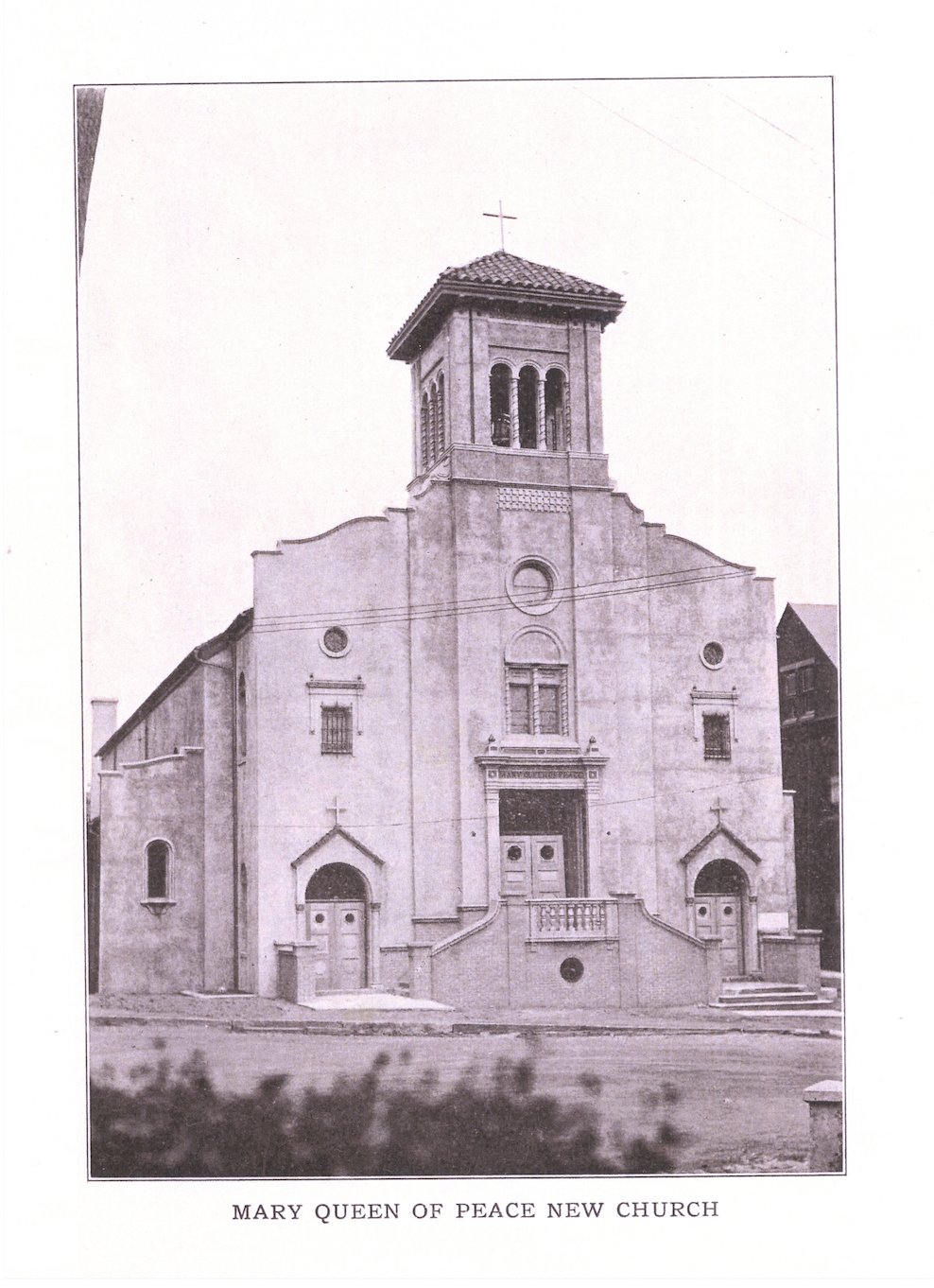
The New Mary Queen of Peace Church — 1929
An early photograph of the newly completed Mary Queen of Peace Church on North Centre Street in Pottsville, designed by architect George W. L. Dorsch in the distinctive Spanish Mission style. The photograph clearly shows the church’s original terracotta clay tile roof, bell tower, curvilinear parapets, and stucco façade—architectural features that gave the new church its distinctive character. Built to provide a permanent home for the growing parish community, the church was solemnly dedicated on August 25, 1929. The photograph was originally published with the caption “Mary Queen of Peace New Church” and preserves an important view of the building close to the time of its completion.
August 25, 1929 — The New Church Is Dedicated
Sunday, August 25, 1929, became one of the defining days in the history of Mary Queen of Peace. Most Rev. Gerald P. O’Hara, Auxiliary Bishop of Philadelphia, came to Pottsville to solemnly dedicate the new church. The visit was a major parish occasion. Bishop O’Hara was received by clergy and representatives of the parish before proceeding to Mary Queen of Peace, where hundreds of parishioners, visiting clergy, and guests gathered for the ceremonies.
At approximately 11:00 a.m., Bishop O’Hara solemnly dedicated the church. A Pontifical Mass followed. Rev. Patrick J. Dougherty of Heckscherville preached the sermon, while the combined children’s choirs of Mary Queen of Peace and Little Flower Chapel provided the music under Helen Little’s direction.
The dedication represented the culmination of years of work under Father George W. Shay, who had been appointed to take charge of the developing parish in 1920 and had guided its transformation from a temporary chapel into a substantial Catholic parish complex.
Contemporary accounts repeatedly praised Father Shay’s leadership. Yet those same records make clear how broadly the work had been shared. Children raised money. Parish societies organized benefits. Families donated furnishings. Volunteers staffed events. Mt. Laffee participated alongside Pottsville. The Zachar family gave the bell. Philip Storch donated the cornerstone. Friends of the parish provided devotional furnishings. The new church was therefore both the great undertaking of Father Shay and the collective achievement of the community he served.
A Parish-Wide Celebration
Dedication day did not end with the morning ceremonies. Former assistant Rev. Paul Lambert, who had served Mary Queen of Peace during its formative years, returned for the occasion and preached during evening devotions in the new church. His presence provided a direct link with the earlier chapel years and with the development of the parish’s strong devotion to St. Thérèse of Lisieux. Newspaper coverage from Mt. Laffee recorded numerous residents traveling to Pottsville for the dedication, while the combined choir gave the mission community an active role in the solemn liturgy itself. The dedication was therefore not simply the opening of a new building. It was the celebration of a parish community that had developed together during the preceding decade.
Furnishing the New Church
Even the August dedication did not mark the end of work on the church. Within weeks, additional devotional furnishings were being blessed and placed into use. By late September, newspaper reporting specifically identified two new shrines within the church: a shrine to St. Thérèse of Lisieux, the Little Flower and a shrine to the Poor Souls. Both were described as gifts from friends of the parish.
Their installation is important because the new church did not abandon the devotional traditions that had developed in the original chapel. Instead, those traditions were deliberately carried into the permanent building. Special Sunday devotions continued in honor of the Little Flower and the Souls in Purgatory, including prayers, sermons, Benediction of the Most Blessed Sacrament, and application of the Little Flower relic. A triduum was also held in preparation for the feast of St. Thérèse. The surroundings had changed dramatically, but the devotional identity of Mary Queen of Peace remained continuous with its earlier years.
The Building Fund Continues
Dedication also did not mean that every construction expense had been paid. In September, parishioners organized a three-night block party on the church and school grounds specifically for the church building fund. Additional benefits followed throughout the autumn.
Men of the parish hosted one event. Married women hosted another. School groups continued their participation, while the Blessed Virgin Mary Sodality maintained an extensive schedule of card parties and benefits.
The continuing building fund after August indicates that dedication marked the completion and opening of the church rather than the immediate end of every financial obligation associated with constructing and furnishing it. It also reveals something that appears throughout the surviving record of the 1920s: Mary Queen of Peace depended heavily upon organized lay participation.
Eight Bands of the Blessed Virgin Mary Sodality
By late 1929, the Blessed Virgin Mary Sodality had become one of the most visible organizations in parish life. Contemporary newspaper accounts document the Sodality operating through at least: Bands 1 through 8.
Individual bands took turns sponsoring weekly euchre, five hundred, and bridge parties. Reports frequently named substantial committees of women responsible for organizing the events, securing prizes, preparing refreshments, and maintaining an active parish social calendar. The eight-band structure demonstrates that the Sodality was not a small devotional circle but a large and formally organized component of Mary Queen of Peace.
Other activities were sponsored specifically by the men of the parish, married women, school groups, and other parish organizations. Together, they reveal a congregation whose lay members assumed considerable responsibility for fundraising, devotional activities, social life, and community building.
Life in the New Church
By autumn, the new church had settled into the regular rhythm of parish life. Sunday schedules commonly included Masses at 7:00 and 9:00 a.m., followed by Sunday School. Little Flower devotions and Benediction continued on Sundays, while Mt. Laffee maintained its own Sunday Mass and Sunday School.
In November, Mary Queen of Peace publicly invited visitors to see the newly completed church. Its doors were reported to be open daily from 6:00 A.M. until 7:00 P.M. The invitation is a small but revealing detail. The new Mary Queen of Peace was intended to be accessible not only during scheduled services, but throughout the day as a place of prayer and devotion.
The church also immediately became the setting for the ordinary milestones of parish life: baptisms, marriages, funerals, children’s activities, devotions, and community gatherings. In October, for example, the children of the parish were invited to a Halloween masquerade party. The building had quickly become more than a construction project. It was becoming home.
A New Dramatic Society
In November, another organization emerged that would demonstrate just how extensively the new parish complex had been designed for community use. Between 50 and 60 members of Mary Queen of Peace Parish attended a meeting to organize a new Dramatic Society. Its first officers were:
Helen Little — President
Thomas Sheehan — Vice President
Anna Brennan — Secretary
The Society immediately began preparing its first public performance. In announcing those plans, the newspaper provided an unusually valuable description of another part of the new church: "its lower-level auditorium could seat more than 700 people and contained spacious dressing rooms." That description makes clear that the social facilities beneath the sanctuary were not an afterthought. They formed a significant part of the building’s original design.
The New Social Hall Opens
Contemporary newspapers used several terms for the lower level of the church: the new church auditorium, new parish hall, hall under the church, and church social hall. Together, the reports establish both its location and its intended purpose.
The social hall formally opened on: December 9, 1929. The opening event included euchre, five hundred, bridge, prizes, an orchestra, and dancing. A contemporary article described it specifically as the opening of the new church social hall and stated that it was the first social event held in the new church hall.
The audience extended well beyond the immediate neighborhood. People came from Pottsville, Branchdale, New Philadelphia, Port Carbon, Schuylkill Haven, Heckscherville, and elsewhere. Mt. Laffee residents also traveled to Pottsville for the occasion.
Within only a week, another benefit card party was drawing players from Pottsville and surrounding communities to what the newspaper called the “new church auditorium of the Mary Queen of Peace Parish.”
The scale of the auditorium—more than 700 seats, dressing rooms, space for orchestras, dancing, theatrical performances, and large social gatherings—demonstrates that the 1929 Mary Queen of Peace building was conceived as more than a sanctuary above an incidental basement. The church itself was designed to support both sacred worship and community life.
The People Who Kept the Parish Running
The completed parish complex also required people whose work rarely appeared in ceremonial accounts. Among them was James Murray, a Nichols Street parishioner and skilled plumber who worked as janitor of Mary Queen of Peace. On December 4, 1929, Murray died suddenly while attending to the lighting in the lower level of the church. Father Shay discovered him after noticing that the basement lights remained burning. The newspaper explicitly identified Murray both as the church janitor and as a member of Mary Queen of Peace.
His High Mass of Requiem was celebrated at Mary Queen of Peace by Father Shay, with Rev. Joseph Hartley later officiating at the committal in St. Patrick’s Cemetery. Murray’s story provides an important reminder that the history of the new church belongs not only to bishops, priests, architects, and major donors, but also to the lay men and women whose everyday work maintained the parish.
Father Joseph Hartley
The closing weeks of 1929 also clarify the role of Rev. Joseph F. Hartley in the parish. Hartley appears repeatedly in the sacramental and educational life of Mary Queen of Peace during the year. He addressed the Commercial Course graduates, participated in funerals, and celebrated Masses at the church. A December newspaper article finally identifies his position explicitly: Assistant Curate at Mary Queen of Peace Church.
The same report provides an unusual glimpse into his earlier life. Hartley had served in the United States Navy, spending approximately 20 months in service before being released from active duty in September 1919. He later studied for the priesthood while remaining in the Naval Reserve until 1921. In December 1929, Pottsville’s American Legion selected him as its new chaplain.
Contemporary parish schedules also continued to identify Rev. Joseph Rhoades as a curate during portions of late 1929. The exact clerical arrangement has not yet been fully reconstructed, but the surviving record clearly establishes Hartley as an assistant curate actively serving Mary Queen of Peace by the end of the year.
The First Christmas in the New Church
Christmas 1929 marked another milestone: the first Christmas celebrated in the new Mary Queen of Peace Church. Christmas morning began extraordinarily early. A Solemn High Mass was celebrated at 5:00 a.m., followed by additional Masses at 6:00, 7:00, 8:00, and 9:00 a.m.Benediction of the Blessed Sacrament followed the final morning Mass. Little Flower Chapel at Mt. Laffee maintained its own Christmas schedule. Christmas hymns and carols accompanied its celebration, followed by Benediction.
The season also brought community activities for the children of Mary Queen of Peace School. Newspaper accounts record visits and Christmas programs involving Pottsville’s theaters, where schoolchildren received candy and toys and participated in holiday entertainment.
For parishioners who had spent years raising money, organizing benefits, watching the church rise from the ground, and witnessing its dedication only four months earlier, Christmas 1929 was the first opportunity to celebrate the Nativity in the permanent church they had worked to build.
The Auditorium Takes the Stage
The year ended with the parish putting another part of its new building fully to use. On December 30, 1929, the Mary Queen of Peace Dramatic Society made its first public appearance in the new church auditorium. A children’s matinee was presented during the afternoon, followed by the principal public performance that evening. Visitors came from Pottsville and neighboring communities, including Minersville, Heckscherville, and St. Clair.
The program included songs, choruses, instrumental performances, dancing, and comedy. Helen Little participated as pianist, while numerous parishioners and Mt. Laffee residents appeared in the program. The performance had been arranged and practiced under the direction of Father George W. Shay and M. M. Reddington.
The following day’s Pottsville Republican reported that the Dramatic Society had “scored” on its initial appearance and praised the performers as first-class entertainers. Before the evening ended, another social event had already been announced for January 1930. It was a fitting conclusion to an extraordinary year.
The Legacy of 1929
At the beginning of 1929, Mary Queen of Peace was still a parish in the midst of a building campaign. The walls of its new church stood on North Centre Street, but the bell had not yet been raised into the tower. The cornerstone had not been formally laid. Interior furnishings were still arriving. Parish organizations and schoolchildren were still raising money.
By the end of the year, nearly every part of the parish’s vision had become reality. The new Spanish Mission church stood prominently on North Centre Street. The Mary Zachar memorial bell sounded from its tower. Cardinal Dennis Dougherty had personally laid its cornerstone. Bishop Gerald O’Hara had solemnly dedicated its sanctuary. Stained-glass windows, Stations of the Cross, devotional shrines, and sacred furnishings filled its interior. Mary Queen of Peace School continued educating parish children and offered its Commercial Course. Little Flower Chapel remained an active extension of parish life at Mt. Laffee. Eight Sodality bands, parish groups, schoolchildren, choirs, and a new Dramatic Society filled the calendar with religious and community activity. And beneath the church, a social auditorium capable of accommodating more than 700 people had opened its doors to Pottsville and the surrounding region.
Only two years earlier, the June 1927 parish history had recorded that plans were being made for a new church to rise between the rectory and convent. In 1929, that plan became reality. Mary Queen of Peace had built more than a church. It had created a permanent home for the religious, educational, social, and cultural life of a Catholic community whose reach extended from North Centre Street and the neighborhoods of Pottsville to Mt. Laffee and communities throughout the surrounding region.
The church solemnly dedicated on August 25, 1929 is the Mary Queen of Peace that survives today—its bell still in the tower, its open nave still defined by the original structural design, and its sanctuary and parish spaces preserving the work of the community that built them nearly a century ago.
1930 — The First Full Year in the New Church
Mary Queen of Peace entered 1930 only a few months after the dedication of its new church on North Centre Street. The great building campaign of 1928–1929 had produced far more than a larger sanctuary. During the first full year in the new building, contemporary newspaper accounts show a remarkably active parish whose religious, educational, social, and cultural life extended throughout the entire complex and outward into the surrounding neighborhoods of northern Pottsville and the mission community at Mt. Laffee.
Fundraising for the recently completed church continued into the new year, but parish life was already expanding well beyond construction. Masses and devotions filled the church above, Mary Queen of Peace School remained active beside it, and the large auditorium beneath the church quickly became one of the principal gathering places of the parish.
Life in the New Parish Auditorium
The new auditorium had opened only weeks before 1930 began, yet it immediately became a center of parish activity. The Mary Queen of Peace Dramatic Society repeated its first theatrical production in January after the original December performance generated sufficient interest for another showing. Dances, card parties, school events, parish fundraisers, and other gatherings followed in rapid succession.
By February, newspaper reports were still describing card parties and other events as benefits for the church building fund, showing that the August 1929 dedication had not marked the end of the parish’s financial campaign. Residents of different neighborhoods, schoolchildren, parish societies, men and women of the parish, and the Mt. Laffee community all participated in raising funds. The effort that had physically built the new church continued as a broad community undertaking after its doors had opened.
The parish school itself demonstrated the scale of the new social space on April 28, when the fourth annual musicale of the Mary Queen of Peace pupils drew a reported crowd of more than 800 people to the new auditorium. The program was prepared under the direction of the Sisters of the Immaculate Heart of Mary and featured music, dramatic presentations, and performances by parish-school pupils. The extraordinary attendance provides some of the clearest contemporary evidence that the large lower level of the church was functioning from the beginning as an important parish and community assembly space.
The First Lent in the New Church
The first Lenten season celebrated in the new church brought an intensive period of religious activity.
In March, Mary Queen of Peace hosted a two-week parish mission, with the first week devoted to the women of the parish and the second to the men. The mission was conducted by Father John McGarrity, a Paulist priest from New York City. Daily exercises included several early-morning Masses as well as evening Rosary, sermon, and Benediction. Contemporary reports show that the mission drew participation not only from Pottsville but also from the Mt. Laffee portion of the parish, where newspapers reported that large numbers of men traveled to Mary Queen of Peace for the services.
The mission illustrates an important side of the parish that can easily be obscured by the many newspaper reports of dances and card parties. The social life of the new building was extraordinarily active, but so too was its devotional life. Lent brought missions, Stations, Rosary, Benediction, confessions, and the regular sacramental life of the parish.
Holy Week followed in April. On Holy Thursday, Mary Queen of Peace celebrated High Mass with a procession of the parish children, continuing traditions already documented in the former chapel. The 1930 observances were the first Holy Week and Easter celebrated in the newly dedicated church.
Mary Queen of Peace School
The parish school remained a central institution during 1930. The Sisters of the Immaculate Heart of Mary continued both academic instruction and religious formation. In May, children preparing for First Holy Communion were described as having been trained under the Sisters’ direction. The communicants assembled at the school before processing to the church with the other schoolchildren.
The school continued through the eighth grade while also maintaining its Commercial Class, a program distinct enough that a November newspaper notice specifically referred to the children of the eighth grade and those of the Commercial Class holding a Harvest Party together in the school building.
These references strengthen the picture established by the 1929 Commercial Course graduation: Mary Queen of Peace was providing not only the regular elementary grades but also additional practical commercial education for older pupils.
Corpus Christi Across the Parish Grounds
One of the most revealing religious events of the year came in June. For the Feast of Corpus Christi, Mary Queen of Peace planned a Procession of the Most Blessed Sacrament in which all members of the parish were invited to participate. Hymns to the Holy Eucharist accompanied the procession, while temporary altars decorated with flowers and candles were prepared at three stations: the cemetery, the school portico, and the church.
The newly arrived curate, Father Gaffney, assisted Father Shay in arranging the ceremony. Mary Queen of Peace extended beyond the walls of the church itself. The church, cemetery, school, and surrounding grounds together formed a sacred parish landscape through which the Eucharistic procession moved.
A Change in Parish Clergy
The summer brought an important clergy transition. Rev. Joseph F. Hartley, who had served as assistant rector of Mary Queen of Peace for approximately a year, was transferred from the parish on June 6, 1930, to the Church of the Immaculate Conception in Allentown. During his time in Pottsville, Hartley had also served as chaplain of the Robert Woodbury Post of the American Legion, participating in the city’s Memorial Day observances. Later that summer he was reassigned from Allentown to SS. Simon and Jude in Bethlehem.
Hartley was succeeded by Rev. James J. Gaffney, who appears in the newspapers variously as curate, assistant rector, assistant, and assistant pastor. Gaffney quickly became deeply involved in parish life. He celebrated baptisms and funerals, preached both at Mary Queen of Peace and neighboring parishes, supervised major parish events, helped organize the annual block party, and later coached the parish Dramatic Society. By December, when Father Shay left for an extended period of rest in California, Gaffney was explicitly entrusted with attending to the business of the parish.
Devotion to St. Anne
The summer also reveals another important element of the church’s early devotional life. In July, Mary Queen of Peace held a three-day period of prayer in preparation for the Feast of St. Anne, with early Masses and evening devotions. Father Shay had recently returned from a visit to a shrine of St. Anne in Quebec and brought back a supply of St. Anne oil, which was used in connection with the devotions.
The same newspaper report records that Mary Queen of Peace possessed a dedicated Shrine of St. Anne, donated by George Haring, a theatre owner associated with Shamokin, Tamaqua, and Pottsville. This adds another identifiable original shrine to the interior of the new church and provides a valuable lead for determining whether portions of the 1929–1930 devotional furnishings survive today.
Mary Queen of Peace and Little Flower Chapel
Throughout 1930, newspaper reports repeatedly demonstrate that Little Flower Chapel at Mt. Laffee was not a separate parish, but the mission chapel serving the Mt. Laffee portion of Mary Queen of Peace Parish. Mt. Laffee residents traveled regularly to North Centre Street for parish card parties, plays, missions, funerals, and other events. Children from Mt. Laffee were among those receiving First Communion at Mary Queen of Peace. Conversely, the Mt. Laffee community held its own events to benefit the Mary Queen of Peace church fund.
The relationship is made especially clear by several obituaries. James Loftus, a Mt. Laffee resident, was explicitly described as a member of Mary Queen of Peace Church. Later in the year, lifelong Mt. Laffee resident Elizabeth Brennan was likewise identified as a member of Mary Queen of Peace. Feast-day schedules reinforce the same structure. For the Assumption in August, Masses were celebrated at the main church in Pottsville while another Mass was celebrated at the chapel in Mt. Laffee.
The Little Flower building also mirrored the social function of the mother church. In December, a card party was held in the basement of the chapel at Mt. Laffee, confirming that the mission chapel’s lower level was being used for community gatherings just as the large auditorium beneath Mary Queen of Peace served the Pottsville congregation.
The B.V.M. Sodality
The Blessed Virgin Mary Sodality remained one of the parish’s most visible organizations. Its annual summer picnic at Moffitt’s Grove brought together Father Shay, Father Gaffney, young women of the parish, and other parish participants for games, singing, dancing, and fellowship. Many names found in the picnic roster also appear in earlier Sodality bands and parish organizational activities.
The Sodality was not merely an inherited organization from the original chapel years. Newspaper reports late in 1930 indicate that receptions of new members continued to be part of parish life, showing an organization still actively renewing itself.
The Annual Block Party
Father Gaffney assumed responsibility for one of his first large parish undertakings when the annual Mary Queen of Peace block party was scheduled for September 4–6. Planning meetings were held in the church hall, committees were appointed, and parishioners were invited to help make the event a success. The festivities took place on the church grounds and included outdoor amusements, refreshments, and a card party in the basement. The Republican reported after the opening night that the block party had already proven a “big success.”
For a parish that had only recently completed a major construction campaign, the block party and similar events served more than a fundraising purpose. They brought together parishioners, friends, neighboring communities, and families around the new church complex.
The Little Flower Devotion
Perhaps the most distinctive devotional discovery from 1930 concerns St. Thérèse of Lisieux, the Little Flower. Mary Queen of Peace had cultivated devotion to St. Thérèse for several years, and Little Flower Chapel at Mt. Laffee had already taken her popular title as its dedication. In September 1930, a novena to St. Thérèse was held nightly at the main church, with the application of a relic during each devotion. The newspaper then made a remarkable statement about the shrine inside Mary Queen of Peace: the shrine “has no counterpart in this country.” The article described the shrine as the gift of several devoted supporters of St. Thérèse.
Taken together with the 1929 report that a new St. Thérèse shrine had been erected in the church, this suggests that the Little Flower devotion was one of the defining devotional features of early Mary Queen of Peace. The precise meaning of the newspaper’s claim that the shrine had “no counterpart” remains to be determined, but the description makes its original design and possible survival an important subject for further preservation research.
A Parish Organized by Neighborhood
One of the most revealing patterns of the year appears in the parish’s weekly card-party series. Rather than relying on a single centralized committee, Mary Queen of Peace rotated responsibility among groups of parishioners organized by the streets and neighborhoods in which they lived.
During the fall, contemporary reports identify events sponsored by parish members from:
- Railroad and Peacock Streets
- Nichols Street, Mamie’s Avenue, Mill Creek Avenue, and Louise Avenue
- North Centre Street
- Jalappa
- New Street
For example, a November notice explicitly stated that “members of Mary Queen of Peace Parish living on Centre Street” would host the next card party in the parish auditorium. Later, a Jalappa event was described as being conducted by members of the parish living in Jalappa, and the next event was assigned to the New Street group. On December 3, another notice explicitly described the girls of New Street as members of Mary Queen of Peace Parish.
These articles provide an unusually vivid picture of the social geography of Mary Queen of Peace. The neighborhoods named in the card-party rotation closely reflect the areas the parish had originally been created to serve.
The Mary Queen of Peace Players
The parish’s theatrical organization became one of its most visible cultural activities during 1930. In March, the Dramatic Society presented the three-act comedy The Egotist. The initial performance drew a crowded house and received favorable newspaper reviews. Demand was sufficient for repeat performances, and the production was even taken outside Pottsville for a performance in Hamburg.
By November, the organization—referred to variously as the Mary Queen of Peace Dramatic Society, Dramatic Club, and Mary Queen of Peace Players—was preparing another three-act comedy, The Patsy.
The cast included returning performers Gladys Bratsch, Martha Marrah, Margaret Curran, Catherine Hyland, Andrew Campion, Leo Keller, John Grace, and William Orff. Several were connected with the Mt. Laffee community, again demonstrating the integration of the mission with parish cultural life.
Father Gaffney personally coached the group through weeks of rehearsals.
When The Patsy was presented on November 24, the parish auditorium was reported to have been “packed to the doors.” The audience included clergy and visitors from surrounding communities, and the cast presented Father Gaffney with a large basket of flowers in appreciation of his work. Popular demand led immediately to plans for another performance.
The Players provide perhaps the clearest example of how the new auditorium fulfilled the purpose envisioned when it was incorporated into the 1929 church. It was not simply a basement meeting room; it functioned as a large parish cultural venue from the building’s earliest months.
Parishioners Across the Community
The year’s obituaries, funerals, baptisms, weddings, and social reports also allow individual members of the early congregation to emerge from the record.
Among those explicitly identified in 1930 as members of Mary Queen of Peace were Frank P. Meyer of North Centre Street; Mary Eagan, a longtime Fishbach-area resident; Mary A. Groody; James Loftus of Mt. Laffee; Mary Thomas Eagan of Mt. Laffee; Edward J. Hanney; Mary Ann Quinn Morgan of North Centre Street; Elizabeth Brennan of New Street, Mt. Laffee; and James Ryan of North Centre Street, a Spanish-American War veteran. These records demonstrate that the parish drew together families from North Centre and Nichols Streets, Fishbach, Jalappa, New Street, Mt. Laffee, and surrounding communities.
The growing collection of documented addresses also reveals just how heavily the immediate North Centre Street neighborhood was represented in the congregation.
Father Shay Leaves for California
The year ended with an unusual change in routine for the founding pastor. On December 3, Father George W. Shay left Pottsville for an extended period of rest and a visit with family in California. Father James Gaffney was left responsible for parish business, while another priest was expected to assist with Sunday Masses during Shay’s absence.
Later in December, Pottsville newspapers reported that Shay was making part of the journey aboard the steamship President Johnson of the Dollar Line, traveling toward Los Angeles by way of the Panama Canal. The trip was expected to take approximately fourteen days.
While Shay traveled west, parish life continued under Gaffney. On December 27, Gaffney celebrated the Requiem Mass of confirmed parishioner James Ryan of 626 North Centre Street, preached the sermon, and performed the absolution.
A Parish Fully Established
If 1929 was the year Mary Queen of Peace completed and dedicated its permanent church, 1930 was the year the parish fully inhabited it. The new sanctuary became the setting for missions, processions, novenas, First Communions, weddings, baptisms, funerals, and an active cycle of Catholic devotions. The IHM Sisters continued the educational mission of the parish school. The B.V.M. Sodality and neighborhood groups organized parish life. The auditorium beneath the church welcomed crowds numbering in the hundreds for music, theater, dances, card parties, and community gatherings. Little Flower Chapel remained closely integrated with the mother parish, both religiously and socially.
Perhaps most revealing is the way the newspaper record repeatedly moves between church, school, auditorium, cemetery, parish grounds, neighborhoods, and Mt. Laffee.
1931 — A Parish Coming Into Its Own
Only two years after the dedication of the new Mary Queen of Peace Church, the parish had settled into an active rhythm of worship, education, devotion, and community life. Father George W. Shay continued as pastor, assisted during the year by Father James J. Gaffney, while the parish school, B.V.M. Sodality, Holy Name Society, Little Flower Chapel at Mt. Laffee, and numerous parish activities filled the calendar.
The newspaper record from 1931 reveals a parish whose influence was also extending beyond its own boundaries. Mary Queen of Peace hosted gatherings of major Catholic organizations, its priests participated prominently in the religious and civic life of Pottsville, and the church and its large lower hall increasingly served as gathering places for the wider Catholic community.
The Parish School
Mary Queen of Peace School remained one of the centers of parish life. When the 1931–32 school year opened on September 8, the children assembled at the school at 8:00 a.m. and proceeded together to Mass, celebrated by Father Shay. Following Mass, Father Shay addressed the students before they returned to the school, where 136 children—73 boys and 63 girls—answered the opening roll call. The first week consisted of half-day sessions before the regular schedule resumed.
The enrollment provides an important snapshot of the school during the early years of the new church. Earlier parish records had reported approximately 125 pupils in 1927, illustrating the substantial educational community that Mary Queen of Peace maintained alongside its parish church and Mt. Laffee mission.
The school year was closely intertwined with the sacramental life of the parish. On December 8, the Feast of the Immaculate Conception, a group of parish children received their First Holy Communion during a special 9:00 a.m. Mass celebrated by Father Gaffney.
An Active Devotional Life
The religious calendar at Mary Queen of Peace extended far beyond Sunday Mass. Throughout 1931, newspaper notices documented an extensive cycle of seasonal devotions, including Stations of the Cross and Lenten exercises, Marian observances, Benediction, novenas, prayers for the dead, and special feast-day services.
The parish’s devotion to St. Thérèse of Lisieux—the Little Flower remained particularly prominent. During the fall, a nine-day novena brought worshippers to Mary Queen of Peace each evening for the Rosary, Litany of the Little Flower, a sermon, and Benediction of the Most Blessed Sacrament.
A particularly important newspaper account also identifies the object used for one of the parish’s longstanding devotional practices: a relic of St. Thérèse that had been given to Father Shay by a friend in Rome. The relic was exposed for veneration following the novena services. This provides a direct historical link to the Little Flower devotion that had already become deeply rooted at Mary Queen of Peace during the 1920s.
October was also observed as the Month of the Rosary. Two weekday Masses were celebrated at 6:30 and 8:00 each morning, with the Rosary and Litany of the Blessed Virgin recited during the later Mass.
In November, Sunday afternoon Little Flower devotions continued at Mary Queen of Peace, followed by Benediction. During the month traditionally devoted to prayer for the faithful departed, Stations of the Cross were offered in memory of the dead.
The parish also observed other devotions that have largely disappeared from ordinary parish life today. On the feast of St. Ann in July, special evening devotions concluded with the faithful being anointed with oil associated with a St. Ann shrine.
Together, these notices preserve an unusually detailed picture of the devotional culture that shaped daily Catholic life at Mary Queen of Peace.
Little Flower Chapel at Mt. Laffee
Little Flower Chapel remained an integral part of Mary Queen of Peace Parish throughout 1931. The usual Sunday schedule placed Mass at Mary Queen of Peace at 7:00 and 9:00 a.m., with Mass at Little Flower between them at 8:00 a.m. Sunday School also accompanied the mission’s religious life.
One particularly useful newspaper account describes a card party held in the “auditorium underneath the chapel of the Mary Queen of Peace Parish, in Mt. Laffee.” The article further states that these gatherings were held semi-monthly.
That description provides important evidence about how Little Flower functioned. Like the main Mary Queen of Peace Church, the mission chapel combined sacred and community space: worship took place above, while an auditorium below accommodated regular social activities.
Contemporary newspapers occasionally described the mission in standardized service listings as the “Little Flower Chapel at Fishbach.” Other articles, however—including one appearing in the very same newspaper issue—explicitly place Mary Queen of Peace’s chapel at Mt. Laffee. The varying terminology therefore appears to reflect contemporary local geographic usage rather than the existence of two separate Little Flower chapels.
Parish Societies
Mary Queen of Peace’s lay organizations remained exceptionally active. The B.V.M. Sodality, already documented in parish records during the 1920s, continued to operate through its established system of numbered bands. During the fall and winter, different bands took turns sponsoring parish-hall activities. Contemporary notices identify women such as Mamie Brown, Margaret Bergen, Georgine Young, and Margaret Sheehan in leadership roles as band counselors.
The Holy Name Society was likewise active. This is particularly important because a much later parish account remembered Mary Queen of Peace’s Holy Name Society as one of the oldest in the Diocese of Allentown. The early parish history already documents the society by June 1927, and the 1931 newspapers provide direct evidence of its continuing activity.
In November, Father Gaffney and committees composed of Holy Name Society members organized the parish’s annual turkey euchre. The event was described as an established parish custom held shortly before Thanksgiving, with turkeys awarded as prizes for the holiday table. Another contemporary report called it the largest parish social event of the year.
The surviving committee lists reveal the lay leadership behind these events, including Albert Bigler, Albert Ney, Edward Curran, Andrew Campion, John Ackerman, Michael McAnulty, John Grace, Patrick Eagan, Leo Keller, Timothy Sheehan, George Schaeffer, Daniel Kelly, P. Haverty, and Vincent Haverty.
These names, together with the women leading the B.V.M. Sodality, provide a rare glimpse of the parishioners who sustained Mary Queen of Peace’s organizations during the early 1930s.
A Parish Hall Filled With Activity
The spacious hall beneath the new church was already fulfilling the purpose envisioned when the building was constructed. Card parties, dances, Sodality gatherings, children’s activities, and larger parish events occurred throughout the year. A three-night block party on North Centre Street from July 27–29 included dancing, derby races, and cards and was explicitly described as being sponsored by members of Mary Queen of Peace Parish.
In the fall, the B.V.M. Sodality resumed its established winter series of card parties. Parish children also gathered in the hall for a Halloween masquerade, continuing a children’s tradition already documented at Mary Queen of Peace in 1929.
These activities were more than incidental entertainment. They provided a regular meeting place for parish families and helped sustain the dense network of religious societies, school families, and neighborhood relationships that surrounded the church.
Serving Pottsville’s Wider Catholic Community
By 1931, the new Mary Queen of Peace complex was also being used by Catholic organizations extending well beyond the parish. Father James J. Gaffney, who served Mary Queen of Peace as assistant or curate, was chaplain to the Santa Maria Court of the Catholic Daughters of America and was also associated with its large Junior Court.
In September, approximately 25 women were formally received into the Catholic Daughters during initiation ceremonies held in the Mary Queen of Peace parish hall. Both Father Gaffney and Father Shay addressed those gathered.
The following month, the Catholic Daughters assembled at Mary Queen of Peace for their annual corporate Communion. Father Gaffney celebrated Mass, with Father Shay present in the sanctuary, before the women proceeded together to the Necho Allen Hotel for their Communion Breakfast. Father Shay later served as toastmaster.
In November, Mary Queen of Peace welcomed another major Catholic organization. Approximately 120 members of Schuylkill Council No. 431, Knights of Columbus, attended a special 8:00 a.m. Mass celebrated by Father Shay before proceeding to their annual fall Communion Breakfast.
Only two years after its dedication, Mary Queen of Peace had therefore become more than a neighborhood church. Its sanctuary and hall were serving the broader Catholic community of Pottsville and the surrounding region.
Father Shay and Father Gaffney
The newspapers also reveal considerably more about the two priests serving the parish. Father George W. Shay, who had led Mary Queen of Peace since its formative years, remained pastor. His activities extended well beyond the parish campus. In September, he was among the speakers selected for the reunion of veterans of the 48th Pennsylvania Volunteer Infantry, appearing on the program alongside civic and military leaders. His participation illustrates the place he had acquired in the wider public life of Pottsville.
Father James J. Gaffney emerges from the 1931 record as an especially active curate. In addition to celebrating parish Masses, he baptized children, celebrated Requiem Masses, preached funeral sermons, assisted with parish societies, celebrated the children’s First Communion Mass, served as Catholic Daughters chaplain, and was invited to preach at religious observances elsewhere in Pottsville.
Together, Shay and Gaffney ministered not only to the congregation at North Centre Street but also to the Mt. Laffee mission and to the broader Catholic community.
The People of the Parish
The 1931 newspapers also allow some of the people behind the institutions to emerge more clearly.
Among those explicitly identified as members of Mary Queen of Peace was Lawrence Bridi, of 443 Nichols Street, whose children appear to connect his household with the parish school and other parish activities.
Mary (Quinn) Leibel, a lifelong Pottsville resident, was likewise explicitly identified as a member of Mary Queen of Peace. Her daughter Anna appears independently in parish organizational records.
Later in the year, Carrie (Kull) McGovern, of New Street, was described not only as a member of Mary Queen of Peace but as a member of “its societies.” Her large family and the Curran, McGovern, Little, Brennan, and other families appearing repeatedly in parish records illustrate the interconnected Catholic community of North Pottsville, New Street, and Mt. Laffee.
Funerals, baptisms, school events, society activities, and social gatherings increasingly allow the early parish to be reconstructed not simply as an institution, but as a community of families.
Christmas at Mary Queen of Peace
The year ended with Christmas celebrated at both Mary Queen of Peace and Mt. Laffee. On Christmas morning, Mary Queen of Peace offered Masses at 5:00, 7:00, and 9:00 a.m. The first was a Solemn Mass, while the 9:00 High Mass was followed by Benediction of the Most Blessed Sacrament. At Mt. Laffee, the Little Flower community began Christmas morning with its own 5:00 a.m. Mass. The schedule provides a fitting conclusion to the year: two worshipping communities, centered on the church at North Centre Street and its mission at Mt. Laffee, celebrating together as one parish.
Looking Back on 1931
By the close of 1931, Mary Queen of Peace had clearly moved beyond the intense years of property acquisition, construction, and expansion that characterized the 1920s. The church dedicated in 1929 was now supporting a mature network of worship, education, societies, charitable activity, social life, and regional Catholic gatherings.
The parish school educated more than a hundred children. Little Flower remained active at Mt. Laffee. The B.V.M. Sodality and Holy Name Society provided structured lay leadership. The lower halls of both Mary Queen of Peace and Little Flower brought families together. Father Shay and Father Gaffney maintained an extensive sacramental and devotional calendar, while the church itself welcomed Catholic organizations from throughout the area.
Perhaps most importantly, the newspaper record preserves the names of the people who made that life possible.
1932-1939: Depression-Era Parish Life and Endurance
The 1930s marked the first full decade following the dedication of the present Mary Queen of Peace Church in August 1929. Entering the new decade, the parish possessed a complete Catholic campus that included its church, rectory, convent, parish school, and mission chapel at Mt. Laffee. Built through years of sacrifice and generosity, these buildings now became the foundation of parish life during one of the most difficult economic periods in American history.
Only weeks after the church’s dedication, the stock market crash of October 1929 ushered in the Great Depression. Like communities throughout Schuylkill County and the broader Anthracite Coal Region, the families of Mary Queen of Peace faced unemployment, financial uncertainty, and the challenges of providing for their households. A later parish anniversary history recalls that the Depression placed a heavy burden on the parish as it struggled to maintain its buildings while continuing to meet the financial obligations incurred during its years of rapid growth. At the same time, parishioners were making their own sacrifices to support their families while remaining faithful to their church.
The economic hardships of the decade also affected the community’s population. According to the anniversary history, many younger families and young adults left the Pottsville area in search of employment elsewhere. This migration reflected a broader demographic shift throughout the Coal Region and gradually reduced the number of parishioners who had formed the parish during its earliest years.
Despite these challenges, the religious life of Mary Queen of Peace continued. The Holy Sacrifice of the Mass, the celebration of the sacraments, Catholic education, and parish devotions remained at the heart of parish life. The parish school, staffed by the Sisters, Servants of the Immaculate Heart of Mary, continued to educate the children of the parish, while established organizations such as the Blessed Virgin Mary Sodality, the Altar and Rosary Society, and the Holy Name Society provided opportunities for prayer, fellowship, and service. Although relatively few surviving records presently document the daily activities of the parish during the 1930s, these organizations almost certainly remained important expressions of Catholic life within the community.
Photographs surviving from the late 1930s provide valuable glimpses into parish life during this period. Images of schoolchildren, the IHM Sisters, First Holy Communion classes, parish gatherings, and devotional celebrations help preserve aspects of everyday Catholic life that are only briefly mentioned in written histories. As additional photographs and documents become available, they will continue to enrich our understanding of this important decade.
Viewed in retrospect, the 1930s were a decade not of expansion but of perseverance. Having completed the remarkable work of establishing a parish campus during the previous decade, Mary Queen of Peace now demonstrated its resilience by sustaining its spiritual, educational, and communal life through the hardships of the Great Depression. The parish emerged from the decade with its Catholic identity intact, prepared to face the opportunities and challenges that would accompany the years ahead.
1940s: War, Sacrifice, and Changing Community
The 1940s brought both sacrifice and profound change to Mary Queen of Peace. The later parish anniversary history recalls that, just as the worst years of the Great Depression appeared to be passing, the United States entered the Second World War and young men of the parish joined millions of Americans in military service. The war reached directly into parish families as sons, brothers, husbands, and former schoolchildren entered the armed forces. Some never returned, while others eventually settled elsewhere as new opportunities opened beyond the Coal Region.
Contemporary records preserve some of the individual stories behind that larger experience. In November 1943, Mary Queen of Peace offered a memorial Mass for Lt. John E. Young, a local Army Air Forces officer who had been killed while flying a bombing mission over Germany. The newspaper reported that the church was well filled with members of his family, friends, and parishioners. Rev. George W. Shay, the founding pastor of Mary Queen of Peace, celebrated the Mass, while Rev. John V. Brogan, then pastor of the parish, was among the clergy present. The church choir, under the direction of Virginia Moser, provided the music.
Father Shay also preached the sermon. The newspaper recalled that he had known Young as a boy and spoke of his service and sacrifice. The account noted the longstanding connection of the Young family with Mary Queen of Peace, including the involvement of his father and grandfather in the parish. The memorial Mass provides a poignant contemporary glimpse of how the war was experienced at the parish level: not simply as a distant national conflict, but through the loss of young men known personally by the priests, families, and people who filled the pews of Mary Queen of Peace.
Among the other servicemen connected to Mary Queen of Peace was George Burck Roth. A surviving program from the 1946 Good Will Fire Company No. 4 Veterans Home Coming Celebration identifies Roth, born in St. Clair in 1918, as a graduate of the eighth grade at Mary Queen of Peace Parochial School. According to the program, he entered military service in March 1942, trained at Camp Chaffee, Arkansas, went overseas in February 1944, crossed the English Channel that June, and was killed during operations in France on August 8, 1944. His story provides another personal connection between Mary Queen of Peace and the sacrifices made by local families during World War II.
The surviving records of Young and Roth should not be understood as a complete accounting of Mary Queen of Peace parishioners who served or died during the war. Rather, they are two individuals whose connections to the parish can presently be documented from surviving sources. Further research may identify additional parishioners among the many men and women from Pottsville who entered military service during the conflict.
Parish Life During the War
Despite wartime uncertainty and the absence of many young parishioners serving in the armed forces, Mary Queen of Peace continued its sacramental, devotional, educational, and charitable life. The memorial Mass for Lieutenant Young illustrates the role the parish church played in helping families and the wider community confront wartime loss. It also reveals continuity with the parish’s earliest years: Father George W. Shay, who had organized Mary Queen of Peace more than two decades earlier, returned to the altar of the church he had helped establish to offer Mass and preach for a young man he had known since childhood.
Other Catholic newspaper references from the decade document the parish’s continuing sacramental and institutional activity. A 1946 notice records a Solemn Requiem Mass celebrated at Mary Queen of Peace by Father Donnelly, while other mid-1940s references place the parish among Catholic mission and Holy Land collection reports. Although brief, these contemporary notices demonstrate Mary Queen of Peace’s continuing participation in the wider spiritual and charitable work of the Church.
The parish school and convent likewise remained important parts of life at Mary Queen of Peace. Later memories and surviving photographs portray a community shaped by schoolchildren, religious sisters, Catholic education, parish devotions, sacramental milestones, and the close relationships characteristic of neighborhood parish life. The connection between school and parish can also be seen in the military record: George Burck Roth was remembered specifically as an eighth-grade graduate of Mary Queen of Peace Parochial School before eventually entering military service.
From War to Peace
The end of the war brought celebration, remembrance, and the return of servicemen to Pottsville. On November 7, 1946, the Good Will Fire Company No. 4 held a Veterans Home Coming Celebration honoring local men who had served. The evening included prayer, dinner, remarks, presentation of gifts to returning veterans, and entertainment. Rev. John V. Brogan, Rector of Mary Queen of Peace Church, delivered the benediction. The same surviving program memorialized George Burck Roth and recorded his connection to Mary Queen of Peace School.
For parish families, however, the transition from war to peace was accompanied by broader economic and demographic change. The later parish anniversary history notes that coal, long the dominant industry of the region, declined in popularity as a fuel after the war. Increasingly, parish breadwinners traveled outside the immediate area for employment in industrial plants and construction trades. Some younger families left the region altogether as opportunities emerged elsewhere, beginning population shifts that would influence Mary Queen of Peace and other Coal Region parishes in the decades ahead.
The 1940s therefore stand as a decade of both continuity and transition. Mary Queen of Peace continued its mission through the Holy Sacrifice of the Mass, Catholic education, prayer, charitable support, and community involvement while its families experienced the extraordinary demands of wartime and the economic changes that followed. Contemporary accounts such as the memorial Mass for Lt. John E. Young and the surviving record of George Burck Roth preserve individual faces within that larger history—young men whose lives connected a neighborhood parish in North Pottsville to the worldwide conflict that defined their generation.
1950s: School, Devotions, and Mid-Century Parish Life
The 1950s appear to have been a strong school and parish-family decade for Mary Queen of Peace. Although fewer complete parish records from this period are presently available, public references, later anniversary histories, photographs, and parish memories point to a community centered on worship, Catholic education, devotional life, and family formation.
Father John V. Brogan is documented in connection with Mary Queen of Peace during the mid-1950s. A 1954 Catholic newspaper reference places him among clergy present at the groundbreaking for Pottsville Area Central High School, and a 1955 reference notes his transfer from Mary Queen of Peace to St. Peter’s in Reading. These references help establish the parish’s pastoral leadership during the decade and provide useful research leads for diocesan directories and Catholic newspaper records.
The parish school remained a central part of Mary Queen of Peace’s identity during the 1950s. The school had been established in the 1920s under the Sisters, Servants of the Immaculate Heart of Mary, and by the mid-twentieth century it continued to shape the daily life of parish families. Later parish memories and images preserve the world of schoolchildren, sisters, First Communion classes, May Processions, school music, and devotional activity. These records suggest that the school functioned not only as an educational institution but also as one of the main ways children and families were formed in the parish’s Catholic life.
The devotional culture of the period is especially important. May Processions, First Communion classes, and school-related religious observances reflected the broader Catholic parish life of the era. These practices connected the parish school, the church sanctuary, the sisters, clergy, parents, and children into a shared rhythm of worship and community identity.
The 1950s also came near the end of the period when Mary Queen of Peace still had fuller staffing and a broader parish-campus structure. The later anniversary history notes that in 1957 the parish was informed that a full-time assistant priest would no longer be available. Father William J. Cox was identified as the last full-time assistant pastor, leaving Mary Queen of Peace in May 1957. After that point, weekend assistance was provided by educator-priests, first from other diocesan schools and later from priests assigned to Nativity B.V.M. High School.
This change marked an important turning point. It did not end parish life, but it foreshadowed later reductions in staffing and services that would affect the Mount Laffee chapel and the parish school in the 1960s. The 1950s therefore stand as both a period of active school-centered parish life and the beginning of administrative pressures that would reshape Mary Queen of Peace in the following decade.
In historical terms, the 1950s represent the mature mid-century parish: a community of Masses, schoolchildren, sisters, sacraments, family milestones, processions, and Catholic neighborhood identity. Many later memories of Mary Queen of Peace were formed during this period, especially among those who attended the parish school or participated in First Communion, May Procession, music, and other devotional activities.
1960s: Diocese of Allentown, Father McNulty, and School Transition
The 1960s were one of the most significant transitional decades in the history of Mary Queen of Peace Parish. During this period, the parish moved from the jurisdiction of the Archdiocese of Philadelphia into the newly formed Diocese of Allentown, experienced the closing of its Mount Laffee chapel, faced major changes involving its parish school, and adapted its church interior to the liturgical reforms of the period.
Until 1961, Mary Queen of Peace had been part of the Archdiocese of Philadelphia. On January 28, 1961, Pope John XXIII established the Diocese of Allentown, separating a portion of the former Philadelphia diocesan territory into a new diocese. Bishop Joseph McShea was appointed as the first Bishop of Allentown on February 11, 1961, and was installed on April 11, 1961. From that point forward, Mary Queen of Peace belonged to the Diocese of Allentown.
Father Charles L. McNulty was pastor by the early 1960s and became one of the important figures in the parish’s mid-century history. Photographs and parish memories from this decade preserve images of schoolchildren, sisters, youth groups, processions, and the church interior. The parish archive includes images of Sister Anthony Marian and Sister Mary Jane with children in the school or play-yard setting, as well as First Communion and procession photographs. These records show that Mary Queen of Peace remained active as a parish community during a period of institutional change.
The decade began with the closing of Saint Theresa’s Chapel at Mount Laffee, also known as Little Flower Chapel. The 1995 anniversary history states that the closing of Saint Theresa’s was announced on April 24, 1960, after a reduction in available parish services and population loss in the area. The loss was especially felt by the people of New Street and Mount Laffee. The same history notes that many of the chapel’s items and furnishings were later present in the Chapel of Calvary Cemetery.
The parish school also entered its final period during the 1960s. In the spring of 1966, the parish was informed that the school building had been condemned and had to be closed. For approximately two years afterward, a temporary arrangement allowed some education to continue. Grades one through four were housed in the church basement, while grades five through eight were bused to Saint John’s School, where classroom space was provided through the assistance of Saint John’s pastor.
Efforts were made to consider a new parish school building, but the cost of constructing a school that met contemporary requirements was found to be beyond the means of a parish of Mary Queen of Peace’s size. In 1968, Mary Queen of Peace School was officially closed, and the Sisters, Servants of the Immaculate Heart of Mary were withdrawn. The closing ended more than forty years of parish school history.
Following the school’s closure, the former convent and school buildings were razed, and parking was constructed adjacent to the church for the convenience of parishioners attending Mass and parish functions. This marked a major physical change to the parish campus. The earlier campus model of church, rectory, convent, school, and chapel gave way to a parish centered more directly on the church building itself.
The 1960s also brought changes to the church interior connected with broader liturgical reforms in the Catholic Church. In 1969, the interior was renovated. The earlier altar and side altars were removed and replaced with a new altar table and chairs for the celebrant and servers. Photographs from the late 1960s are therefore especially important because they preserve views of the earlier sanctuary, altar rail, and interior arrangement before later changes.
In historical terms, the 1960s were a decade of institutional narrowing but continued parish identity. Mary Queen of Peace lost its Mount Laffee chapel and its parish school, and its campus changed significantly. At the same time, photographs and memories from the period show continuing sacramental life, religious formation, parish processions, youth activity, and devotion. The decade formed the bridge between the broader parish-campus life of the early and mid-twentieth century and the smaller parish structure that continued into the 1970s.
Source note: the 1995 anniversary booklet’s history section records the creation of the Diocese of Allentown in 1961, the April 24, 1960 announcement of the closing of Saint Theresa’s Chapel at Mount Laffee, the 1966 condemnation of the school building, the temporary arrangement using the church basement and Saint John’s School, the official 1968 closure of Mary Queen of Peace School, the withdrawal of the IHM Sisters, the razing of the convent and school building, and the 1969 interior renovation.
1970s: Golden Jubilee and Continuing Parish Life
The 1970s opened with the Golden Jubilee era of Mary Queen of Peace Parish. In 1970, the parish marked fifty years since its founding, placing the community at an important midpoint between the founding generation of the 1920s and the later parish history of the late twentieth century.
The Golden Jubilee is one of the most important research areas for the middle decades of Mary Queen of Peace history. The Catholic Historical Research Center holds records related to the parish’s fiftieth anniversary, including a Golden Jubilee banquet program, an October 23, 1970 Pottsville Republican article titled “Mary, Queen of Peace Church to Celebrate 50th Anniversary,” and a 1971 student paper titled “A History of Mary, Queen of Peace, Pottsville, Pennsylvania.”
Father Thomas L. Edwards became pastor in 1970 and served through 1977. According to the later anniversary history, the parish’s Golden Jubilee was celebrated during his pastorate. The same history states that Father Edwards continued the remodeling project begun under Father Charles L. McNulty. During this period, changes were made to the sanctuary and new pews were installed.
The 1970s were also a period of continuing parish life after the major transitions of the previous decade. Mary Queen of Peace School had closed in 1968, and the former school and convent buildings were later razed to make way for parking. Even after the end of the parish school, Mary Queen of Peace continued as an active neighborhood parish centered on worship, sacraments, devotions, parish organizations, and community gatherings.
Parish photographs and memories from this decade include weddings, First Communion classes, Confirmation memories, and parish gatherings. These records show that Mary Queen of Peace remained a living parish community after the school era. The church continued to serve families from the surrounding neighborhoods through sacramental life and parish activity.
In historical terms, the 1970s represent a transition from the older parish-campus model of church, school, convent, rectory, and neighborhood institutions into a smaller but still active parish centered around the church itself. The Golden Jubilee provided an occasion to look back on fifty years of parish history, while the remodeling of the sanctuary and installation of new pews reflected the ongoing adaptation of the church building for parish worship in the post-Vatican II period.
The decade closed with another pastoral transition. In May 1977, Father Robert C. Quinn came to Mary Queen of Peace. His pastorate would lead into the parish developments of the 1980s, including increased lay ministry, charismatic services, the Permanent Diaconate, building projects, and expanded outreach.
1980s: Parish Renewal, Queen of Peace Apartments, Rededication, Carillon, and Expanding Ministries
The 1980s were a significant decade of renewal and transition for Mary Queen of Peace Parish. The period included changes in pastoral leadership, building projects, expanded lay ministries, the development of the Permanent Diaconate, the rededication of the church, the dedication of Queen of Peace Apartments, the blessing of new stained-glass windows and doors, and outreach beyond the parish church itself.
Parish photographs from the early 1980s preserve evidence of continuing social and devotional life at Mary Queen of Peace. Images of a New Year’s Day 1982 gathering in the basement hall, along with Christmas-era interior photographs, show the parish hall and church interior still being used for community gatherings and seasonal devotional display.
From 1977 to 1984, Father Robert C. Quinn served as pastor of Mary Queen of Peace. The 1995 anniversary history states that he concentrated on the “secular ministries” of parishioners, including lay ministers of the Eucharist and charismatic services. This period reflected broader post-Vatican II developments in parish life, including increased lay participation in liturgical and devotional ministries.
A major diocesan development during this period was the formation of the Permanent Diaconate in the Diocese of Allentown. On October 16, 1982, Bishop Joseph McShea ordained the first class of permanent deacons for the diocese. Deacon Stephen Andrusisian was a member of that first class and was assigned to Mary Queen of Peace Parish. His ministry later became an important part of the parish’s late twentieth-century history.
On March 8, 1983, Bishop Thomas J. Welsh celebrated his installation as Bishop of Allentown with a Mass at Mary Queen of Peace. This event placed the parish in a notable diocesan context during the early years of Bishop Welsh’s episcopal ministry.
Father Charles A. Marciano served as pastor from 1984 to 1987. During his pastorate, several building-related projects were completed. Groundbreaking ceremonies for Queen of Peace Apartments were held on August 18, 1984. The 1995 anniversary booklet preserves a photograph of this event, identifying clergy and participants connected with the project. Fifteen months later, on November 19, 1985, the Rite of Dedication was celebrated for the apartments.
On May 12, 1985, Mary Queen of Peace was rededicated by Bishop Thomas J. Welsh of Allentown. The rededication honored Father Charles L. McNulty, Pastor Emeritus; Father Charles A. Marciano, Pastor; and Permanent Deacon Stephen Andrusisian. This rededication belongs alongside the other major building and renewal events of the decade.
Around the same period, a Schulmerich Quadrabell II-D carillon was installed at Mary Queen of Peace. It was donated in memory of Charles E. Bobinis Sr. by his daughters and friends. The carillon added to the church’s long-standing bell tradition and strengthened the public devotional presence of Mary Queen of Peace in the surrounding neighborhood.
The decade also included important improvements to the church building itself. On March 9, 1986, sixteen new stained-glass windows and four doors were blessed during a dedication ceremony and Mass by Bishop Thomas J. Welsh. The anniversary booklet includes a photograph of Bishop Welsh blessing the windows inside Mary Queen of Peace, with Father Marciano and other clergy present.
The parish’s connection to the Permanent Diaconate continued in 1986. In March of that year, parishioners Cyril A. Roth and Carl J. Roos were accepted into a new formation class for the Permanent Diaconate Program in the Diocese of Allentown. The anniversary booklet preserved a newspaper clipping noting their acceptance and identifying both men as members of Mary Queen of Peace Church.
Father Charles L. McNulty, pastor emeritus of Mary Queen of Peace, also remained closely connected to the parish during this period. The anniversary materials include a 1986 newspaper clipping reporting that he was honored on the fiftieth anniversary of his ordination to the priesthood, with Bishop Thomas J. Welsh and Father Charles A. Marciano present. The 1995 parish history later notes that Father McNulty celebrated his Golden Jubilee in May 1987.
From 1987 to 1989, Father Charles J. Dene served at Mary Queen of Peace. The anniversary history records that he was instrumental in starting a prison ministry at the Schuylkill County Prison. Mass was celebrated on the first Monday of each month for male residents, and a Eucharistic service was held on the fourth Sunday of each month for women residents. This ministry represented an expansion of Mary Queen of Peace’s pastoral activity beyond the parish church and into institutional outreach.
The 1980s therefore stand out as a period of institutional and pastoral development. The parish maintained its sacramental and devotional life while also taking part in diocesan initiatives, housing-related development, building improvements, lay ministry, permanent diaconate formation, and prison ministry. These developments show Mary Queen of Peace adapting to the changing needs of parish and community life in the late twentieth century.
1990s: Seventy-Fifth Anniversary, Parish Ministries, and Late-Parish Renewal
The 1990s were marked by the celebration of Mary Queen of Peace Parish’s seventy-fifth anniversary and by continued efforts to maintain parish life, worship, religious education, and the church building as the parish approached the end of the twentieth century. Father James J. Mihalak, who arrived at Mary Queen of Peace on September 5, 1989, served as pastor during this anniversary period.
The 1995 anniversary history records that repairs were needed to both the interior and exterior of the church during this era. Exterior projects included new concrete work in front of the church, landscaping of the garden in front of the rectory, and painting of the church and rectory. Interior projects included a new heating system for the church and rectory and replacement of carpeting in the sanctuary and aisles with Spanish tile.
The anniversary materials also record several devotional and educational developments. Adult Religious Education classes were revitalized, the Holy Name Society was revived, and the Chaplet of Divine Mercy and Exposition of the Blessed Sacrament were observed on First Fridays during Lent. A parish mission was held during the week of November 7–10, 1993.
In 1995, Mary Queen of Peace celebrated the seventy-fifth anniversary of its founding. The anniversary booklet included a letter dated October 21, 1995, from Bishop Thomas J. Welsh of Allentown to the parish community. Bishop Welsh described the anniversary as a time to recall the parish’s past while looking toward the twenty-first century. He noted that Mary Queen of Peace had been founded to serve Pottsville’s increased Catholic population after World War I and identified the parish as part of the Catholic life of the Coal Region.
The anniversary booklet placed the founding of Mary Queen of Peace in the context of the years immediately after World War I and the growing devotion to Mary under the title Queen of Peace. It recalled that the parish began with modest means and developed into a church, rectory, convent, and school through the efforts of the people of Fishbach, Jalappa, Mt. Laffee, and surrounding areas. The booklet also summarized parish life over seventy-five years, listing 1,919 baptisms, 1,837 confirmations, 763 marriages, 981 funerals, and more than 35,000 Masses celebrated on the parish altar.
The 1995 anniversary booklet is also important because it documents active lay ministries and parish organizations near the end of the twentieth century. Photographs in the booklet identify Eucharistic ministers, lectors, ushers, altar servers, organists, choir members, a guitar group, rectory staff, CCD teachers and staff, CCD students, All Saints students, Leader Nursing Home ministry, subsale workers, and bingo workers. These images show that Mary Queen of Peace still had an organized network of liturgical, educational, charitable, musical, and fundraising activity during the 1990s.
Surviving anniversary photographs and materials also connect bishops, priests, deacons, parishioners, alumni, and friends to the later life of the parish. Among those represented or remembered in the anniversary materials are Bishop Thomas J. Welsh, Bishop Ronald W. Gainer, Father Robert Sharkey, Father Charles L. McNulty, Father Charles A. Marciano, Father Robert C. Quinn, and Deacon Stephen Andrusisian.
The anniversary booklet also preserved older photographs and historical materials, connecting the 1990s parish community with earlier periods of parish life. These included images of altar servers, the 1984 Queen of Peace Apartments groundbreaking, Bishop Thomas J. Welsh blessing windows in 1986, interior devotional scenes, and older school or First Communion images. By including these materials, the booklet served not only as an anniversary program but also as a compact parish archive.
The 1990s also marked the parish’s early presence on the internet through maryqpeace.com, which shared parish information, Mass times, devotions, activities, prayer resources, and Catholic links. This early web presence later became an important bridge between the former parish era and the modern restored chapel’s digital presence.
The seventy-fifth anniversary came at a time when Mary Queen of Peace was looking backward to its founding generation and forward toward the next millennium. The anniversary materials present the parish as a community conscious of its history, aware of the sacrifices that built the parish, and still engaged in worship, education, service, and maintenance of the church property.
In historical terms, the 1990s represent the last major anniversary era before the parish’s eventual consolidation in 2008. The 1995 booklet provides one of the clearest late-parish snapshots of Mary Queen of Peace: its clergy, ministries, devotional practices, building projects, parish statistics, early digital presence, and community memory. It is therefore a major source for understanding the parish as it existed near the close of the twentieth century.
2000s: Parish Suppression, Farewell, and the Beginning of Preservation Efforts
The 2000s marked the final decade of Mary Queen of Peace as an independent parish. The parish continued its regular sacramental, liturgical, and community life into 2008, when it became part of the Diocese of Allentown’s broader parish restructuring process. As part of that process, Mary Queen of Peace Parish was suppressed and its territory was incorporated into St. Patrick Parish, Pottsville, bringing nearly nine decades of independent parish life to a close.
As the restructuring process developed, parishioners began formally advocating for the preservation of Mary Queen of Peace. In February 2008, members of the parish submitted a detailed petition to the Diocese’s committee for parish restructuring asking that the church remain open. The petition described Mary Queen of Peace as the only Catholic church on Pottsville’s North Side and emphasized its accessibility to elderly and disabled residents, its active parish organizations, its distinctive Spanish Mission-style architecture, and the strong spiritual and personal attachment generations of families had developed to the church. The petition also pointed to the sacrifices parishioners had made over many years to maintain and improve the property. It provides an important contemporary record of the reasons parishioners believed Mary Queen of Peace should continue to serve the Catholic community.
The final parish bulletin materials from July 2008 provide a particularly important snapshot of Mary Queen of Peace immediately before suppression. The bulletin for the Fifteenth Sunday in Ordinary Time, July 13, 2008, lists Masses for Saturday, July 12, and Sunday, July 13. The Sunday schedule included a 9:00 a.m. Mass for “Parishioners and Friends of Parish” followed by a separately scheduled 3:00 p.m. Farewell Mass. The final day therefore included both the regular Sunday celebration of Mass and a special liturgy marking the conclusion of Mary Queen of Peace’s life as an independent parish.
The Farewell Mass notice invited present parishioners, former parishioners, family members, and friends to attend the 3:00 p.m. liturgy, followed by refreshments in the parish hall. Altar servers were asked to vest and participate, and the notice thanked the committee responsible for organizing the farewell observance. The gathering provided an opportunity for the wider Mary Queen of Peace community to come together in worship, gratitude, remembrance, and fellowship at this significant moment in the parish’s history.
The farewell materials also preserve how Mary Queen of Peace remembered its own history at the time. A memorial card prepared for the Farewell Mass identified Mary Queen of Peace Church as “Founded in 1920.” The card included the Salve Regina and concluded with the invocation, “Pray for us, O Mary Queen of Peace.” Dated July 13, 2008, it served as a devotional remembrance of the parish and the generations of Catholics who had worshipped there.
Administrative arrangements for the transition were also explained in the final bulletin. Parishioners were informed that parish membership could be transferred to the parish of each person’s choice, while Mary Queen of Peace’s sacramental records—including records of Baptism, Confirmation, First Holy Communion, and Marriage—would be preserved at St. Patrick Parish. The bulletin explained that these records would remain in their bound volumes and would be available through St. Patrick’s when certificates or other documentation were needed. This provides an important contemporary record of how the sacramental history of the former parish was preserved following suppression.
The bulletin also offered thanks to the priests and deacons who had served Mary Queen of Peace since 1920 and expressed gratitude to parishioners who had contributed their time, talent, and financial support throughout its history. These closing words framed the end of independent parish life as an occasion to recognize the worship, service, sacrifice, and community that had characterized Mary Queen of Peace for generations.
Following the Farewell Mass, Mary Queen of Peace Parish was suppressed and its territory was incorporated into St. Patrick Parish, Pottsville. The church building remained standing, however, and the suppression of the parish did not itself settle the separate canonical status and future of Mary Queen of Peace Church. That distinction between the parish as a canonical entity and the church as a sacred building would become increasingly important in the years that followed.
Only a few months later, the contents of the church were carefully documented. On October 27, 2008, a formal inventory was prepared for the Diocese of Allentown’s Office for Synod Implementation by Church Furnishings Clearinghouse, LLC / Ken Pribanic and Associates. The inventory recorded the church’s oak altar, altar of repose, reredos and screen, side altar, pulpit, baptismal font, pews, Stations of the Cross, statues, tabernacles, sanctuary lamp, bells, candlesticks, vestments, linens, organ, chandeliers, and numerous other sacred, devotional, and liturgical objects. The inventory became an important record of the church’s physical condition and contents immediately following the suppression of the parish.
The Farewell Mass also did not mark the end of efforts to preserve Mary Queen of Peace as a Catholic sacred place. Former parishioners pursued the remedies available to them under canon law, seeking review of the decisions affecting the former parish and church. Their correspondence, petitions, and supporting materials document a sustained effort to preserve Mary Queen of Peace and to seek continued access to the church for Catholic worship. What began during the 2008 restructuring would develop into a lengthy canonical process involving the Diocese of Allentown, the Congregation for the Clergy in Rome, and eventually the Supreme Tribunal of the Apostolic Signatura.
The importance of those efforts would become clearer in the following decade. The canonical proceedings ultimately drew an important distinction between the suppression of Mary Queen of Peace Parish and the canonical status of Mary Queen of Peace Church. The former parish would not be restored as an independent parish, but the future of its historic church as a Catholic sacred place remained a separate and important question.
The 2000s therefore marked both an ending and the beginning of a new chapter. Mary Queen of Peace ceased to exist as an independent parish, but former parishioners continued advocating for the preservation and sacred use of the church in which generations had worshipped. The parishioners’ petition, Farewell Mass materials, sacramental-record notices, expressions of gratitude, October 2008 inventory, and the beginning of canonical recourse together preserve an unusually detailed record of this pivotal period. The future of Mary Queen of Peace Church was not yet settled, and the distinction between the suppressed parish and the sacred church building would become central to the remarkable history that unfolded during the 2010s.
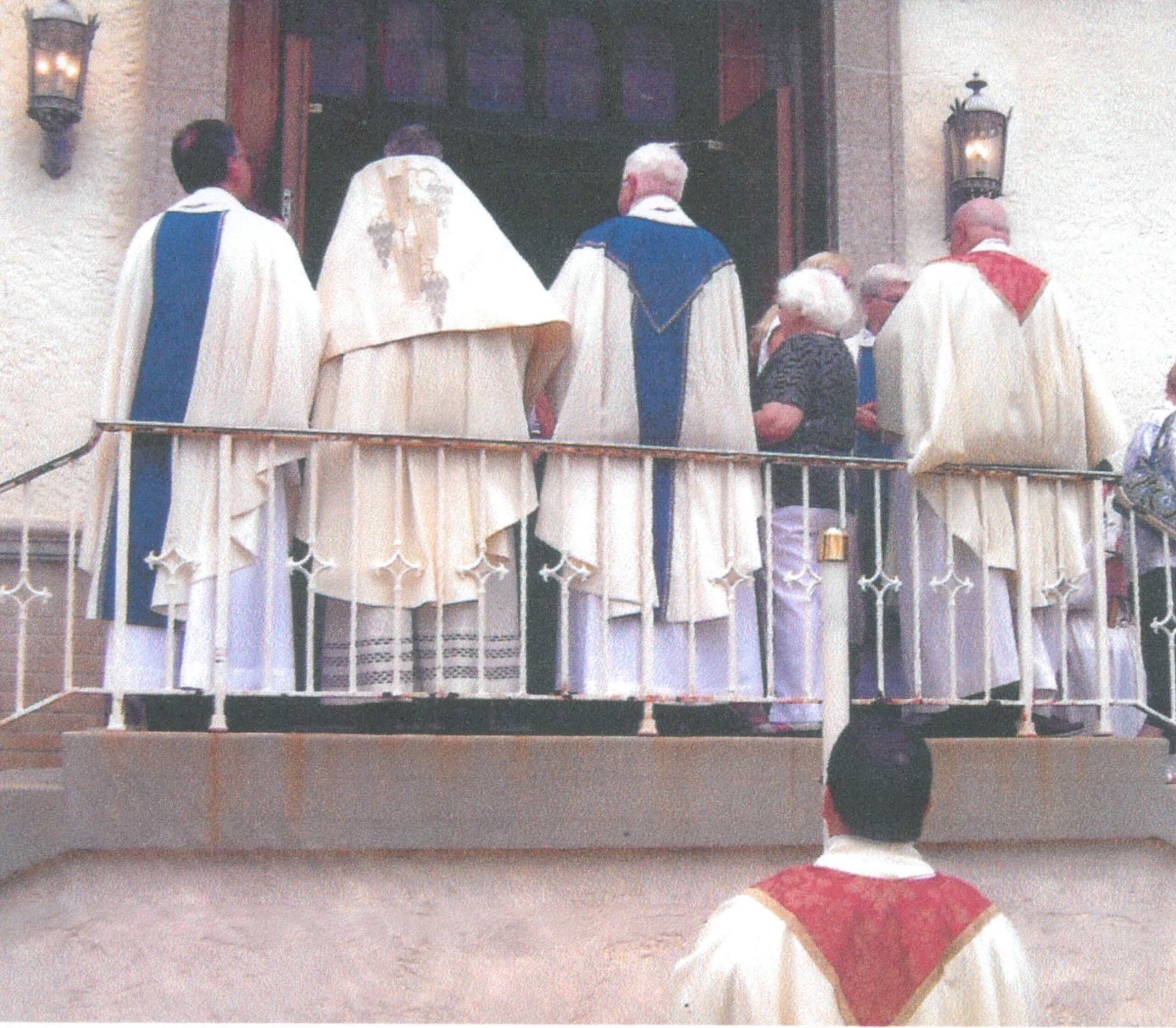
The Final Farewell Mass — July 13, 2008
Clergy and parishioners gather at the entrance of Mary Queen of Peace following the Farewell Mass on July 13, 2008, shortly before the doors were locked. The day marked the end of Mary Queen of Peace’s nearly nine decades as an independent parish following its consolidation into St. Patrick Parish, Pottsville. Although regular parish life had come to an end, the church and the community’s attachment to this sacred place endured.
2010s: Canonical Proceedings, Continued Sacred Use, and Preservation Efforts
The 2010s opened with Mary Queen of Peace Parish having been suppressed and its territory incorporated into St. Patrick Parish, Pottsville, but the future of Mary Queen of Peace Church remained the subject of an ongoing canonical process. Former parishioners had sought review through the remedies provided by canon law, and the proceedings that followed would establish an important distinction between the suppression of the former parish and the canonical status and use of its church building.
On December 21, 2010, the Vatican’s Congregation for the Clergy issued decisions concerning Mary Queen of Peace and other former parishes affected by the Diocese of Allentown’s 2008 restructuring. The Congregation upheld the suppression of the former parishes while treating the status of their church buildings as a separate canonical matter. In the case of Mary Queen of Peace, the Congregation sustained the substantive recourse concerning the church, finding that the requirements for changing its sacred status had not been established. The former parish therefore remained suppressed, while Mary Queen of Peace Church retained its sacred status.
The distinction was significant. Under canon law, suppression of a parish does not by itself constitute relegation of its church building to profane use. The Congregation’s reasoning addressed the church as a sacred building intended for divine worship and considered the requirements of canon law governing both the faithful’s access to a church and the circumstances under which a sacred building may be relegated to profane but not sordid use. The proceedings therefore separated two questions that had initially arisen together: the future of Mary Queen of Peace Parish as a canonical entity and the future of Mary Queen of Peace Church as a sacred building.
The Diocese of Allentown publicly explained the Vatican decisions in a March 10, 2011 statement. The Diocese reported that the Congregation had upheld its reasoning and canonical procedures concerning the suppression and restructuring of the affected parishes. At the same time, the Diocese acknowledged that Mary Queen of Peace was among nine former parish churches that the Congregation ruled would retain sacred status, with some form of Divine Worship to be held. The Diocese explained that the Congregation had determined that the required “grave cause” for altering the sacred status of these churches had not been established, even though the associated parishes had been suppressed.
The Diocese also emphasized an important limitation of the ruling: retention of sacred status did not restore the former parish or require restoration of its previous Sunday Mass or sacramental schedules. Questions therefore remained about precisely what form of continuing sacred use would be appropriate for churches such as Mary Queen of Peace. The Diocese announced that it would seek review of the Mary Queen of Peace church determination, along with five other cases, before the Supreme Tribunal of the Apostolic Signatura. It also sought clarification concerning whether the affected churches should reopen for sacred worship while those proceedings were pending.
Contemporary correspondence demonstrates how closely these developments were being followed by those interested in preserving the affected churches. A January 2011 analysis circulated among supporters emphasized the canonical distinction between suppression of a parish and the status of its church, particularly Canon 1214, which describes a church as a sacred building intended for divine worship to which the faithful have a right of access, and the separate requirements governing relegation to profane use. Although this correspondence represented the interpretation of advocates rather than an official Vatican determination, it illustrates the canonical questions being studied as former parishioners sought to understand the implications of the Congregation’s ruling.
By May 2011, the Diocese decided not to continue its appeal of the Mary Queen of Peace church ruling before the Apostolic Signatura. Contemporary reporting stated that the Diocese had withdrawn its appeals involving Mary Queen of Peace and five other churches and was instead exploring available “canonical options” for their future. The Diocese continued to explain that, in its understanding, the Vatican decrees did not necessarily require the churches to reopen on the same basis as before suppression. Former parishioners, meanwhile, continued to seek clarification concerning the practical implications of the churches’ retained sacred status.
The withdrawal was subsequently confirmed through correspondence from the Apostolic Signatura. With the diocesan recourse withdrawn, the Congregation for the Clergy’s determination concerning Mary Queen of Peace Church remained standing. The canonical discussion therefore shifted increasingly from the validity of the original parish suppression to the practical question of how the continuing sacred status of Mary Queen of Peace Church should be implemented.
Correspondence continued through 2011 as former parishioners sought clarification from Church authorities regarding access to Mary Queen of Peace and the meaning of the Congregation’s decision. The Diocese maintained that the ruling did not require restoration of the former parish or its previous schedule of worship, while former parishioners sought greater access to the church for Catholic prayer and worship. The matter was referred again to the Congregation for the Clergy for clarification of the practical implications of its decision.
By January 2012, Bishop John O. Barres reported that the Congregation’s interpretation required Mary Queen of Peace Church to be opened for some sacred use. A proposal was developed under which the church could be used for funeral Masses of former Mary Queen of Peace parishioners who requested them and for an annual Mass associated with the church’s patronal observance. This arrangement provided a defined form of continuing Catholic worship while Mary Queen of Peace remained part of St. Patrick Parish rather than returning to independent parish status.
The Congregation for the Clergy subsequently accepted this arrangement. In correspondence dated May 16, 2012, the Congregation confirmed that it had received the Diocese’s response providing for funeral Masses of former parishioners and an annual celebration of the patronal feast and stated that it considered the matter concerning Mary Queen of Peace Church concluded. Thus, the canonical process resulted in a lasting distinction: Mary Queen of Peace Parish remained suppressed, while Mary Queen of Peace Church retained its sacred character and continued to be used for specified Catholic worship.
The practical implementation of this arrangement is documented later that year. A program for August 15, 2012, identifies Mary Queen of Peace Roman Catholic Church as the site of a Mass for the Solemnity of the Assumption of the Blessed Virgin Mary. The program identifies St. Patrick’s Roman Catholic Church as the conducting parish and references Bishop Barres, Monsignor Edward O’Connor, and the Congregation for the Clergy in Rome. It also reflects the continuing hope of former parishioners that Mary Queen of Peace might eventually be available for additional sacred uses.
The annual observance continued during the decade. A surviving August 15, 2016 program again documents Mass at Mary Queen of Peace for the Solemnity of the Assumption. The program identifies St. Patrick Parish as responsible for the celebration and demonstrates that the limited sacred-use arrangement established earlier in the decade was not merely theoretical but continued to provide opportunities for worship at the historic church.
By 2016, preservation efforts were also becoming more organized. Correspondence from that year shows continued research into canon law and comparable cases involving former parish churches elsewhere in the United States. An April 2016 communication, for example, forwarded material concerning St. Joseph’s Parish in Poughkeepsie, New York, and questions involving access to former parish churches for private prayer and occasional Masses. These materials did not constitute decisions concerning Mary Queen of Peace, but they demonstrate the continuing effort to understand possible models for preserving a Catholic church after the suppression of its former parish.
Printed programs and emerging social media also helped maintain connections among those interested in Mary Queen of Peace. Materials from the period directed readers to the “Friends of Mary Queen of Peace Church, Pottsville, Pa.” Facebook presence, illustrating how supporters increasingly used online communication alongside traditional correspondence and printed programs to share information, preserve memories of the former parish, and encourage continued interest in the church.
The 2010s were therefore much more than a period in which Mary Queen of Peace simply stood largely unused. They were a decade in which the canonical relationship between the suppressed parish and its church was clarified, a limited but continuing pattern of sacred worship was established, and former parishioners continued exploring ways to preserve and make greater devotional use of the historic building. The annual Masses, canonical correspondence, preservation proposals, volunteer activity, historical research, and emerging online community all demonstrate that Mary Queen of Peace continued to hold considerable spiritual and historical importance long after the former parish ceased to exist.
By the end of the decade, Mary Queen of Peace had not returned to independent parish status, nor had a separate preservation organization yet assumed responsibility for the property. Nevertheless, an important foundation had been established. The church had retained its sacred status, Catholic worship continued on a limited basis, and the idea of an organized preservation effort had been explicitly proposed. Those developments formed an important bridge between the suppression of the former parish in 2008 and the renewed preservation efforts that would emerge in the 2020s, eventually opening a new chapter in the life of Mary Queen of Peace.
2020 — A Church Without a Parish
More than a decade had passed since the suppression of Mary Queen of Peace Parish in 2008, yet the church on North Centre Street remained standing. Following the parish restructuring, Mary Queen of Peace had been associated with St. Patrick Parish in Pottsville. Although it no longer functioned as an independent parish church, the building had not immediately disappeared from Catholic life. Occasional liturgical use continued during the years following the parish’s suppression, preserving a connection between the former parish community and the church generations of families had built and maintained.
By 2020, however, Mary Queen of Peace faced an increasingly uncertain future. Without its own parish community and regular schedule of worship, the long-term preservation of the building—and whether it would continue to remain a Catholic sacred space—had yet to be determined. The following year would bring that question into sharp focus.
2021 — Desire to Preserve Mary Queen of Peace
The future of Mary Queen of Peace reached a critical point in 2021. On April 29, 2021, Most Rev. Alfred A. Schlert, Bishop of Allentown, issued a decree relegating the church building of the former Mary Queen of Peace Parish to profane, but not sordid use. Canonically, such a decree would allow a church building to cease being used for divine worship and potentially permit its disposition for another appropriate purpose. The decree did not mean that the building was immediately demolished or sold, but it fundamentally changed the possibilities for its future.
An Appeal for Mary Queen of Peace
Former parishioner Theresa Zelinski submitted a canonical petition asking Bishop Schlert to revoke the April 29 decree. The petition specifically sought time so that the Saint Stephen Protomartyr Project and individuals in Pottsville committed to retaining Mary Queen of Peace Church as a Roman Catholic sacred space could enter into discussions concerning its future care. The appeal marked an important transition in the history of Mary Queen of Peace. The effort was no longer directed toward restoring the former parish that had been suppressed in 2008. Instead, attention increasingly centered upon a different objective: preserving the church itself as a Catholic sacred place.
The Decree is Suspended
On June 11, 2021, the Solemnity of the Most Sacred Heart of Jesus, Bishop Schlert responded by formally suspending the April 29 decree for sixty useful days. Significantly, the Bishop expressly asked that consideration be given to the various means by which the “sacred edifice of the former parish of Mary, Queen of Peace, Pottsville” might be preserved. Those pursuing the effort were directed to communicate their intentions to the Vicar General of the Diocese within thirty days.
The suspension also protected the church’s sacred interior while the canonical process continued. Bishop Schlert directed that the sacred images, vessels, furnishings, and especially the altars remain within the church building and that their sacred dignity be ensured until the process reached its conclusion.
For Mary Queen of Peace, the significance of the June decree was considerable. The future of the building remained unresolved, but the canonical process had created an opportunity for preservation rather than immediate disposition.
2022 — Preservation Discussions Continue
The suspension of the 2021 decree did not itself determine the ultimate future of Mary Queen of Peace. Instead, it opened a longer period of discussion concerning whether a sustainable arrangement could be developed to preserve the church. During 2022, Mary Queen of Peace remained without an independent parish and without the regular liturgical life that had characterized the building for most of the twentieth century. Nevertheless, the preservation effort begun during the canonical proceedings of the previous year continued to keep alive the possibility that the church could remain Catholic.
This period is less extensively documented in the surviving records presently available for the archival history. What can be said with certainty is that the preservation question raised in 2021 did not disappear. The church remained standing, and the effort to find a long-term solution continued. In retrospect, these quieter years formed the bridge between the canonical intervention of 2021 and the organized preservation movement that emerged by 2024.
2023 — Toward a Permanent Solution
By 2023, Mary Queen of Peace had been without its own parish for fifteen years. The building nevertheless remained an important physical reminder of the Catholic community that had occupied North Centre Street since the early twentieth century. Its Spanish Mission architecture, stained-glass windows, altars, bell tower, devotional furnishings, and other surviving features continued to embody more than a century of Catholic history in North Pottsville.
The central challenge remained unchanged: how could Mary Queen of Peace be preserved without recreating the territorial parish that had been suppressed in 2008? The answer that eventually emerged was a new organizational model—one in which an independent nonprofit organization could assume responsibility for preserving the property while operating within an approved canonical relationship with the Roman Catholic Church.
That concept would move from preservation effort to legal reality the following year.
2024 — The Society of Mary Queen of Peace
The year 2024 marked the beginning of a new institutional chapter in the history of Mary Queen of Peace. After years of uncertainty, those working to preserve the church began establishing an organization specifically designed to safeguard the building and maintain its Catholic identity.
The Society Takes Shape
On October 23, 2024, the Internal Revenue Service assigned an Employer Identification Number to the newly organized Society of Mary Queen of Peace of Pottsville Inc. The administrative action was an early formal step in establishing the organization that would eventually assume responsibility for the historic church.
Two days later, on October 25, 2024, the Society was formally incorporated as a Pennsylvania domestic nonprofit corporation. Its Articles of Incorporation stated its purpose clearly:
“To preserve Mary Queen of Peace Church in Pottsville as a Catholic Sacred Space, to insure the property is in good repair and that the public can use the space for private prayer and Catholic devotional activities.”
The additional provisions established the corporation for charitable and educational purposes and were drafted with the intention that the organization ultimately qualify for federal tax exemption under Section 501(c)(3) of the Internal Revenue Code.
The significance of the new organization went beyond creating another nonprofit corporation. For the first time, a legal entity existed whose specific purpose was the preservation of Mary Queen of Peace itself.
An Agreement to Save the Church
Only six days after the Society’s incorporation, another major milestone followed. On October 31, 2024, the Society entered into a signed Agreement for the Sale of Real Estate with Most Rev. Alfred A. Schlert, Bishop of the Roman Catholic Diocese of Allentown. Under the agreement, the Diocese would sell the former Mary Queen of Peace Church property at 730 North Centre Street to the newly formed Society for $44,000.
The agreement represented the most concrete step yet toward securing the building’s future. The property was to be transferred “as is,” placing responsibility for its condition and future preservation upon the Society. The agreement also contained provisions intended to protect both the Catholic identity and important historic features of the church.
Protecting the Stained Glass
Among the most significant provisions concerned Mary Queen of Peace’s historic stained-glass windows.
Under the sale agreement, ownership of the windows remained with the Diocese of Allentown. The Society could neither sell nor remove them and was required to maintain separate insurance protection for them. At the same time, the Diocese agreed that it would not remove the windows while the Society—or a similar successor organization—continued to maintain or retain the property.
The arrangement effectively provided an important layer of protection for one of the church’s defining historic features. Rather than being treated simply as fixtures accompanying the real estate, the windows received specific preservation protections within the agreement.
The proposed conveyance also included restrictions against uses of the property inconsistent with Catholic doctrine and teaching, further demonstrating that the contemplated sale was intended to preserve more than the physical structure alone.
From Preservation Campaign to Stewardship
The October 31 agreement was not yet the final transfer of ownership. That distinction is important in the archival history. It was a binding agreement establishing the terms under which the property would be sold; the actual transfer of Mary Queen of Peace to the Society would not be completed until 2025.
Nevertheless, the events of October 2024 fundamentally changed the outlook for the church. Three years earlier, Mary Queen of Peace had faced a decree relegating it to profane use. Former parishioners and preservation advocates had responded by seeking an opportunity to develop another future for the building. By the end of 2024, that effort had produced a legally incorporated nonprofit organization and a signed agreement through which the organization could acquire Mary Queen of Peace and accept responsibility for its preservation. The question was beginning to change from whether Mary Queen of Peace could be saved to how it could be sustained.
The work was far from complete. Ownership had not yet transferred, a canonical structure for the Society still had to be established, and the practical challenges of maintaining and restoring an aging church remained ahead. But after years of uncertainty, the path forward was becoming clear.
In 2025, that path would lead to the canonical recognition of the Society of Mary Queen of Peace, the restoration of the church’s future as a Catholic sacred space, the acquisition of the property, and eventually the reopening of its doors.
2025 — Preservation, Recognition, and a New Beginning
After years of uncertainty surrounding the future of Mary Queen of Peace, 2025 became one of the most consequential years in the church’s history since the suppression of the former parish in 2008.
The effort to preserve the church had never entirely disappeared. Former parishioners and friends continued to maintain an attachment to the building and its Catholic heritage even after regular parish life ended. By 2025, those preservation efforts had developed into an organized movement seeking not merely to save the physical structure, but to preserve Mary Queen of Peace as a Catholic sacred place.
The result was the beginning of an entirely new chapter: canonical recognition of the Society of Mary Queen of Peace, the reversal of the church’s previous relegation to profane use, acquisition of the property, and the reopening of the doors for Catholic prayer and devotion.
Recognition of the Society of Mary Queen of Peace
Central to the preservation effort was the formation of the Society of Mary Queen of Peace of Pottsville, organized to ensure the long-term preservation and sacred use of the historic church.
On April 30, 2025, Bishop Alfred A. Schlert, Bishop of Allentown, formally recognized the Society as a Private Association of the Christian Faithful. Its approved mission centered upon the salvation of souls through the preservation and use of the historic and sacred edifice of Mary Queen of Peace.
The canonical arrangement created an important distinction between the old and new chapters of Mary Queen of Peace. The former Mary Queen of Peace Parish, suppressed during the diocesan restructuring of 2008, was not reestablished. Instead, the Society was entrusted with preserving the historic church as a Catholic chapel, with public worship and sacramental activity remaining subject to the authority of the Bishop of Allentown. Today, the Society describes its mission as preserving the building as a Catholic sacred space for prayer, devotion, restoration, historic preservation, and community involvement.
Restoring the Church’s Sacred Status
The canonical recognition of the Society was accompanied by another development of particular importance. Mary Queen of Peace had been formally relegated to profane but not sordid use by diocesan decree in 2021, a canonical action that would have permitted the former church to pass out of sacred use.
On April 30, 2025, that earlier decree was abrogated, preserving Mary Queen of Peace’s Catholic sacred character and clearing the way for the Society’s preservation effort to proceed within the Church. The action meant that saving Mary Queen of Peace would involve more than preserving an architecturally distinctive building. The church itself could remain a sacred place.
The Society Acquires Mary Queen of Peace
The next major milestone came on September 3, 2025, when ownership of Mary Queen of Peace was transferred to the Society. For the first time in its history, the building was no longer owned directly by the Diocese or its predecessor ecclesiastical entities. Responsibility for the church now rested with an independent nonprofit organization whose purpose was its preservation and continued Catholic use.
The Society assumed responsibility not only for the historic church but also for the practical obligations that came with it: utilities, insurance, heating, maintenance, repairs, restoration, grounds, security, furnishings, and long-term preservation. The chapel receives no financial support from the Diocese of Allentown, making donations, volunteer work, fundraising, and community support essential to its future.
Preparing the Church to Reopen
Almost immediately after the acquisition, volunteers began the work of bringing the long-closed church back to life. The interior required extensive cleaning after years of limited use. The sanctuary, altar, pews, devotional areas, and other portions of the building were carefully cleaned and prepared. Historic furnishings were examined, electrical and mechanical systems evaluated, and deferred maintenance began to be addressed.
Photographs from September preserve the altar at the newly purchased Mary Queen of Peace awaiting deep cleaning as volunteers began preparing the church once again for prayer and devotional use. Later photographs document restoration work on interior trim and other portions of the building. Much of the work was accomplished not through a large institutional restoration program, but through the efforts of volunteers, former parishioners, supporters, local tradesmen, and donors.
The Doors Open Again
On September 22, 2025, Mary Queen of Peace reopened as a Catholic chapel. After years in which the future of the building had remained uncertain, the faithful could once again enter the church for prayer and devotion. The reopening did not attempt to recreate the former parish. Instead, it established a new model intended to preserve what was most important about Mary Queen of Peace: its identity as a sacred Catholic place.
Weekly opportunities for private prayer and the Rosary followed. Contemporary reporting described groups of approximately 25 or more people gathering for the Rosary during the early weeks after reopening, while former parishioners and visitors returned to a church many had feared might never again open for Catholic worship.
Preservation Becomes the Mission
As 2025 drew to a close, the work increasingly shifted from simply reopening the doors toward ensuring that they could remain open. Attention turned to heating and plumbing, utilities, exterior maintenance, lighting, grounds, historic furnishings, stained glass, accessibility, bells, fundraising, historical records, and longer-term restoration planning.
At the same time, photographs, documents, parish memorabilia, and personal memories began to be gathered and preserved so that the history of Mary Queen of Peace could accompany the physical restoration of the building. The events of 2025 did not restore the parish that had existed before 2008. Instead, they accomplished something different: Mary Queen of Peace had been preserved as a Catholic sacred place and entrusted to a new generation of stewards.
2026 — A Sacred Space Renewed
The year 2026 marked the first full year of a new era for Mary Queen of Peace. The previous year had centered upon preservation: the Society of Mary Queen of Peace of Pottsville acquired the former parish church, reopened its doors, and secured its future as a Catholic sacred space. In 2026, attention increasingly turned toward restoring the life of the chapel itself.
Throughout the year, the historic bell sounded again over North Centre Street, regular opportunities for prayer and Marian devotion continued, restoration work advanced throughout the building, and Mass returned under the stewardship of the Society. Historic Catholic furnishings and devotional objects also began returning to the church, while an expanding archival effort sought to recover and preserve the history of the former parish and the generations who had worshiped there.
By year’s end, Mary Queen of Peace was no longer simply a former parish church that had been saved. It was once again an active Catholic sacred space whose history continued to be written.
Preserving the Church and Its Mission
The Society entered 2026 continuing the extensive work necessary to care for a building approaching its centennial. Years of limited use and deferred maintenance had left numerous electrical, mechanical, exterior, and interior needs requiring attention.
Much of this work was deliberately undertaken with preservation in mind. Rather than modernizing the church without regard for its historic character, the Society sought wherever practical to retain historic fixtures and architectural elements while improving their reliability and efficiency.
One significant project involved the church’s lighting. Large incandescent lamps—including fixtures using 500-watt bulbs—were converted to modern LED technology while retaining the appearance and use of the existing fixtures. By the summer, the conversion was substantially complete, dramatically reducing electrical consumption while improving illumination throughout the church.
Work also continued on the heating plant and other mechanical systems. These less visible projects were essential to the Society’s larger goal: ensuring that Mary Queen of Peace could remain a viable sacred space rather than merely a preserved building.
The organizational foundation supporting that work also strengthened. In April 2026, the Society received recognition from the Internal Revenue Service as an organization exempt under §501(c)(3) and classified as a public charity, effective from its organizational date of October 23, 2024.
After Seventeen Years, the Bell Rings Again
One of the most visible—and audible—milestones of the year occurred in the spring.
High in the bell tower remained the original bronze bell installed during the construction of the present church in 1929. Cast by Stuckstede & Bro., the approximately 800-pound bell was given in memory of Mary Zachar by her husband and children and had once been a familiar voice over the North Centre Street neighborhood.
After approximately seventeen years of silence, efforts led by Robert Doyle returned the historic bell to operation in April 2026.
On April 7 and April 12, recordings documented the 1929 bell sounding again along with Mary Queen of Peace’s later electronic carillon. By April 20, the return of the bell had attracted local newspaper attention under the fitting headline, “After 17 years of silence, bell at Mary Queen of Peace rings again.”
The restoration represented more than the repair of a piece of machinery. For generations, church bells had marked worship, feast days, funerals, celebrations, and the passage of time. The return of the bell restored one of the most recognizable expressions of the church’s presence within its neighborhood.
Mary Queen of Peace also retained another chapter of its bell history: the Schulmerich Quadrabell II-D electronic carillon, installed in 1985 in memory of Charles E. Bobinis Sr. through the generosity of his daughters and friends. The Society began efforts to preserve and restore this system as well, recognizing the contributions of those—including longtime caretaker Paul C. Filiac—who had maintained the church’s bell tradition through earlier decades.
Thus, by 2026, preservation encompassed both generations of the bells of Mary Queen of Peace: the bronze bell of 1929 and the electronic carillon added more than half a century later.
Prayer and Devotion Return to Mary Queen of Peace
Although Mary Queen of Peace no longer functioned as a territorial parish with a regular Sunday Mass schedule, its reopening restored the building to its original purpose as a place of Catholic prayer.
Regular opportunities for private prayer, the Rosary, Marian devotion, and fellowship continued during 2026. The Angelus again became associated with the sounding of the church’s bells, reconnecting the restored chapel with a devotional tradition deeply rooted in Catholic life.
These recurring gatherings were important to the character of the reopening. The Society’s goal was not simply to preserve Mary Queen of Peace as an architectural monument or historical museum, but to maintain it as a living Catholic sacred space in which the building’s religious purpose could continue.
Bells Across America — July 4, 2026
The restored bells took on a broader civic role on July 4, 2026, as Mary Queen of Peace participated in Bells Across America, part of the commemoration of the 250th anniversary of the United States.
The observance brought together two eras of the church’s bell history. The 1929 Stuckstede & Bro. bronze bell was rung from the tower, while the 1985 Schulmerich Quadrabell II-Dalso participated in the observance, including the playing of Battle Hymn of the Republic.
Mr. Robert Doyle recorded the observance, while Dr. Michael Rajchel operated the bell controls. For a church whose bell had been silent for so many years, participation in the national semiquincentennial carried particular significance. The bell that had sounded over Pottsville through much of the twentieth century once again joined the life of the surrounding community—this time marking a national anniversary that stretched back more than a century before Mary Queen of Peace itself was founded.
The Return of the Mass — July 9, 2026
Five days later came one of the defining moments of the modern history of Mary Queen of Peace. On July 9, 2026, the Feast of Mary Queen of Peace, the altar was once again prepared for the celebration of Mass. The celebrant was Rev. John S. Pendzick, Pastor of the Church of St. Patrick in Pottsville.
The distinction is historically important. The July celebration was not literally the first Mass celebrated in the church since the former parish’s 2008 consolidation; an Assumption Mass had been celebrated there on August 15, 2012. Rather, the July 9 celebration represented the first Mass celebrated at Mary Queen of Peace following the Society’s acquisition and reopening of the church.
For those involved in preserving the building, the significance was nevertheless profound. Ongoing restoration of the roof, masonry, electrical systems, furnishings, bells, and other physical elements ultimately served a larger purpose: allowing the building to continue functioning as a Catholic sacred space.
Former parishioners, supporters, members of the Society, and visitors once again gathered within the nave. Prayer and fellowship surrounding the celebration further demonstrated the continuing attachment to Mary Queen of Peace.
The Mass established a pattern envisioned for the restored chapel. Mary Queen of Peace would not attempt to recreate the territorial parish that had existed before 2008. Instead, with appropriate ecclesiastical oversight, the chapel could host seasonal and special Masses, together with regular Catholic devotions and opportunities for private prayer.
Ninety-Seven Years — August 25, 2026
A second Mass followed on August 25, a date inseparable from the history of the building. Exactly 97 years earlier, on August 25, 1929, the newly completed Mary Queen of Peace Church had been dedicated. In 2026, the community again assembled within the same Spanish Mission-style church to commemorate its dedication anniversary. The celebrant was Rev. Hubert Asante Kumi, Parochial Vicar of the Church of St. Patrick.
Music chosen for the anniversary included The Church’s One Foundation, Daily, Daily Sing to Mary, Gift of Finest Wheat, and Faith of Our Fathers. Fellowship followed the Mass. The anniversary increasingly pointed toward another milestone. Only three years remained before August 25, 2029, when the present church would reach its centennial.
Unlike many centennial commemorations, however, the approaching anniversary could not be taken for granted. Mary Queen of Peace had experienced parish consolidation, years of uncertainty, relegation from parish use, sale of the property, and eventual preservation by an nonprofit Society within the Diocese of Allentown.
Recovering the Interior of Mary Queen of Peace
Physical preservation during 2026 increasingly extended beyond the building itself. Historic photographs, parish inventories, newspaper accounts, surviving artifacts, and the memories of former parishioners were used to identify furnishings and devotional objects that had once characterized the interior of Mary Queen of Peace.
Where original objects survived and could potentially be recovered, the Society began identifying them. Where they could not, period-appropriate Catholic furnishings were sought so that replacements would remain sympathetic to the historic appearance and devotional character of the church.
This approach reflected an important distinction in the preservation effort. The objective was not to manufacture an artificial reconstruction of the past. Instead, the Society sought to understand what had historically occupied the building, preserve surviving original material whenever possible, and carefully return appropriate sacred furnishings to spaces that had lost them.
One of the most visible examples came in September.
The Infant Jesus of Prague Returns
Historic photographs of Mary Queen of Peace showed that an Infant Jesus of Prague statue had once occupied an elaborate wall-mounted shrine within the church. The devotion would have been familiar to generations of parishioners, but the original statue and shrine had been removed during the years following the former parish’s closure.
In 2026, the Society began searching for a historic replacement. Rather than purchasing an entirely modern shrine, the search focused upon finding a period-appropriate example resembling the former installation at Mary Queen of Peace. That search eventually located an Infant Jesus of Prague statue with an ornate wall pedestal offered through church-inventory.com by Henninger’s.
The shrine had its own history. Henninger’s confirmed that the statue and pedestal came from the former Our Lady of Hope Catholic Church in Bedford, Ohio. The Society deliberately requested this provenance so that the history of the former parish would accompany the object rather than disappear when it changed hands.
Our Lady of Hope itself had been established in 2009 following the merger of Catholic parishes in the Bedford area and worshiped at the former St. Pius X church. In 2025, Our Lady of Hope was merged into St. Mary of the Immaculate Conception Parish. Its final Mass was celebrated on May 31, 2025. Following the church’s closure, the Infant of Prague shrine entered the inventory of Henninger’s.
On September 10, 2026, the Society inquired about purchasing the statue and wall pedestal, listed as Item No. 14640023, “Infant of Prague w/ Wall Pedestal.” After additional photographs and discussions concerning its condition, the donor, Dr. Michael Rajchel, agreed to purchase it with shipping to Pottsville. The shrine was collected for shipment on September 16. On September 17, Henninger’s advised the Society that delivery was expected the following day.
The replacement is not represented as the original Mary Queen of Peace shrine, nor is it an exact duplicate. Research identified differences between the surviving historic photographs and the replacement, including the design of the upper portion of the backing. Instead, it was selected as a period-appropriate, approximately 1956-1958, historic shrine capable of restoring a familiar Catholic devotion to the church.
Its journey carried an additional meaning. Only a year earlier, Our Lady of Hope had closed. During approximately the same period, Mary Queen of Peace—another Catholic church whose future had once been uncertain—was entering a new period of life.
A devotional object displaced from one closed Catholic church had therefore found a home within another historic Catholic church that had been preserved and reopened. The Society intentionally chose to preserve that provenance and honor the former parishioners of Our Lady of Hope, ensuring that the history associated with the shrine would remain known. The restored Infant of Prague shrine was also intended as a memorial for unborn children and children who died in infancy, adding a new intention to the devotion at Mary Queen of Peace.
In this way, the shrine represented both continuity and renewal: the restoration of a devotion once present at Mary Queen of Peace, the preservation of a sacred object from another Catholic community, and the beginning of a new chapter in the object’s history.
Preserving the Memory of the Parish
The preservation effort during 2026 extended beyond architecture and furnishings to something equally vulnerable: the historical memory of Mary Queen of Peace itself. Photographs, documents, parish publications, newspaper articles, home movies, videos, sacramental records, and personal recollections were increasingly gathered and studied.
Historic film and video offered glimpses of parish life that written records alone could not provide. Material recovered and identified during the archival effort included scenes associated with First Holy Communion in the early 1950s, Confirmations and May Processions during the 1950s, school and parish activities of the 1960s, and community life during later decades. Material associated with the Dan Eagan collection became part of this effort to preserve the visual history of the parish.
At the same time, systematic newspaper research began reconstructing portions of parish history that had largely disappeared from living memory. That research revealed details of the earliest chapel, school, convent and rectory; the relationship between Mary Queen of Peace and Little Flower Chapel at Mount Laffee; parish organizations such as the Holy Name Society, Altar and Rosary Society and B.V.M. Sodality; parish picnics and athletic teams; former clergy and religious sisters; individual parishioners; and the construction and dedication of the present church.
The objective gradually became larger than producing a simple chronology. The Society sought to preserve the names and experiences of the people who had actually constituted Mary Queen of Peace.
The Historic Campus
Historical research also broadened beyond the surviving church. The original Mary Queen of Peace campus had once included the rectory, school, convent and other structures, while nearby St. Patrick’s Cemetery No. 3 appeared repeatedly in historical parish records and newspaper accounts.
By 2026, only portions of that historic landscape survived intact. Research therefore increasingly sought to reconstruct the physical arrangement and development of the former campus from deeds, maps, photographs, newspaper accounts and surviving buildings.
Particular attention was given to the origins of the property acquired from the Seltzer family in 1920, the conversion of existing buildings for early parish use, and the eventual construction of the present Spanish Mission-style church in 1929.
This work also began supporting exploration of possible historic-register recognition for Mary Queen of Peace. The process encouraged a more rigorous examination of the church’s architecture, development, setting, surviving resources and significance within the history of Pottsville and the surrounding coal region.
A Community Sustains the Restoration
None of the work of 2026 occurred in isolation. Volunteers, donors, former parishioners, local residents and supporters contributed time, money, expertise, historical material and physical labor. Community events, raffles and fundraising efforts helped support both the operation of the chapel and its continuing restoration.
Events and gatherings also allowed Mary Queen of Peace to function again as a place where people encountered one another—not simply as visitors to an old building, but as participants in a continuing community.
The Society increasingly used its website and social-media presence to share historic photographs, restoration progress, events and discoveries with former parishioners and others who retained connections to Mary Queen of Peace. In turn, public outreach helped locate additional photographs, memories, artifacts and historical information.
The preservation of the church thus became increasingly collaborative. Each recovered photograph, identified person, repaired fixture, returned furnishing and recorded memory contributed another piece to the larger story.
Toward 2029 and the Centennial
As Mary Queen of Peace approaches the 100th anniversary of the dedication of the present church in 2029, its future looks markedly different from what seemed possible only a few years earlier.
The former suppressed parish remains part of history, but its church survives.
The building once again welcomes people for Catholic prayer and devotion. Mass has returned on significant occasions. Its bells again sound. Volunteers continue caring for the property. Historic records and photographs are being recovered and preserved. A nonprofit organization and Catholic association now exist specifically to safeguard the chapel for the future.
The work remains substantial. A building approaching its centennial requires continuing restoration, financial support, and careful stewardship. Yet the events of 2025 and 2026 established something that had remained uncertain for many years: Mary Queen of Peace has a future as a Catholic sacred place.
More than a century after the parish was established and nearly one hundred years after the present church was built, Mary Queen of Peace continues to serve the purpose expressed in the Society’s mission—to promote the salvation of souls through the preservation and use of this historic and sacred church.
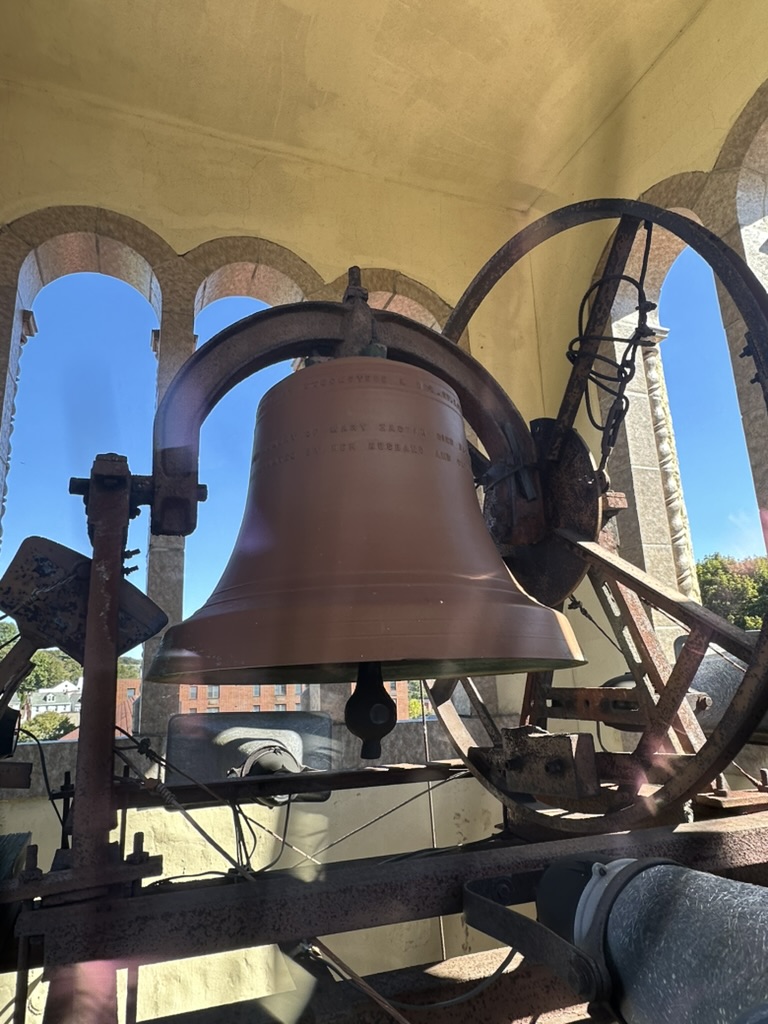
Sources Cited and Consulted
This history of Mary Queen of Peace has been compiled from surviving parish records, contemporary newspapers, diocesan and Vatican documents, canonical correspondence, anniversary publications, civil and property records, photographs, oral and community history, and records of the Society of Mary Queen of Peace of Pottsville. Where possible, contemporary and primary-source records have been given preference.
Parish and Mary Queen of Peace Historical Records
- Mary Queen of Peace parish anniversary histories and commemorative publications, including the 50th Anniversary history (1970) and 75th Anniversary history (1995).
- 1927 historical account of Mary Queen of Peace, documenting the origins of the parish, the acquisition of the Seltzer property, and the appointment of Rev. George W. Shay on May 4, 1920.
- 1929 dedication materials and contemporary accounts relating to the construction and dedication of the present Mary Queen of Peace Church on August 25, 1929.
- Parish bulletins, programs, memorial cards, photographs, sacramental materials, school materials, and other surviving parish ephemera spanning the former parish’s history.
- July 13, 2008 Farewell Mass bulletin and memorial materials, documenting the final day of Mary Queen of Peace as an independent parish, the transfer of sacramental records, and expressions of gratitude to clergy and parishioners.
- October 27, 2008 church inventory, prepared for the Diocese of Allentown Office for Synod Implementation by Church Furnishings Clearinghouse, LLC / Ken Pribanic and Associates, documenting the church’s sacred furnishings, devotional objects, liturgical items, organ, bells, and other contents.
- August 15, 2012 and August 15, 2016 Mary Queen of Peace Mass programs, documenting continued sacred use of the church following suppression of the former parish.
- Materials of the Friends of Mary Queen of Peace Church, Pottsville, Pa., including printed programs, correspondence, photographs, and surviving social-media materials.
Parish Restructuring and Canonical Records
- February 18, 2008 parishioner petition concerning parish restructuring, submitted by members of Mary Queen of Peace to the Diocese of Allentown’s restructuring process and documenting contemporary arguments for retaining the church. This record is particularly valuable for understanding the beginning of the preservation effort.
- Canonical recourse petitions, correspondence, supporting documentation, and related records, 2008–2012, concerning the suppression of Mary Queen of Peace Parish and the separate canonical status and use of Mary Queen of Peace Church.
- Congregation for the Clergy decree of December 21, 2010, concerning Mary Queen of Peace and the canonical recourse arising from the Diocese of Allentown’s parish restructuring.
- Correspondence and records of the Supreme Tribunal of the Apostolic Signatura, 2011, concerning the subsequent recourse and its withdrawal.
- Diocese of Allentown News Release, March 10, 2011, reporting the Vatican decisions concerning fourteen former parishes and identifying Mary Queen of Peace among the churches ruled to retain sacred status. The Diocese explained that the Congregation found the required grave cause for altering the church’s sacred status was not present even though the parish had been suppressed.
- Correspondence between former parishioners, diocesan officials, and Church authorities, 2011–2012, concerning implementation of the Congregation’s decision, access to Mary Queen of Peace, and appropriate continuing sacred use.
- 2012 correspondence from the Congregation for the Clergy, concerning the arrangement for funeral Masses of former parishioners and an annual Mass at Mary Queen of Peace.
- 2016 correspondence and preservation proposals, including research concerning comparable canonical cases, proposals for expanded devotional access, and the proposed establishment of a preservation society for Mary Queen of Peace.
Contemporary Reporting on the Canonical Proceedings
- Associated Press, January 5, 2011, “Boston churches lose appeal to pope.” Consulted primarily for broader historical context concerning Catholic parish suppression and church-preservation efforts in the United States and the involvement of Peter Borré in comparable cases. This article does not concern Mary Queen of Peace directly.
- The Morning Call, May 5, 2011, “Diocese drops appeal on church closings.” Contemporary reporting on the Diocese of Allentown’s decision to withdraw its appeals concerning six churches, including Mary Queen of Peace, and its consideration of other canonical options for the affected sacred buildings.
- Additional contemporary reporting from The Morning Call, Republican & Herald, Pottsville Republican, Catholic newspapers, and other regional publications concerning parish restructuring, Catholic life, parish events, and the history of Mary Queen of Peace.
2021 Canonical and Preservation Records
- April 29, 2021 decree of Most Rev. Alfred A. Schlert, Bishop of Allentown, concerning the relegation of the former Mary Queen of Peace Parish church to profane but not sordid use.
- 2021 canonical recourse and supporting correspondence requesting reconsideration of the relegation and an opportunity to explore preservation of Mary Queen of Peace as a Roman Catholic sacred space.
- June 11, 2021 decree of Bishop Alfred A. Schlert, suspending the effects of the April 29 relegation decree while preservation alternatives were considered and directing that sacred images, vessels, furnishings, and especially the altars remain within the church and be treated according to their sacred character.
Society of Mary Queen of Peace and Modern Canonical Records
- Pennsylvania Articles of Incorporation, Society of Mary Queen of Peace of Pottsville Inc., filed October 25, 2024. The filing states the corporation’s purpose as preserving Mary Queen of Peace Church as a Catholic sacred space, maintaining the property, and providing public access for private prayer and Catholic devotional activities.
- Additional Provisions to the Society’s Articles of Incorporation, establishing its charitable and educational purposes and provisions relating to federal tax-exempt status.
- Agreement for the Sale of Real Estate, October 31, 2024, between Most Rev. Alfred A. Schlert, Bishop of the Roman Catholic Diocese of Allentown, and the Society of Mary Queen of Peace of Pottsville, concerning the property at 730 North Centre Street for $44,000 and including provisions concerning Catholic use and preservation of the stained-glass windows.
- Decree of Bishop Alfred A. Schlert, April 13, 2025, approving the Society of Mary, Queen of Peace as a Private Association of the Christian Faithful in the Diocese of Allentown, promulgating its canonical Statutes, and granting permission for the Association to use the name “Catholic.”
- Canonical Statutes of the Society of Mary, Queen of Peace, approved in 2025, defining its spiritual, preservation, financial, and ecclesiastical responsibilities.
- Decree of Bishop Alfred A. Schlert, April 30, 2025, abrogating the April 29, 2021 relegation decree and expressly rescinding and rejecting the earlier relegation of Mary Queen of Peace to profane but not sordid use.
- Property deed, title, settlement, and related records concerning the September 3, 2025 transfer of Mary Queen of Peace to the Society.
- Pennsylvania Department of State annual reports and filing acknowledgments, 2025–2026, documenting the Society’s continuing civil existence and governance.
- Internal Revenue Service determination letter, April 30, 2026, recognizing the Society of Mary Queen of Peace of Pottsville Inc. as tax-exempt under IRC §501(c)(3) and as a public charity, with exemption effective October 23, 2024.
- Society of Mary Queen of Peace Executive Committee minutes, 2025–2026, documenting restoration, maintenance, fundraising, historical preservation, devotional life, diocesan coordination, and preparations for renewed celebration of Mass. The records also document preparations for the July 9, 2026 Feast Day Mass and planning toward the church’s 2029 centennial.
Deeds, Property, and Architectural Records
- April 20, 1920 deed and related property records concerning the acquisition of the original Mary Queen of Peace property.
- Schuylkill County deeds, parcel records, assessment records, maps, and other public property records relating to Mary Queen of Peace and its associated parish properties.
- Architectural documentation, historic photographs, building inventories, contractor assessments, and restoration records used to reconstruct changes to the church, school, convent, rectory, and parish campus over time.
Catholic and Diocesan Sources
- Diocese of Allentown decrees, news releases, correspondence, canonical records, and historical materials.
- Congregation for the Clergy, Holy See, decrees and correspondence concerning Mary Queen of Peace and comparable parish/church cases.
- Supreme Tribunal of the Apostolic Signatura, correspondence and records concerning the 2011 proceedings.
- The Official Catholic Directory, consulted for clergy assignments, parish status, institutions, and historical diocesan information.
- Catholic newspapers and archival collections, including materials available through the Catholic News Archiveand other Catholic historical repositories.
Newspapers and Periodicals
Contemporary newspaper reporting has been used to supplement parish and official records, particularly for events where surviving parish documentation is incomplete. Sources consulted include:
- Pottsville Republican / Republican & Herald
- The Morning Call
- Catholic Standard and Times
- Other Schuylkill County and Pennsylvania newspapers available through historical newspaper collections and archival databases.
Newspaper reports have been compared, where possible, with parish, diocesan, civil, and other primary records before being incorporated into the historical narrative.
Community, School, and Military History
- Good Will Fire Company No. 4 Veterans Home Coming Celebration program, November 7, 1946, documenting Rev. John V. Brogan of Mary Queen of Peace delivering the benediction and identifying George Burck Roth as an eighth-grade graduate of Mary Queen of Peace Parochial School who died during military service in France in 1944.
- Surviving school photographs, class materials, commencement and sacramental photographs, alumni recollections, and other materials relating to Mary Queen of Peace Parochial School.
- Family photographs, memorial cards, funeral materials, wedding photographs, First Communion and Confirmation photographs, parish organization records, and other privately preserved materials contributed by former parishioners and their families.
Photographs, Oral History, and Community Memory
Historical photographs and personal recollections supplied by former parishioners, school alumni, clergy, families, volunteers, and members of the Pottsville community have been consulted to identify people, events, furnishings, architectural changes, and aspects of parish life not always recorded in official documents.
Where personal recollections are used, they should be understood as oral or community history and, whenever possible, compared with contemporary documentary evidence before being presented as established historical fact.
Online and Reference Sources
The following have also been consulted for supplemental research and historical context:
- Mary Queen of Peace Catholic Chapel / Society of Mary Queen of Peace of Pottsville website and preserved social-media materials.
- Diocese of Allentown historical and contemporary materials.
- Pennsylvania Department of State, Bureau of Corporations and Charitable Organizations.
- Schuylkill County public property and assessment records.
- Internet Archive and digitized historical publications.
- Catholic Research Resources Alliance / Catholic News Archive.
- Regional historical societies, libraries, genealogical resources, and digitized newspaper collections.
- Published and online histories of Pottsville, Schuylkill County, the Coal Region, and the Catholic Church in northeastern Pennsylvania, consulted for broader historical context.
A Note on Historical Sources
This history remains a work in progress. Mary Queen of Peace’s surviving historical record is dispersed among parish and diocesan archives, government records, newspapers, private collections, photographs, correspondence, and the memories of former parishioners and their families. New materials continue to be discovered and incorporated into the archive.
Whenever possible, this history distinguishes between contemporary primary sources, later retrospective accounts, official records, newspaper reporting, and personal recollections. Where sources disagree, preference is generally given to contemporary documentary evidence, while differing accounts are preserved when they contribute meaningfully to understanding the history of Mary Queen of Peace.
Former parishioners, alumni, clergy, families, and community members who possess photographs, programs, bulletins, sacramental keepsakes, school materials, correspondence, newspaper clippings, or other records relating to Mary Queen of Peace are encouraged to share them with the Society so that they may be documented and preserved for future generations. Records may be submitted here.
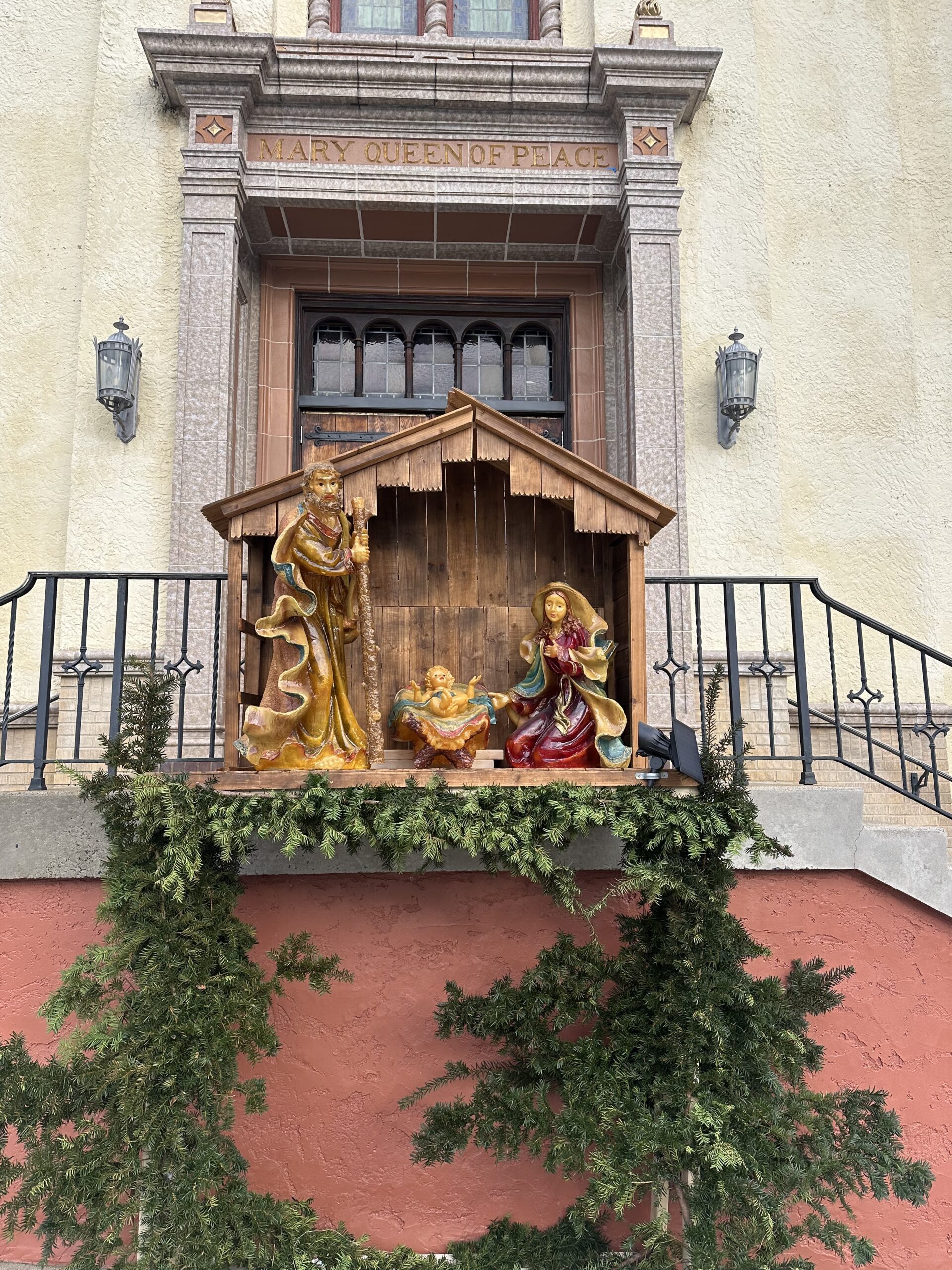
Support The Chapel
Your generous contributions play a vital role in maintaining the spiritual and historical legacy of the Catholic Chapel of Mary Queen of Peace. By donating, you help preserve, maintain, and operate this sacred space and support community activities. Every gift, no matter the size, makes a difference in sustaining our chapel's future.
The Society receives no funding from the Diocese of Allentown and is fully financially independent. As owner and steward of Mary Queen of Peace, the Society relies on the generosity of supporters to sustain the chapel’s ongoing operations, preservation, and mission.
The Society of Mary Queen of Peace of Pottsville, Inc. is a Pennsylvania nonprofit corporation and IRS-recognized 501(c)(3) public charity (EIN: 33-1603537). By decree of the Diocese of Allentown, the Society is recognized as a Private Association of the Christian Faithful and is authorized to identify itself as Catholic in carrying out its mission of preserving Mary Queen of Peace as a Catholic sacred space for prayer, devotion, and community benefit. Contributions are tax-deductible to the extent permitted by law.